In August 2019, Jaime Nacach had a new daughter, two businesses to attend to, and fewer than ten clients at Virtual Latinos. He was working six days a week. The business he hoped would help other owners recover their time was consuming rather a lot of his own. Freedom, at this stage, had an awkward timetable.
He kept going. Virtual Latinos connected businesses with remote professionals in Latin America, a proposition that would become easier to explain as remote work gained acceptance. But the early scene deserves to linger: a founder keeping his marketing agency afloat while asking a second business to justify the hours he was giving it.
By 2023, Virtual Latinos would rank No. 80 on the Inc. 5000. The distance between those two moments is the familiar material of an entrepreneurial story. Nacach’s more interesting subject is what happens to the person crossing it. You can build a business around delegation and still have trouble handing things over.
A map he already knew
Nacach was born in Mexico City and moved with his family to San Diego at twelve. Mexico remained part of his life rather than a place he had finished with. When a hiring problem eventually sent him looking south, he had personal reasons to recognize what might be possible there.
His formal education also crossed borders. After studying business administration with a focus on management information systems at San Diego State University, he pursued an MBA at Tel Aviv University. The program took him to Singapore on exchange and to India on a ten-day study trip. He was learning about business while acquiring several different views of where it could happen.
At the time, his ambitions were open-ended: return home and start something, or find work in business development, consulting, or strategy. Business ownership was familiar territory in his family. His father was someone to exchange ideas with, and the prospect of running a company belonged to ordinary conversation rather than distant fantasy.
Bloominari, his marketing agency, became the practical classroom. He dates its start to 2013 and its legal formation to 2015. It brought the everyday business of clients, contractors, and work that someone had to finish. Eventually, it also brought the problem that would supply his next company with a reason to exist.
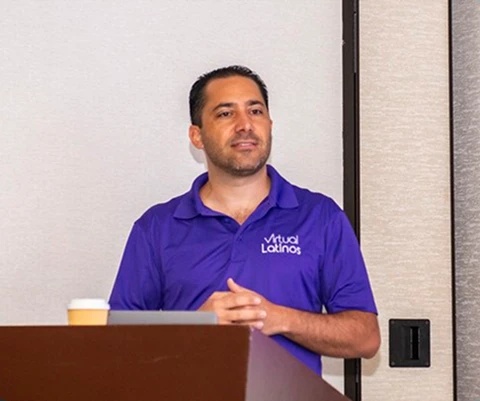
The directory needed a human
Remote hiring had disappointed him. He had tried finding help for Bloominari, including through a provider in the Philippines, and encountered reliability problems and inconvenient working hours. His account is a specific experience, with specific frustrations. A working relationship becomes difficult when the conversation you need today keeps arriving tomorrow.
Latin America offered overlapping hours and a region he knew. He began Virtual Latinos in 2018, initially using a directory to connect candidates and clients. The first version gave businesses access to people. Soon it became apparent that access left another considerable piece of work untouched: choosing whom to hire.
A busy owner could browse a directory, review candidates, compare backgrounds, and arrange the next conversation. All perfectly reasonable tasks. Together, they resembled the very workload the owner had hoped to reduce. Nacach’s earlier frustration was now visible from the other side of the counter.
The service developed into supported recruitment. A client could receive a shortlist rather than take on the whole search. That change moved the business closer to the outcome people were buying: someone capable joining the team, with less of the hiring process falling back onto the owner. The directory had been a starting point. Listening supplied the next version.
Selected historical milestones reported by Virtual Latinos. These are dated events, not current headcounts.
Twenty houses and a Telegram group
For a business conducted through screens, Nacach’s idea of community has a distinctly physical origin. He remembers weekends in a small complex in Cuernavaca: twenty houses, a swimming pool, neighbors eating together, children set loose for the weekend. The detail he returns to is the feeling of belonging.
When Virtual Latinos was young, he created a Telegram group and personally welcomed new professionals. There was no elaborate ceremony. Someone arrived; someone noticed. A remote-work business can ask a stranger to trust a website, an unfamiliar employer, and a person in another country. A human greeting at least gives that stranger somewhere to begin.
“Community was never part of the business plan”
Jaime Nacach, reflecting on the early Telegram group
His recollection of the first client is similarly personal. Matthew Henriksen ran a nonprofit in Tijuana. Years later, Nacach knew his family, and Henriksen knew his. A placement can be recorded as a transaction in a spreadsheet. The people involved may remember it through dinners, introductions, and the accumulated evidence that somebody kept showing up.
Nacach’s early hiring stories also leave room for people whose résumés took an indirect route. Jennifer, a makeup artist from Ecuador, caught his attention by welcoming newcomers in the community. He offered her paid work supporting members. Roberta, trained as an architect, joined as his executive assistant and later moved into sales management. In his 2022 account, both stories turn on noticing how a person behaved before deciding where she belonged.
A useful impatience with paperwork
The welcoming founder has another, less sentimental interest: making repetitive work disappear. He recalls looking at business cards, client folders, and printed invoices while working for his father’s company in 2007. Paper was everywhere. He wanted a faster way of doing things.
He taught himself to digitize processes, and later brought that habit to his own businesses. At Virtual Latinos, he used connected software tools to handle follow-ups and workflows that would otherwise require repeated manual attention. Small economies mattered because the early operation had limited money to spend.
There is a pleasingly unglamorous quality to this part of his story. A new business needs customers and a convincing offer. It also needs information to arrive in the correct place without someone copying it for the hundredth time. Enthusiasm rarely survives an afternoon of duplicate data entry entirely intact.
- 01Find the repetitive task.
- 02Check what can be automated.
- 03Look for tools that can connect.
- 04Build the workflow and run it.
Four steps in his approach to automation. Some tasks still need human supervision.
In discussing automation, Nacach makes a practical distinction between work that software can move along and work that still requires someone’s judgment or conversation. The recruitment business lives with that distinction every day. A form can send information to a system. Trust between a client and a new colleague takes longer.
By October 2025, he described a recruitment network spanning about twenty-one countries, with Mexico, Colombia, and Honduras supplying its largest volumes. The work extended across marketing, sales, finance, and administration. He was explicit about leaving programming and engineering roles outside this company’s focus. There was plenty to do within the territory he had chosen.
Training had become part of the offer, too. He described twenty-eight courses built for the Virtual Latinos Academy, including project management and AI tools. Helping someone become better prepared could have value even before a placement happened. That is a longer view of recruitment than simply finding a name to fill an empty box, and it connects his interest in systems with his attention to the people using them.
The work of becoming less necessary
By August 2026, Nacach was writing openly about a difficulty that no software connection could settle for him. He had stayed deeply involved in marketing budgets, processes, client conversations, and sales pitches. There was always one more thing he could check. The business had grown; his reflex to oversee it had kept pace.
A conversation with business advisor Frank Cowell helped him reconsider the difference between management, leadership, and control. If the founder fills every gap personally, colleagues never get full possession of the work. Clear expectations and capable managers require a different sort of effort from continually stepping in.
He admits that letting go remains difficult. That admission gives his public advice some useful friction. Delegation is easy to endorse when it is somebody else’s decision. It becomes more interesting when the decision belongs to you, and someone else may carry it out differently.
The question is familiar from his company’s beginnings. A client needed help with hiring, rather than another task. A growing team needs room to execute, rather than another approval. Nacach has spent years finding ways to move work off someone’s desk. His own desk presents a continuing test.

The phone goes face down
His recent reflections bring the argument home. In July 2026, he wrote about designing his schedule around family, keeping evenings for dinner, and protecting weekends. Short conversations could replace long email exchanges. Clear deadlines could replace hovering. The same attention to systems that served a company could also serve a household.
Then, in September, he described a smaller and more revealing moment. At a family meal, he caught himself half listening while thinking about work. He put his phone face down and asked his oldest daughter to repeat what she had said. Remote work had brought him home. Being present still required an action.
That reflection accompanied Make Space For What Matters, a Virtual Latinos campaign documenting clients and professionals in thirteen cities across six countries. Its stated ambition sits within the company’s broader goal of affecting one million lives. The goal is large. The scene at the dinner table gives it a scale a person can understand.
A recruitment company can fill a role. A workflow can remove a chore. A founder can give a colleague the authority to decide. After that, the recovered hour is still waiting to be used. Nacach’s story becomes most personal at precisely that point: the work has somewhere else to go, and a daughter has something to say.
Keep the conversation going
- Virtual LatinosThe recruitment company
- Jaime on LinkedInEssays and public updates
- Jaime’s personal websitePersonal domain
- Watch: Outsource, Automate & AccelerateManagement Blueprint video conversation
- Read: The Kind of Leader I’m Still Working on BecomingAugust 2026
- Read: Making Space For What MattersSeptember 2026
- Read: The Power of CommunityMay 2026
- Listen: Evolving the Landscape of Remote WorkingHR Insights with Stuart Elliott
- Virtual Latinos on InstagramCompany account
- Virtual Latinos on YouTubeCompany channel