The assignment was a birthday video for his son. Tomas O’Farrell hired a freelancer through an online platform, liked the choice of professionals, and liked how quickly the work came back. A small domestic errand had supplied a business question: why wasn’t there a platform built around the way Latin America worked?
He had recently left Sonico, the social-network business he had helped build. He understood internet companies. Now he was experiencing this particular internet company from the useful position of a customer with something to get done. The attraction was quite ordinary: a person had a task, another person had the skill, and the arrangement worked.
Workana emerged from that observation in Buenos Aires in 2012. Its subject was employment, but its underlying question was geography. How much should someone’s career depend on where they happen to live? For O’Farrell, that question would become a business to run, a case to argue, and eventually a rather personal problem of explaining what Dad does all day.
The suit that never quite happened
O’Farrell’s own working life had already taken an unscheduled turn. He graduated in 2001, during Argentina’s economic crisis. He wanted finance, a suit, a job at a large firm. Banks were not hiring. The respectable plan had encountered a small administrative difficulty: there was nowhere to report for work.
A friend proposed starting an internet business. O’Farrell said yes. In his later account, he was 23 and had little idea what he was doing. He explicitly rejects the childhood-entrepreneur origin story. There was no schoolyard confectionery empire, no early lemonade operation waiting to become a conglomerate. There was a graduate, an economic collapse, and a call from a friend.
He also came from a family of lawyers, another established route he described departing from. His early career included Sonico/Fnbox; Crunchbase lists him as a partner and chief marketing officer at Sonico. The subsequent founder was therefore neither a stranger to internet businesses nor someone whose first career choice had survived intact. His plans had been revised by circumstances before he began revising the possibilities available to other people.
A freelancer catches the founder’s eye
During a long summer break in Uruguay, the regional opportunity took shape. Language, payment difficulties and local habits needed attention. Back from the break, O’Farrell began assembling a team.
Mariano Iglesias was a particularly apt recruit. O’Farrell found an Argentine at the top of a vWorker freelancer ranking, living in Miramar. They spoke over Skype; Iglesias took a bus to Buenos Aires. Their lunch was at a San Telmo bodegón, the kind of unpretentious restaurant O’Farrell enthusiastically prefers. A prospective cofounder had arrived through the very sort of remote reputation system their business would depend on.
Eliana Bracciaforte brought experience from Google, where the relationship with O’Farrell had begun. Fernando Fornales had worked with him at Fnbox. The four started building full time in April 2012, meeting in a bar because they had no office. Workana went online on May 30. The business began with people finding one another, making a judgment, and agreeing to work. Its founders had just done the same.
The telephone that refused to ring
The tidy version of a startup story generally skips the waiting. O’Farrell’s fifth-anniversary account dwells on it. In 2013, the founders went looking for venture capital, convinced that growth and market potential would make their case. After meetings, they waited for the phone. It did not deliver the answer they wanted.
Regional venture investors declined to proceed. Freelancing still looked to them like a niche, associated with people who could not get conventional jobs or preferred remaining in pajamas. The founders’ conviction did not cover the bills. They cut costs and substantially reduced the team, parting with people who had been there from the beginning.
There were operational mistakes too. Users exploited Argentina’s multiple exchange rates at Workana’s expense before the team caught on. This is the unphotogenic part of connecting people across markets: the money must actually behave. O’Farrell’s retrospective makes room for embarrassment as well as pride. A growing marketplace can be an education delivered through its own accounts.
Growing demand. Unsuccessful VC meetings. A smaller team. All part of the same early business.
A world map still needs local knowledge
By 2018, Workana reported more than a million users. It had added Portuguese and entered Brazil in 2013. O’Farrell announced operations in Southeast Asia in July 2018, initially concentrating on Malaysia and Singapore. SEEK, the Australian employment group, had become an important backer. The opportunity was international; the work of entering each market remained particular.
Explaining the approach in Malaysia in 2019, he emphasized something less theatrical than conquering the world. Workana had connected Argentine clients with Argentine freelancers, then followed that pattern in Brazil, Mexico and Colombia. Shared language, time zone and currency made communication easier. The local details were part of the product.
That distinction gives his story its texture. Remote work can sound like the abolition of place. His business required paying attention to it. A client needs to explain an assignment, a professional needs to understand it, and both need a practical arrangement. Distance becomes less troublesome when the everyday details stop getting in the way.
He had made a related argument about entrepreneurship in 2014: Argentina’s relatively small domestic market encouraged founders to think regionally early. He also welcomed a change in ambition among entrepreneurs, from pursuing a Nasdaq listing as a trophy toward building sustainable, profitable businesses. Survival had its own prestige.
Culture, down to the pizza delivery
O’Farrell’s advice about company culture is conspicuously physical. If a founder wants people to be organized, the founder should put papers away and take out the rubbish. If respect matters, it should extend to the person delivering the pizza. If colleagues are meant to make decisions, the founder has to resist interrupting them.
The point is uncomfortable for anyone hoping to outsource culture to a slide deck. People can see what a leader does. They can also see who receives courtesy, whose decisions survive a meeting, and whether an email gets an intelligible answer. In his account, the founder’s example comes before the mechanisms of recruiting and management.
This is a useful counterweight to the abstraction of an online marketplace. O’Farrell deals in remote connections, yet his picture of leadership is built from small, observable acts. The rubbish still needs taking out. Digital transformation has rarely improved that particular job.
His public author biography supplies another modest corrective to founder grandeur: affection for outsourcing, naps and cycling. Someone may spend the working day discussing independence and the future of employment, then quite reasonably want a bicycle ride. The biography leaves room for that person.
“La vida es muy corta para trabajar con gente que no te gusta.”Tomas O’Farrell, 2013
Life is too short to work with people you don’t like.
Independence has homework
His enthusiasm for freelancing comes with an expectation of effort. In a 2016 essay, he argued that independent professionals actively construct their careers. A technical skill is only part of the kit. Selling, pricing, negotiating, planning resources, honoring promises and protecting a reputation all become part of the working day.
He contrasted that learning with the more ordered environment of a large company, where other people supply some of the tools and structure. His argument was that making a path for yourself prepares you for change. It is an interested argument from someone running a freelance platform, and an unusually demanding version of the freedom such platforms advertise.
The picture is less hammock than homework. Independence gives a professional more decisions to make. It also makes those decisions harder to hand to somebody else. O’Farrell’s account treats that responsibility as an education in running a working life, rather than a decorative benefit attached to working from home.
Even remote people need a place to meet
By 2022, O’Farrell described Workana as completely remote. He believed the company had become more productive, while acknowledging the effort and relearning required. His practical recommendation was to meet in person at least twice a year, ideally quarterly. Remote work had not eliminated the usefulness of a shared room.
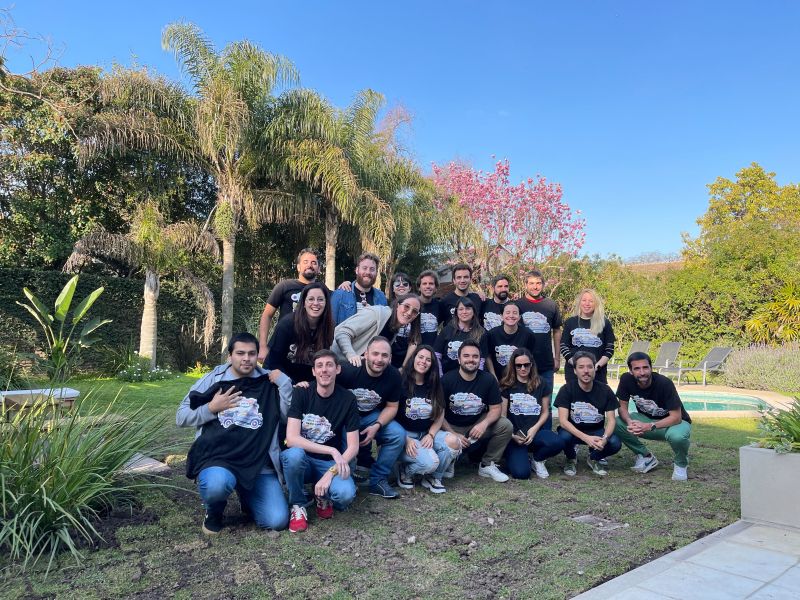
The reason was specific: people needed to align, get to know new colleagues, ask for help and challenge one another. A photograph from a leadership offsite shows the team together outdoors. An argument for working from anywhere had produced a reason to travel somewhere.
In a later post, he described taking his teenage son to an Argentine Workana offsite. Working on a laptop at home had made the job difficult for his children to see. At the gathering, his son could meet colleagues and observe collaboration, challenges and priorities. He even received projects of his own.
The father who had once commissioned a birthday video was now trying to make digital work visible to the next generation. The problem had changed shape: first finding someone to do a job, later showing a child the people and decisions concealed behind a screen.
The next problem on the screen
O’Farrell’s recent experiments with artificial intelligence have a familiar starting point: what useful job does the tool perform? He has described trying automation products, finding some helpful and others noisy. He still has things saved in Evernote, a detail he offers with some amusement at his own expense.
His test for becoming a regular user has three parts. The tool must solve a real problem, a problem he personally struggles with, and one he recognizes. That last condition interests him. A product’s capabilities mean little if its prospective user cannot connect them to an irritation already felt.
Workana has also been changing the duration and depth of its matches. In an October 2025 interview, he described an evolution from short projects toward longer engagements, with more vetting of skills, experience and professional ambitions. He wanted relationships that could continue through different stages of a career.
“We prefer to have fewer, deeper relationships that last over time,” he said. A July 2026 video interview returned to Workana’s beginnings, early challenges and the question of keeping people on a platform. Fourteen years after launch, the conversation still concerned what makes a useful relationship endure.
That brings the story back to the birthday video. A customer needed a particular result and found someone capable of producing it. O’Farrell built a business around making that encounter possible for other people. The ambition grew across countries, languages and kinds of work. Its everyday test remains small enough to understand: can the right people find each other, do good work, and have a reason to meet again?