Rom Agustin has a company that shares a birthday with his eldest son. This makes the usual distinction between building a business and raising a family rather difficult to maintain. When he talks about the two, he sometimes counts four children: three at home, and Callbox. A company rarely asks for the car keys, but it can be equally persuasive about needing your attention.
That small family detail is a useful entrance to a career usually described in the language of pipelines, campaigns, and sales development. Agustin is the founder and CEO of Callbox, established in 2004. Behind the job title is a former systems engineer who tried other businesses, helped build an operation in Iloilo, and now writes about the value of changing your approach. His public story has a recurring question: what needs another look?
The engineer before the entrepreneur
Before he worked on sales pipelines, Agustin worked in oil and gas engineering. He spent ten years in that industry. When he later described its influence, he concentrated on the way engineering taught him to organize a problem. “Engineering is all about process,” he said. The problems would change; the habit of taking them apart would travel.
Internet services and consulting followed. By his own count, Callbox was business number four. That is a useful correction to the tidy founder biography in which a single idea arrives, receives a logo, and becomes destiny. His experience had accumulated across several kinds of work before Callbox acquired a name.
Asked in 2014 what he would tell his younger self, Agustin made room for adventure and travel. He also slipped in the suggestion to buy Apple stock. Retrospective wisdom does enjoy the advantage of a completed share-price chart. Alongside the joke was a less glamorous point: he valued the experience he had earned before starting out on his own.
A different address for ambition
The early Callbox story passes through an internet café in La Paz, Iloilo. Agustin co-founded the business with Glen Norris, and its Philippine operating base became central to its development. A café is a modest setting for an international company. It also has the virtue of making the distance between an intention and an actual working business visible.
By the tenth anniversary, Agustin was emphasizing the people in Iloilo and Davao who had helped the company grow. Local recruitment mattered. So did the universities in those cities. Engineers from Iloilo developed Callbox Pipeline, software designed around the demands of outsourced marketing campaigns.
There is an important distinction inside that history: the city supplied technical work as well as people to make calls. For Agustin, the workforce was capable of changing the company itself. The business he described depended on employees bringing judgment to the job. Iloilo belongs in this account as a place where part of the machinery was designed.
When the telephone became one instrument
Callbox’s development required changes in what it sold and how it worked. Agustin has described an early operation doing inbound contact-center work, then adding outbound work as the business sought room to grow. Over time, the model expanded into marketing conducted through several channels.
A phone call became one part of a longer sequence involving email, social contact, campaign monitoring, and software. The process-minded engineer was now working in a field where the person at the other end could decline to participate. That makes sales a particularly interesting test of any system. The diagram may be immaculate; the buyer is entitled to ignore it.
Callbox’s current company profile describes operations reaching more than 50 countries and a team of more than 700. Those are company-reported figures, and they describe the organization rather than Agustin’s individual output. The connection to his career is the progression: a small operation became a business that had to coordinate people, technology, and different markets.
A camera among the cubicles
In 2016, Channel NewsAsia’s Money Mind brought a camera crew to Callbox. Host Chor Khieng Yuit toured the company and interviewed Agustin. The photographs place him among the office partitions, with lighting stands occupying the same floor as the desks. Television had come to the workplace, and the workplace remained very much in view.
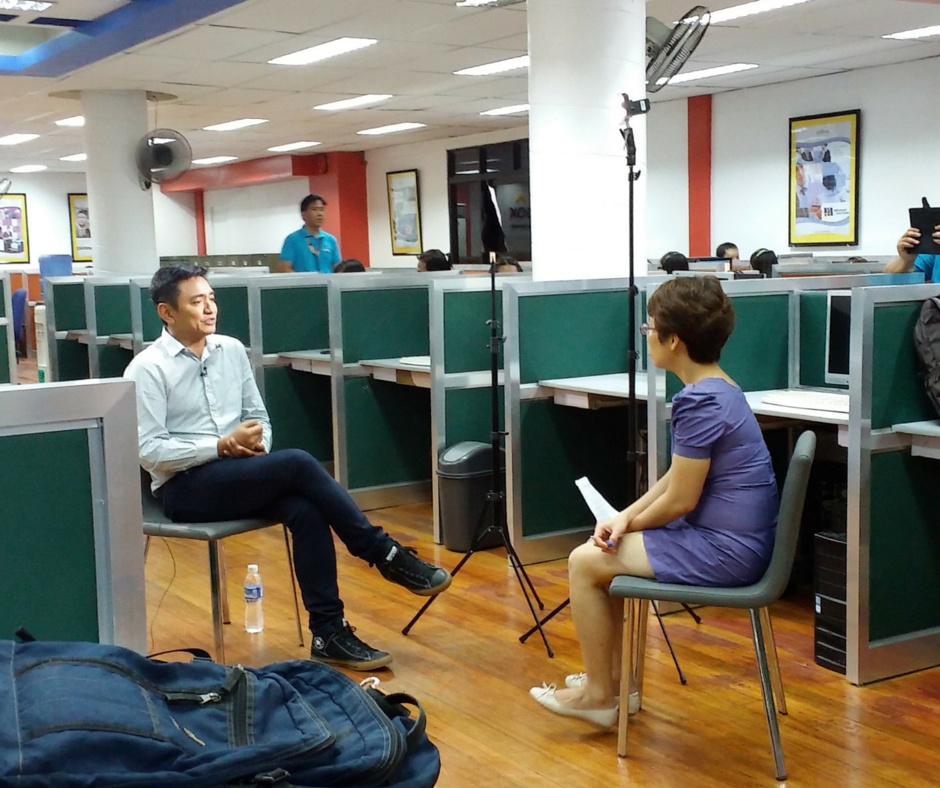
Around that period, he led a company summit organized around change. Its subjects included developing skills, improving processes, and making teams more effective. These are unshowy concerns beside a television appearance. They also explain why the appearance fits the larger story. A founder can describe an ambition in an interview; a growing organization needs people who can turn it into ordinary work the following morning.
Something more useful than applause
Later in 2016, Agustin connected his engineering past with a different group of founders. Callbox announced support for the University of Southern California Viterbi School of Engineering’s Maseeh Entrepreneurship Prize Competition. The pledge was $10,000 in marketing services for the winner. Agustin was also announced as a judge for the competition, with the winner due in April 2017.
The form of the contribution made sense. A technical idea needs people willing to use it, and finding those people is work. Agustin was offering a service his company knew how to perform. The pledge put a practical resource next to the encouragement routinely offered to young entrepreneurs.
He explained his involvement through the difficulty of starting without support. His own route had included engineering, internet services, consulting, and the eventual BPO business. Looking at student entrepreneurs, he recognized a familiar stretch of road. In his account of success, intelligence had to be accompanied by persistence. His compact formulation was “equal parts smarts and relentlessness.”
Four children, one shared birthday
In 2024, with Callbox reaching twenty years, Agustin reflected on fatherhood. He connected raising three children with the patience and tenacity he brought to leadership. The shared birthday with his eldest son gave the comparison a literal place on the calendar. Callbox was another growing responsibility, requiring time while the children required theirs.
His description included a reversal. After years of teaching his children and helping the company develop, he found himself learning from both. It is a revealing admission from someone whose position ordinarily requires him to provide direction. Being in charge had left him with more teachers.

The comparison is personal, and it explains something about the language he uses for work. He talks about growth as something people need the opportunity to do. The father’s task and the executive’s task meet in the need to pay attention, then accept that the people receiving it will develop ideas of their own.
The CEO leaves room for an edit
Agustin introduced his LinkedIn newsletter, Re:Vision, in April 2025. He called himself a “work-in-progress.” The title was well chosen for someone whose account of business increasingly emphasized repeated improvements. He described learning that an early attempt did not have to contain the final answer.
For a founder with two decades at the same company, that is a particular way to frame experience. Years in a role can supply a collection of answers. They can also supply enough examples of being wrong to make another look worthwhile. Agustin’s newsletter made that second possibility part of its premise.
Its promised subjects were practical: reviving stalled conversations, concentrating on suitable prospects, and getting sales and marketing to work together. The engineer’s interest in the relationship between parts was still present. Only now the parts included teams, messages, timing, and the occasional decision to try again.
Curiosity has a job to do
In August 2025, Agustin wrote about a sales representative who noticed a prospect repeatedly reading case studies without replying to emails. She changed the approach, sending a LinkedIn voice note that referred to the material the prospect had been exploring. The detail matters because it gives curiosity an actual task.
The representative had a signal. She then had to decide what to do with it. Another automatic follow-up was available; so was a more specific attempt at conversation. Agustin used the example to argue that tools alone could not explain a team’s ability to learn and adapt.
“Tech can give you speed. But curiosity gives you direction.”
Rom Agustin · August 2025
His list of useful skills included AI literacy, adaptability, explaining information through stories, international collaboration, and empathy. Together they describe a workplace in which technology creates new demands on human judgment. Someone still needs to decide whether a message makes sense for this person, in this situation, at this moment.
A buyer is rarely just one person
Agustin’s sales advice also recognizes how many people can stand behind a company’s purchasing decision. He distinguishes the internal champion, the eventual user or influencer, the person who controls the budget, and the technical evaluator. Each brings different questions. A proposal that satisfies one may leave another unconvinced.
His November 2025 fintech essay carries that thinking into a specific market. He argues for closer targeting, attention to what buyers are already researching, and better coordination when marketing hands a prospect to sales. The ambition is a conversation informed by context, with fewer assumptions about what a click means.
For Agustin, these are operational questions. Who has shown interest? What are they trying to solve? Who else participates in the decision? They bring his business back to a recognizable human problem: before asking someone to say yes, understand what they need to know.
Still a work in progress
In his writing about the future of work, Agustin points to collaboration across regions and investment in helping employees use AI. He describes opportunity in reducing repetitive tasks and giving people more time for strategy and customer relationships. His optimism rests partly on seeing people continue to want to improve.
That thought connects the chapters without making them identical. Engineering gave him a method. Earlier ventures gave him experience. Iloilo supplied colleagues who helped build a company. Fatherhood gave him another way to think about patience, attention, and learning from people he had once taught.
Callbox’s founder has spent years asking how work should change. His own preferred description still leaves the door open for another answer. For an engineer who became an entrepreneur, a father, and an editor of his own assumptions, “work-in-progress” seems an entirely serviceable job title.