In 2012, Henry Eimstad had a company to run and client projects to oversee. Strata Information Group employed approximately 80 people and reported annual revenue of about $15 million. Its president and co-owner was also a practicing consultant. The person at the top of the business remained part of the service it sold.
That detail explains a good deal about Eimstad. His career belongs to the less theatrical end of technology: the assessments, purchasing decisions, implementations and follow-through that colleges need before a new system becomes useful. A university can announce a software purchase in an afternoon. Making the purchase work requires a rather longer attention span.
His assignments ranged from community college districts in California to Harvard Law School. Along the way, he helped build SIG with Frank Vaskelis, another higher education technology professional. The firm grew around institutions with different budgets, different systems and a common need for people who understood how campuses actually operated.
The business would eventually attract private equity investment, acquire other consultancies and pass to new leadership. Eimstad's part in that transition offers a second view of his work. After years helping institutions manage change, he had to consider what change should look like inside the company he had helped create.
A career on both sides of the computer center
Eimstad's early career included work at Pepperdine University. From 1974 to 1977, he was a manager of user services there. He then worked at SCT, later part of Ellucian, from 1977 to 1986 as a senior regional manager and CIO for several colleges. These were jobs close to the daily obligations of institutional computing.
His experience also included directing computer centers and managing projects at the Peralta, Riverside and San Diego community college districts. Software delivery assignments took him into another set of institutions, including the British Columbia Institute of Technology, Santa Clara University and the University of Hawaii. He worked across institutional boundaries long before SIG became a business built around doing so.
His education included a bachelor's degree in mathematics at San Jose State University and graduate mathematics coursework at the University of South Florida in 1972 and 1973. The distinction matters: the latter was coursework toward a master's degree. Mathematics preceded the long list of management assignments.
The resulting career combined organizational analysis with implementation and operational planning. By 2012, his professional résumé counted 38 years in higher education and information technology. It also described three decades of management experience as a chief information officer or chief technology officer. SIG's president had spent much of his working life inside the kinds of institutions his firm advised.
Computer centers. College systems. A company. Then the handoff.
A company built to stay with the problem
Eimstad and Vaskelis established SIG in the late 1980s. They based the company in San Diego and concentrated on technology services for colleges and universities. Their own experience running institutional technology gave the partnership a practical starting point: they knew the work from the customer's side of the desk.
By 2012, SIG described a model in which its consultants were employees, rather than subcontractors. Its team included people who had worked as registrars, controllers, financial aid directors and CIOs. The firm reported that its consultants averaged more than 22 years of higher education experience. That is an unusually patient way to assemble a technology business: hire people who have already lived with the consequences.
The owners remained practicing consultants and provided oversight on engagements. Eimstad's responsibilities included ERP procurement at Chapman University and Brandman University, Banner implementations at Sam Houston State University and Drew University, and a student system implementation at Harvard Law School. Organizational analysis at Oregon State University and the Oregon State System of Higher Education added another kind of assignment.
The firm's scale was already visible in its 2012 workload. SIG reported having assisted more than 280 institutions and having led over 50 system acquisitions. It also described ongoing technical and functional consulting for more than 200 clients. Those figures describe the company and its team, rather than Eimstad's personal caseload. They help explain the organization he and Vaskelis were running: a business with repeat support obligations alongside discrete projects. A completed acquisition or implementation could sit within a much longer institutional relationship.
Those projects reveal the breadth hidden inside the word consulting. Choosing a system, changing an organization's processes and managing an implementation are separate tasks. Eimstad's record includes all three. His work crossed the point where an institution decides what it needs and the point where its staff must make that decision function.
SIG also described itself as vendor neutral in 2012: it did not sell hardware or software. That commercial arrangement gave its advice a defined place in a purchasing process. An institution could bring in the firm for help evaluating a purchase, then retain experienced people to manage what followed. The adviser had work to do after the selection meeting ended.
The price on the box was only the beginning
Eimstad's work for South Orange County Community College District makes the method concrete. In 2013, his assessment of potential systems went beyond preliminary software prices. He identified questions about missing functionality, configuration, implementation, project management, staff training and the people needed to cover existing jobs while employees learned the replacement system.
The assessment also considered interfaces, upgrades, hardware, maintenance and contingency funds. Several cost categories still needed estimates. The list reads like an antidote to a tidy sales presentation. Software is quite capable of arriving with a price; the work surrounding it is less obliging.
Eimstad also raised the possibility of seeking best and final pricing from competing vendors. His role involved helping the district examine both the costs it could already see and the costs that still required investigation. It was a form of practical skepticism directed at a consequential institutional purchase.
- 01ChooseNeeds, proposals, evaluation
- 02PrepareStaffing, training, interfaces
- 03ImplementConfiguration, project management
In 2015, the same district's procurement instructions designated Eimstad and SIG colleague Harold George as the points of contact for vendors during an evaluation. In 2017, Compton Community College District's ERP request directed vendor questions to Eimstad. These assignments put him within the machinery of selection: deadlines, demonstrations, institutional requirements and the communication needed to compare proposals.
The useful unit of measurement here is the assignment. A procurement has to reach a decision. An implementation has to move through its tasks. Staff need answers that fit their institution. Eimstad's project history shows a career spent accepting responsibility for those particulars, over a period when the surrounding technology kept changing.
Another kind of long-distance assignment
There was a life beyond implementation schedules. Eimstad served in the U.S. Navy and the Peace Corps. His interests include travel to Africa and South America. He is also a longtime runner who completed the Boston Marathon in 2018, a race remembered for particularly difficult weather.
These details belong beside the professional record without having to explain it. A marathon finish does not tell us how someone manages a software project. It does establish that the list of completed undertakings extends beyond campus systems and consulting contracts. Eimstad's biography makes room for public service, travel and an actual finish line.
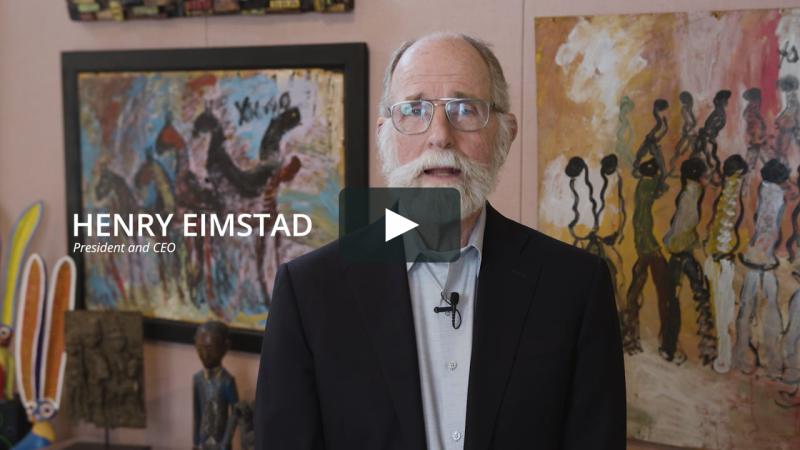
By January 2023, he was welcoming participants to SIGConnect, SIG's third annual virtual conference, as the company's president and CEO. In the welcome video, he appears in front of colorful paintings. After the procurement tables and system acronyms, it is a pleasing change of scenery. The company had a public gathering place as well as a client list.
The founder's final implementation
In June 2021, SIG completed a recapitalization with Fort Point Capital. Eimstad continued as president and Vaskelis as founding partner when the investment was announced. The arrangement paired the existing management team with an investor focused on service businesses. It began a transition rather than an immediate disappearance of the founders.
Eimstad said he was pleased with the partnership and saw value in Fort Point's experience with technology services and management teams. The investor later described working closely with him, as a retiring co-founder and CEO, on the move to new leadership. His subsequent professional profile identifies him as founder and retired president, with retirement in 2023.
That succession took place while SIG's services were expanding. The company acquired akaCRM in 2022, Triaxiom Security in 2023 and RHB in 2024, adding capabilities in Salesforce, cybersecurity and Slate-related work. These are developments in the company Eimstad helped establish; they belong to the next management chapter as well as to the history of the business.
Fort Point sold SIG to Ridgemont Equity Partners in December 2024, announcing the transaction the following January. Eimstad's comment on the handoff returned to the concern he and Vaskelis had brought to selecting an investment partner: finding someone who would “preserve SIG's unique culture and help the Company drive growth.”
“preserve SIG’s unique culture and help the Company drive growth”
Henry Eimstad · January 2025
The phrasing puts continuity alongside expansion. A founder can transfer ownership with transaction documents. Preserving a way of working asks something of the people who remain. For a company whose earlier model depended on experienced employees and owners engaged with clients, culture had a concrete history behind it.
Eimstad's career runs through a succession of institutional obligations: a computer center, a procurement, an implementation, a consulting company, a leadership transition. The last of these has an unusual symmetry. Having spent decades helping colleges move from one arrangement to another, he participated in making the business itself ready for someone else to run. There is no software package for that particular installation.
Follow the work
Explore Eimstad’s professional profile, his conference welcome and the company’s next chapters.