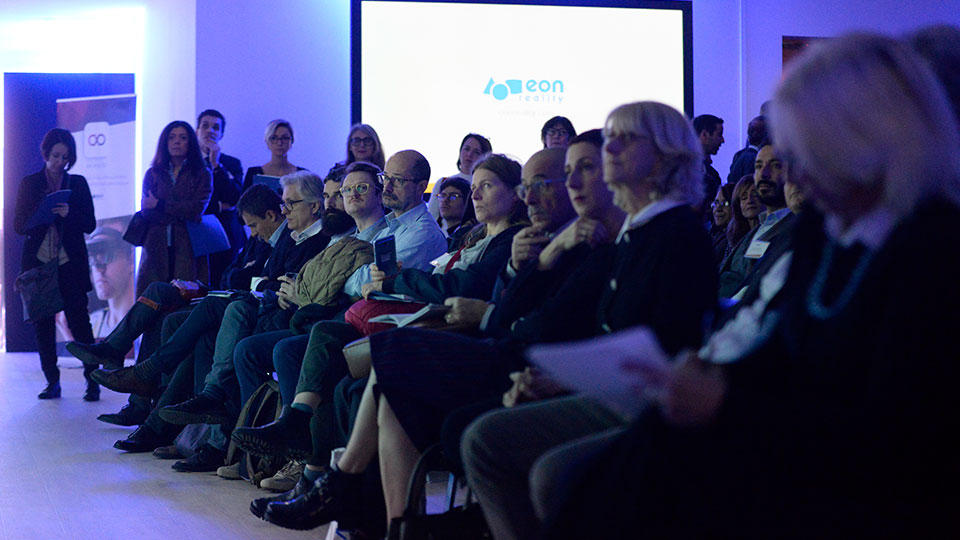
A room full of people is a curious way to launch a technology that promises to take people somewhere else. In November 2018, EON Reality inaugurated its Italian digital centre in Casalecchio di Reno, outside Bologna. There were officials, educators and a proposition with obvious appeal: let people practise with a virtual machine before asking them to operate the real one.
- The product: software for creating and delivering immersive lessons.
- The buyer: schools, universities, employers and public institutions.
- The Italian complication: an ambitious funded hub followed by a failed local subsidiary.
The attraction was access. A scarce piece of equipment could become a repeatable lesson. A teacher could show its hidden parts. A trainee could make a mistake without damaging it. EON’s Italian history became an unusually concrete test of what happens between that appealing demonstration and an institution that actually delivers training.
01 / Put the teacher in the workshop
Founded in 1999 by Dan Lejerskar and Mats Johansson, the Irvine company works in knowledge transfer. Its early professional background includes industrial simulation. Its enduring idea is that expertise should travel: from the person who understands a process to the person who needs to learn it.
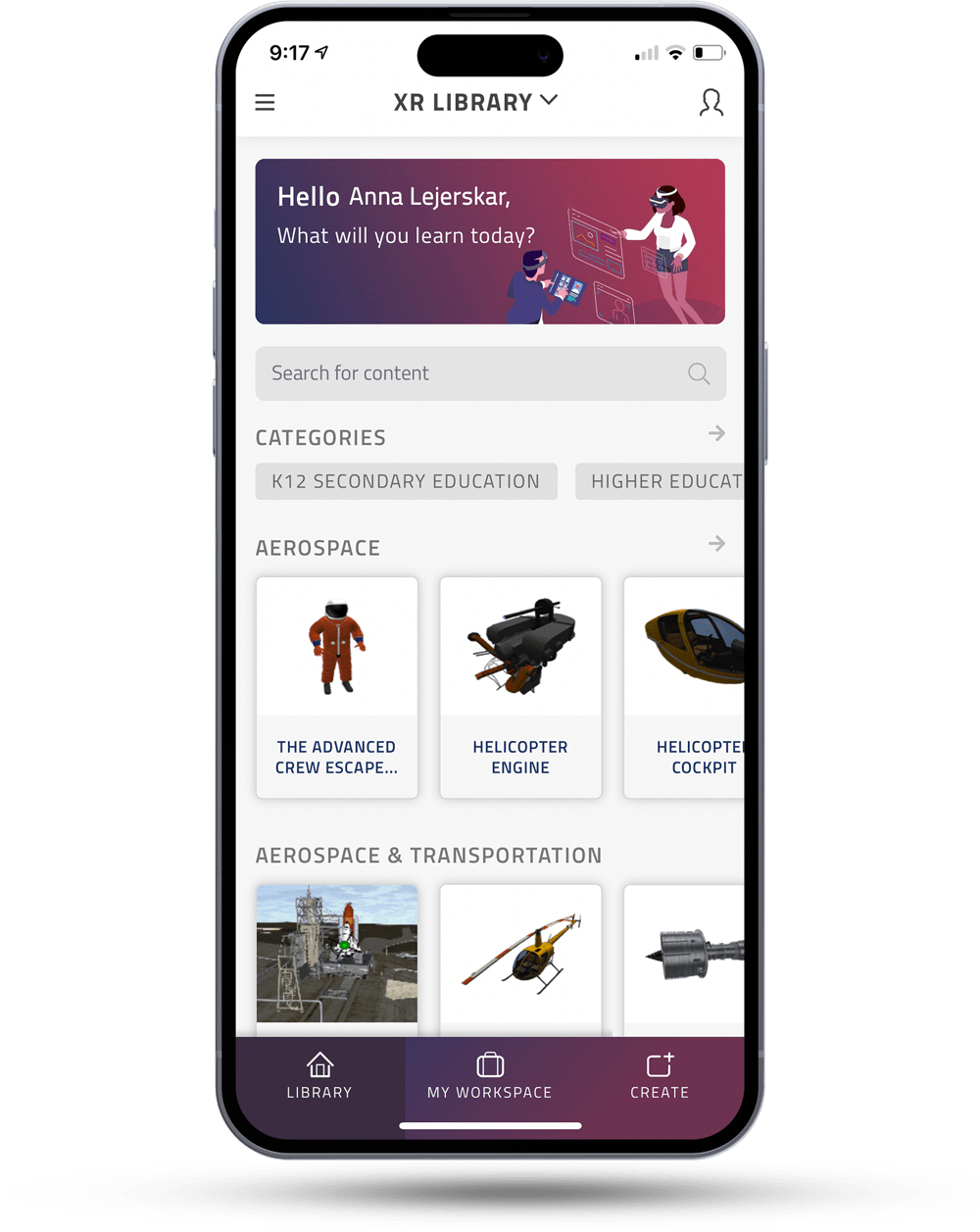
EON-XR made the instructor an author. Instead of commissioning every lesson as a programming project, educators could assemble interactive experiences around 3D objects and environments. EON advertises delivery across phones, computers and headsets. For a school, that widens the possible classroom beyond a cupboard of specialist equipment.
The market sits between conventional online learning and bespoke simulation. Strivr also supplies immersive enterprise training, including authoring and analytics. EON’s pitch places particular weight on educators creating content and AI helping build it. The relevant comparison is the work required to turn one institution’s actual knowledge into a usable lesson.
02 / Bologna supplied a better experiment
A school collaboration made the proposition more tangible. EON announced an expansion to 2,400 students at Bologna’s Aldini Valeriani institute, involving local foundations and industrial groups IMA and Marchesini. Teachers and students would create peer-reviewed lessons; the manufacturers would contribute industrial content and financial support.
That arrangement joined three things often kept apart: the people teaching, the people learning and the people making the equipment. Its useful feature was the source material. A generic machine can teach vocabulary. Content drawn from industrial products can connect a lesson to the objects students may encounter at work.
The Italian office also hosted International Filmmaking Academy activity in 2019. Virtual reality could be a workshop for filmmakers as well as technicians. The common ingredient was an environment someone could explore, rather than another explanation someone had to sit through.
03 / The building had obligations, too
The larger Italian hub depended on a different kind of infrastructure: money, staff and contractual commitments. The regional plan envisaged €24.3 million of investment and 160 jobs. By June 2021, Emilia-Romagna said employment had reached at most about fifteen. The operational commitments were where the project visibly came apart.
The region revoked support and demanded approximately €7.05 million including interest. EON disputed the portrayal. In February 2022, the company said it had invested about $20 million, largely represented by an in-kind contribution of equipment, software and resources, and offered to discuss debt restructuring. Those statements describe different measures of investment, rather than a shared account of completed delivery. EON also blamed disruption among hardware suppliers and said it had redirected resources toward its software platform. That was the company’s explanation of its change in approach.
The creditors portal records Eon Reality Italia Srl entering bankruptcy on November 8, 2022. In March 2026, Il Resto del Carlino reported criminal proceedings involving company leaders over the grant. Those allegations remain distinct from a finding of guilt. The Italian subsidiary’s bankruptcy also needs to be kept separate from the continuing global software business.
EON’s Italian ambitions continued in its announcements. In May 2025 it proposed a Mediterranean-focused AI Academy for Defence, naming prospective collaboration with military institutions and defence manufacturers. The release describes partnerships being established and possible deployment sites. It is a proposal to read in that tense, rather than a roster of contracted customers.
04 / Seeing was no longer enough
The product story took its own turn. In August 2026, EON announced XR Infinite, saying customer conversations had exposed a gap between the earlier platform and a full simulator. That feedback supplied a specific reason to change: learners needed more opportunity to operate the objects they were studying.
EON describes Infinite as the successor combining EON XR and EON AI, included in existing subscriptions without an additional charge. An author supplies a subject; the system builds a narrated, interactive simulation. The announcement also specifies human review of AI-generated labels before publication. For a technical instructor, that approval step is part of the product’s value.
“Knowledge is a human right.”EON Reality’s stated belief
On October 16, 2026, EON announced a vocational library expansion planned for January 2027, covering refrigeration, electrical technology, mechatronics and building services. It is a useful indication of direction: lessons organised around practical trades and assessed activity. The delivery date belongs in the future tense.
05 / Price the lesson, then test the task
EON publishes education pricing of $36 per user per month and enterprise pricing of $124. Its academic pricing page lists a thirty-user annual classroom package at $12,960. These are software prices; a purchasing decision also needs to account for devices, content preparation, instructor time and integration.
30 licences × $36 per user × 12 months.
Software package; implementation needs vary.
The practical lesson for a buyer is to begin with one procedure. Ask an instructor to build it, have another expert check it, and watch a cohort attempt it. Compare their performance with the existing lesson. Record preparation time as well as learner results. That is an editorial recommendation, not a claim about an EON trial.
The approach depends on accurate models, reviewed instructions and people available to teach. It becomes less useful when those ingredients are absent, or when the task demands physical sensations the chosen device cannot reproduce. EON’s Italian experience gives the buyer a concrete question to carry into a demo: who will make this work on Monday morning?