An online order has two lives. In the first, everything is composed: the photograph, the typeface, the carefully placed purchase button. In the second, a parcel is late, a size is wrong, or somebody needs a refund. The customer encounters an employee trying to assemble an answer from several different systems. Particular., a Miami Beach strategy and creative agency, found a software business in that second life.
- The agency: strategy, branding, digital products, commerce development and executive training.
- The invention: commerce tools inside Zendesk, developed at Particular. and spun out as agnoStack in 2019.
- The lesson: study the work required to keep a brand’s promises after the purchase.
A client brief with a second life
The origin is pleasingly practical. In a May 2026 interview, co-founder Adam Grohs described a fast-growing retailer asking his agency to develop a new retail back-office platform. That project became agnoStack. A service assignment had exposed a problem that could travel beyond the original client.
Particular. had already been making that problem visible. In February 2019, it and commerce platform Moltin announced a native plugin for Zendesk. Innovative commerce projects could become detached from the systems used to run the business. A customer might buy through a new experience while the person handling the inquiry remained stranded elsewhere.
The integration put commerce information beside the support ticket. Agents could inspect orders, search customers, browse products and help place purchases. In a subsequent explanation, Particular. described the familiar nuisance of moving between screens and entering information again while a customer waited. Here was a design problem measured in interruptions.
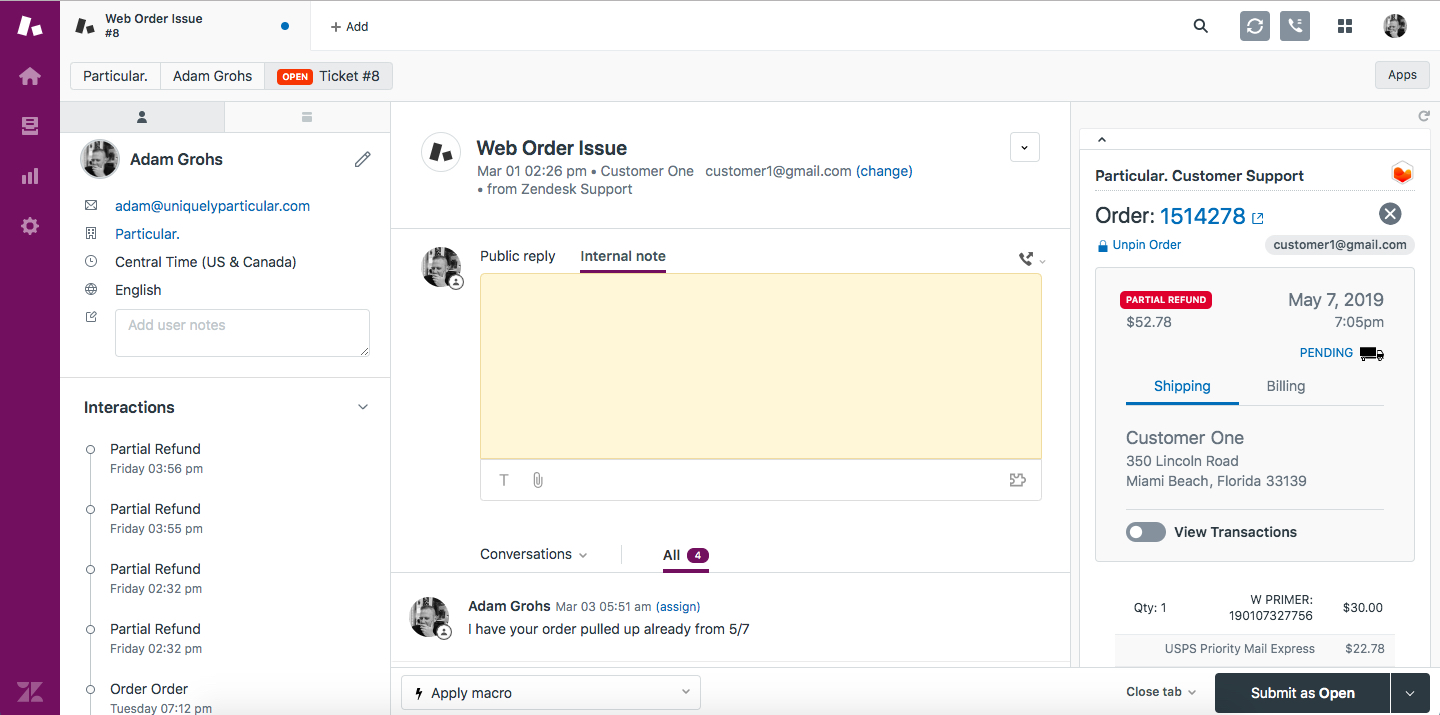
By October 1, 2019, the experiment had become a separate company. The launch announcement said more than 100 brands had signed up in its first few months and described pilots involving Magento 1 and Moltin. That is an early demand signal, rather than a count of long-term paying customers. It helps explain why the tool acquired a life beyond the agency.
order→02Support
ticket→03Information
+ action
A conceptual workflow, not a measured performance comparison.
Build the connection, then teach the team
Particular.’s broader business combines consulting, creative execution and technology implementation. Its menu runs from business and marketing strategy to branding, prototypes, campaigns, websites and commerce platforms. A client can ask about the operating process as well as the interface. That breadth places it between a digital agency, an operational consultancy and a specialist development shop.

Grohs founded Particular. with Thomas Sherman. His background helps make sense of the combination: technology leadership, agency work and education. He co-founded an internal executive program at SapientRazorfish and helped establish HUGE School. At Particular., education appears again as Particularly U, also styled Particular.ly U.
The agency offers executive training and customized workshops, with subjects including behavioral economics, emerging technologies and decisions about in-house versus outsourced work. Its website makes an unusually candid promise:
“We aspire to be the agency that teaches clients how not to need us.”Particular. / Our Offerings
There is a useful commercial tension there. An agency sells expertise; education transfers some of it to the buyer. For a client, the appeal is a team better equipped to run what has been built. Particular.’s published working principles emphasize simplicity, craftsmanship, accountability and continuous learning. Those principles make the training offer coherent with its implementation work.
The business behind the button
Keep the two businesses straight. Particular. offers client services. agnoStack sells commerce-support software through subscription tiers. Its documentation describes monthly billing based on Zendesk agents with access, with features varying by commerce provider and tier. For a buyer, enabled seats and supported actions are concrete things to check before estimating a bill.
The distinction also matters when reading growth figures. In May 2026, Refresh Miami reported that agnoStack served about 350 brands in more than 20 countries. Yogi, the tea company, described using it to connect Zendesk with Shopify for its direct-to-consumer stores. Those are examples of the spinout’s reach, not Particular.’s agency client list.
Reported for agnoStack in May 2026, across 20+ countries. A snapshot of a separate business.
Particular. lists Moltin, now part of Elastic Path, Zendesk, HubSpot and BigCommerce as strategic partners. The original Moltin plugin gives that relationship a tangible output. The positioning becomes clearer: creative and strategic work connected to commerce operations, with a demonstrated route from client assignment to reusable software.
That route has boundaries. The software proposition depends on Zendesk and supported commerce connections. A merchant with a different help desk must consider another integration or a platform change. An internal development team, a specialist agency or a commerce-focused help desk can also be a reasonable alternative. The right comparison starts with the task an agent must complete. A connection that displays an order is useful; a connection that permits the required refund may answer a different need. That distinction belongs in the purchasing conversation, alongside training, permissions and the quality of the information coming from the store.
The next counter is a chat window
The same question now extends into messaging. In June 2026, Particular. described Stackable Labs, a sister company to agnoStack launched that May. Its extensions let customers access information and take actions inside Zendesk Messenger, including checking an order or changing a subscription. The work surface has moved from the agent’s screen into the conversation.
There is something worth copying here before commissioning software. Follow one refund from request to completion. Record each application opened, each repeated entry, each permission required. Ask which handoff causes the wait. Particular.’s story suggests that a productive brief can begin with that small observation. The customer has already bought the product. Somebody still has to make the purchase work.