On the way to her first kitchen demonstration, Doris Christopher nearly turned the car around. In Warren Buffett’s later telling, she was convinced the evening would fail. She went anyway. The guests bought $175 worth of kitchenware. It was October 1980, and a former home economics teacher had found a useful place to open a store: inside somebody else’s dinner plans.
The useful bits
- Pampered Chef pairs kitchen products with recipes and demonstrations.
- Independent consultants sell in person and online; shoppers can also order directly.
- Its lesson for other businesses: show the useful moment, then test whether people will pay.
The $3,000 experiment
Christopher borrowed $3,000 against a life insurance policy and bought small quantities of cooking implements. She operated from her suburban Chicago basement, handling the unglamorous jobs herself. The 1995 account in Inc. describes a founder who was buyer, shipper, bookkeeper and demonstrator. The money bought stock. Her teaching experience supplied the explanation.
Consider the difference between seeing a scraper in a shop and seeing it rescue the last spoonful from a bowl. One encounter requires imagination. The other supplies evidence. Christopher’s approach joined the tool, the recipe and the person explaining both. A guest could leave with something to buy and something to cook.
By the time Berkshire Hathaway acquired Pampered Chef in October 2002, the demonstration had become a repeatable distribution system. Buffett’s shareholder letter described annual business exceeding $700 million and 67,000 consultants. Those are historical figures. They capture how far a modest first experiment travelled.
“Everyone has a good time.”
Warren Buffett, after attending a Pampered Chef party, 2002 shareholder letter
Dinner is the product manual
Today the range stretches from measuring tools and stoneware to cookware, seasonings and countertop appliances. Its audience is the home cook who wants a meal to work on an ordinary evening. The company supplies recipes alongside the equipment, so the purchase comes with a suggested first use.
The range also reaches beginners who are not yet buying their own cookware. Kids Club offers boxes for children aged six to twelve, with recipes, seasoning and a real kitchen tool. That is an unusually literal version of the company’s method: put an implement in somebody’s hands and give them a reason to use it.
The Deluxe Air Fryer & Oven makes the proposition concrete. Its upper compartment is a toaster oven; the lower one air-fries and roasts. A Sync Finish setting coordinates the two. The practical pitch is familiar to anyone who has served hot vegetables beside cooling chicken: dinner has a timing problem.
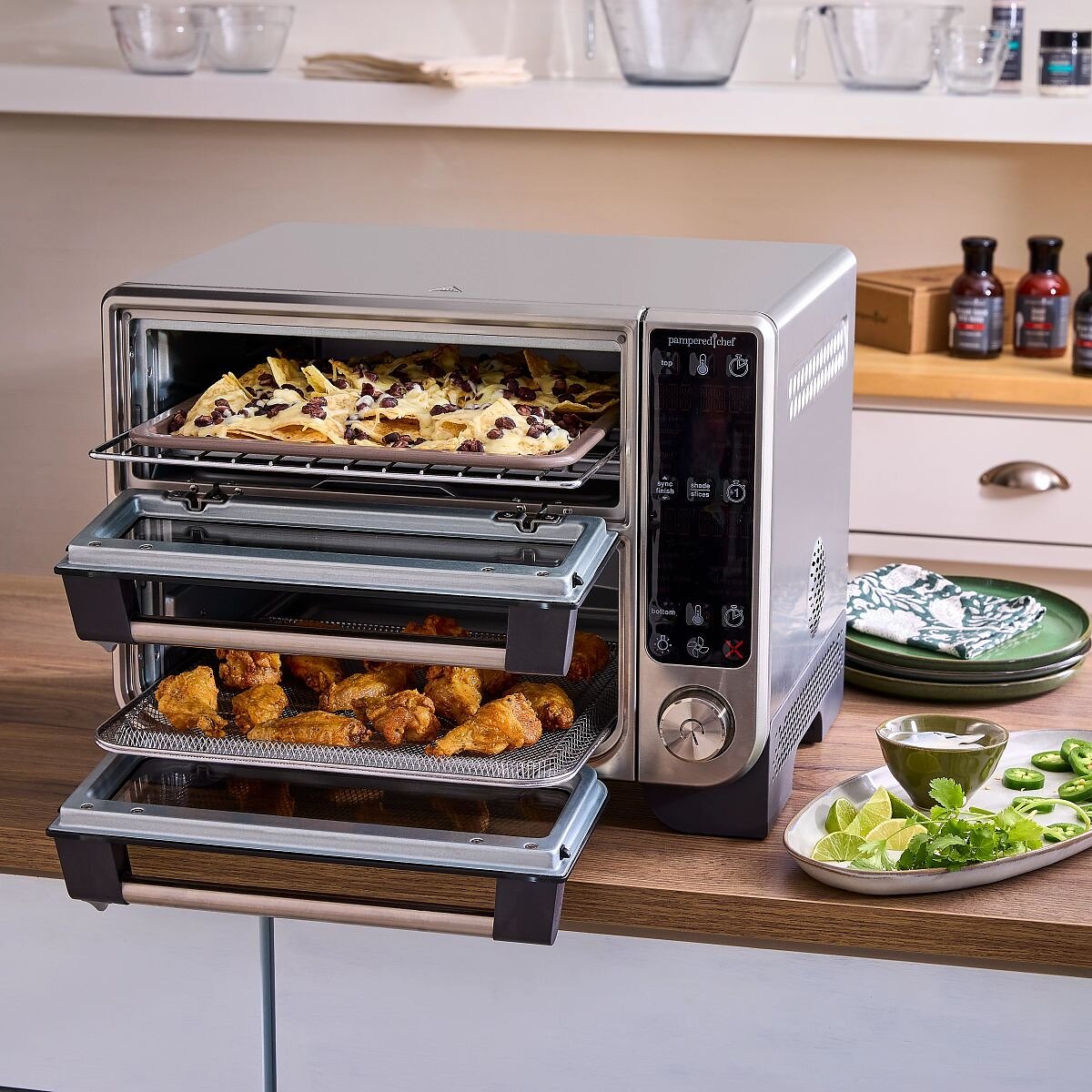
The US product listing checked for this profile priced it at $429. At that price, a demonstration earns its keep only if it helps a buyer judge capacity, convenience and likely use. A smaller household might prefer a simpler appliance. Someone already happy with their oven may need nothing at all.
Alternatives occupy different parts of the basket: OXO for prep tools, Williams-Sonoma for kitchenware shopping, Ninja for countertop appliances. Pampered Chef’s distinctive offer is the combination of equipment, instruction and a consultant relationship. Its expertise lives in translating an implement into a meal someone feels able to attempt.
When the party needed its own address
Moving that relationship online introduced another kitchen complication: the venue belonged to somebody else. In a 2019 company survey, more than half of consultants reported social media restrictions that limited virtual parties. Creating content and following changing rules consumed time. This friction preceded the pandemic.
Table became the company’s answer. Its 2021 launch announcement described a dedicated space for recipes, product catalogues, live video and conversation. Guests could join without sharing the same social media preferences. The gathering still needed a host; it now had a company-owned room.
A party platform, in 14 months
The company reported that Table’s first four months produced 8% higher average party revenue than social media parties. That comparison is company-reported, rather than an independent experiment. The more transferable idea is the sequence: try a prototype, observe real use, then commit to expansion. A new venue still has to earn its guests.
Later, Pampered Chef Live extended the format with events from the home-office test kitchen and consultants’ kitchens. Its 2024 technology submission describes using Zoom and existing tools to develop the experience during 2023. The detail matters: even a company with its own platform could experiment with familiar software before expanding a format.
The commission is only the beginning
Pampered Chef sells both kitchen products and an independent selling opportunity. Its compensation structure includes commissions on personal sales and qualifying overrides on sales made by a consultant’s team. That makes it a multilevel direct-selling model. Buying a spatula and becoming a consultant are different decisions.
The public recruiting page advertises a starting commission of 20%. That is a share of commissionable sales, before the seller’s expenses and time. Ingredients, samples, travel and digital tools can change what remains. A commission percentage alone cannot tell a prospective consultant whether the work will be worthwhile.
There are limits on the customer side, too. A demonstration adds little when somebody already knows the tool they want and simply needs a low price. It helps when uncertainty is the obstacle. Even then, a convincing evening cannot replace safe design: a 2013 US garlic-slicer recall covered about 286,000 units after reports of detached blades, including one cut finger.
More places at the table
The shared-meal theme also has a charitable expression. Feeding America’s fall 2025 impact report credited the partnership, begun in 1991, with cumulative support equivalent to 300 million meals. Customers can round up orders, connecting a small purchase decision with food-bank support.
A February 2026 collaboration with chef and author Kat Ashmore used loaded sweet potato nachos to introduce tools for slicing, chopping and cooking. The celebrity changed; the underlying transaction stayed recognizable. A recipe gave each object a job, and the meal connected the objects into a reason to pay attention.
In October 2026, Pampered Chef marked 26 years in Europe, reporting more than 580,000 cooking shows since its German launch. The scale has changed; the recognizable unit remains a demonstration. For another business, the useful question is precise: what could a customer understand in five minutes of watching that a shelf of products leaves unexplained?