There is a peculiar stretch of asphalt in American commerce where the warehouse ends and the highway has not quite begun. Semi-trailers wait in rows. Yard tractors shuttle them a few hundred yards at a time. Somebody finds the right box, hooks the kingpin, connects air and electrical lines, noses through traffic and backs 50,000 pounds of freight into a dock. Then they do it again. The work is repetitive, weather-beaten and consequential. If the wrong trailer reaches the wrong door late, the expensive automation inside the building gets to stand around.
Outrider chose this overlooked middle for a reason. Public-road autonomy asks a vehicle to survive an almost unlimited world. A distribution yard is private property, low-speed and bounded, with repeatable jobs and a buyer who can count every minute saved. That does not make it simple. It makes the problem containable - which is a very different and more commercially useful thing.
Founded in 2017 by Andrew Smith, the Colorado company sells autonomous yard operations as a subscription. The package includes electric yard trucks fitted with its autonomy system, cloud software, trailer inventory tracking, site infrastructure and round-the-clock support. In 2024, Outrider said it had completed more than 100,000 autonomous trailer moves across customer sites and its test facility. Its customers, mostly unnamed Fortune 500 companies bound by NDAs, represent more than 20 percent of the yard trucks operating in North America. Georgia-Pacific is the conspicuous public reference.
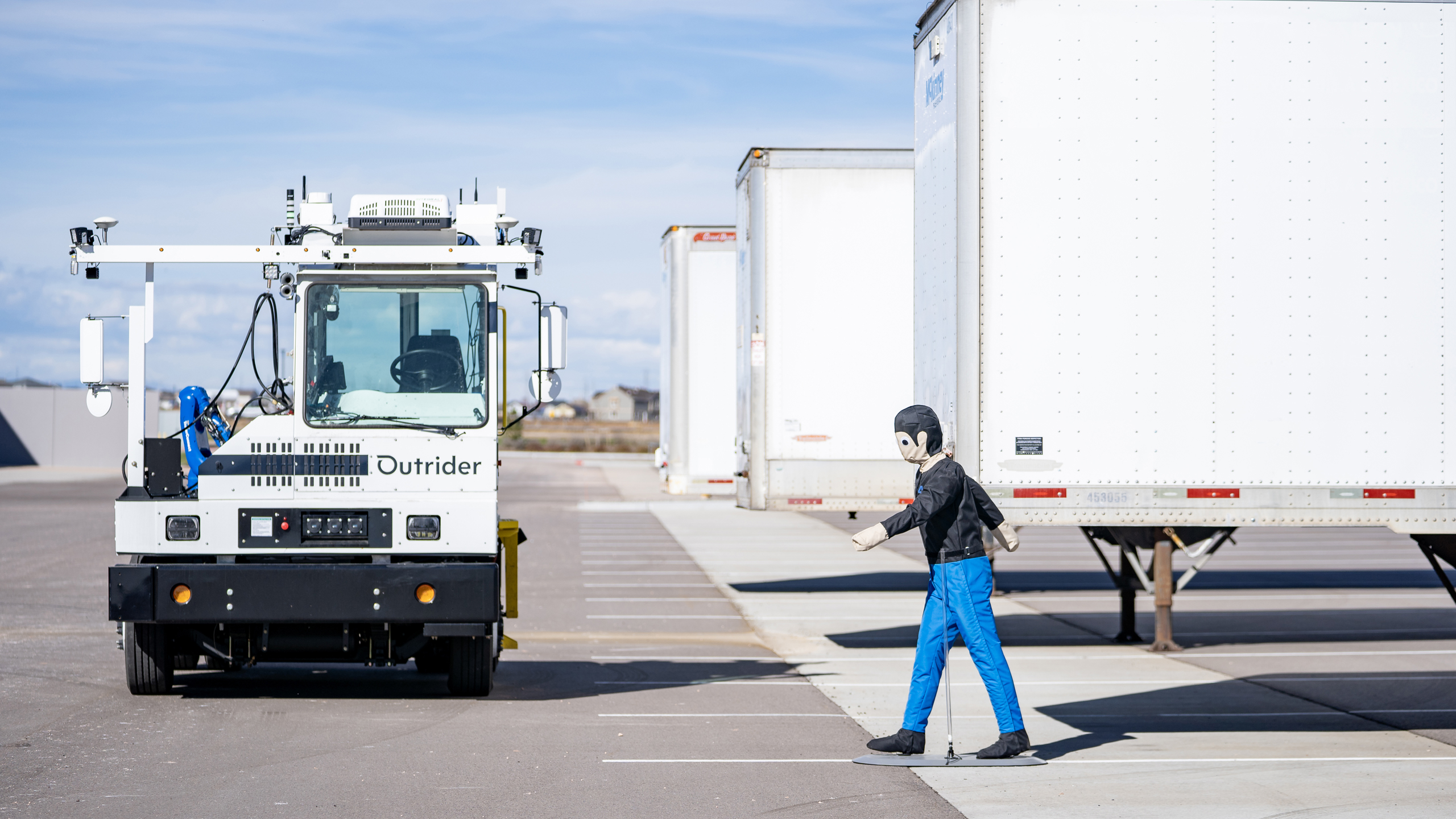
The truck was only the visible part
A camera-covered vehicle makes a satisfying demo. The useful product is everything the camera does not flatter. Outrider’s system must receive a move from a customer’s yard, warehouse or transportation software; locate the correct trailer; plan a legal path through mixed traffic; hitch; connect the lines; back precisely; report the new location; and recover when a parking spot contains a pallet, a dock door stays open or a human parks creatively.
The awkward bit became a moat. A trailer cannot safely travel with its brake and electrical lines dangling loose. Fleets contain innumerable trailer arrangements, and asking customers to retrofit every visiting trailer would smother adoption. Outrider built TrailerConnect, a robotic arm that uses cameras, deep learning and manipulation software to find and attach those lines on ordinary equipment. The company says the unmodified-trailer connection takes less than 30 seconds; captive fleets with simple adapters can connect in seconds.
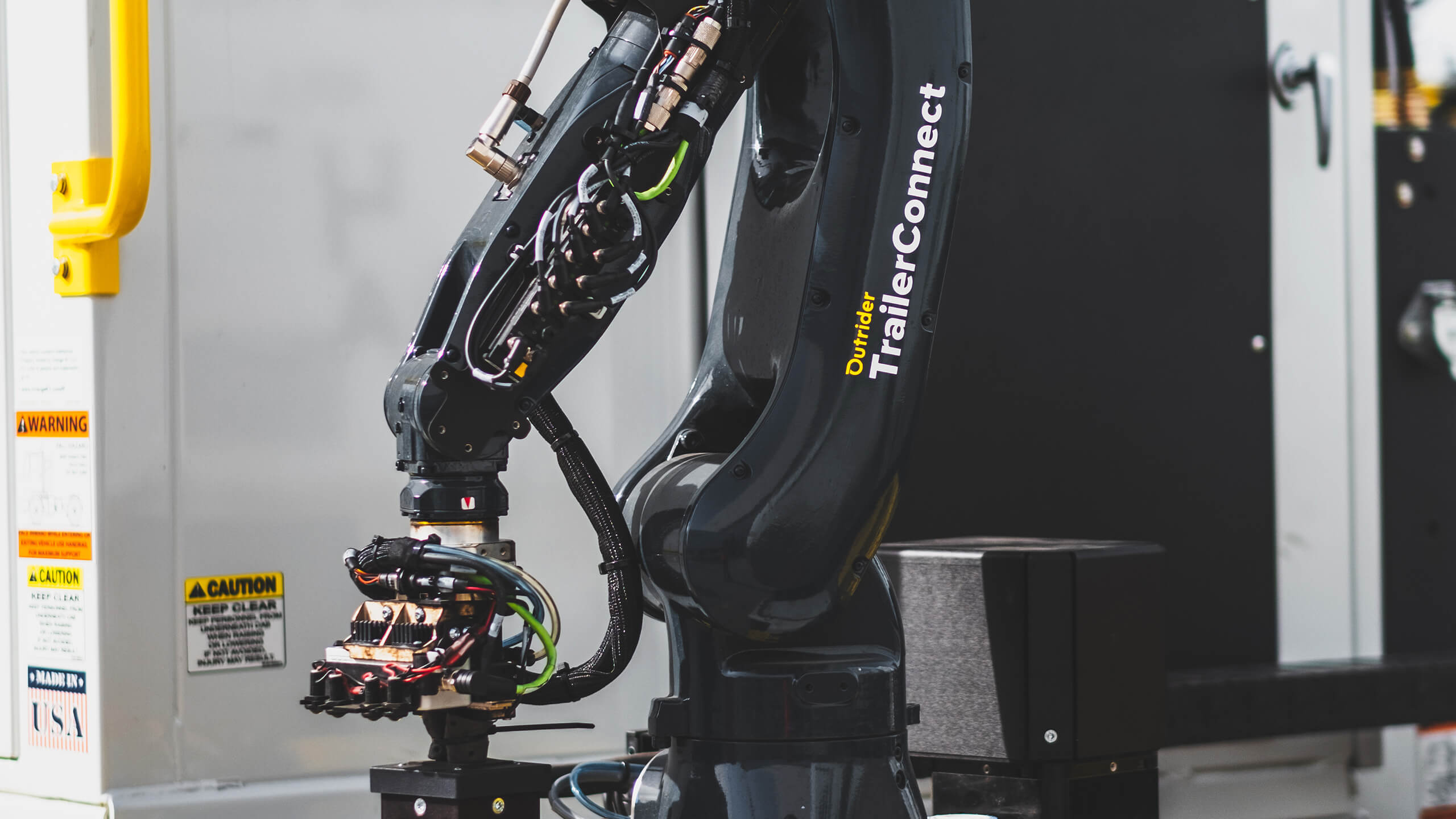
“It is not hard to create a driverless demonstration. It is a major technical undertaking to design an 80,000-pound robot that operates amongst over-the-road trucks, delivery trucks, and warehouse personnel.”Andrew Smith, founder and CEO
What failed first was the easy story
Outrider has not published a tidy postmortem of a product failure. It has published something more revealing: the assumption it rejected. The company wrote that it could not simply “throw some sensors and actuation on a yard truck” and call the yard automated. The vehicle had to become one component in a three-part system - autonomous machines, management software and site infrastructure. That shift from clever truck to managed operation shaped the business.
Smith arrived with a useful scar. His previous company, ATDynamics, sold fuel-saving trailer aerodynamics and reached 500 customers in nine countries before EnPro Industries acquired it in 2015. He came away focused on the friction of adoption. Outrider’s electric-first stance was environmental, but it was also practical: electric platforms are easier to command electronically, maintain and charge automatically than diesel counterparts. Compatibility mattered just as much. The robots would use existing trailers and talk to existing enterprise systems through APIs.
That approach is expensive. Outrider has raised more than $250 million in equity: $65 million in a 2020 Series B, $73 million in a 2023 Series C and $62 million in a 2024 Series D, on top of its earlier rounds. Koch Disruptive Technologies, NEA, 8VC, FM Capital, Prologis Ventures and Nvidia’s NVentures are among its repeat backers. The money bought the unphotogenic essentials of industrial autonomy: perception, controls, patents, field deployments, safety engineering, cloud infrastructure and a 200,000-square-foot Colorado testing yard.
The price is private. The hurdle is not.
Outrider does not publish subscription prices. CMO Londonne Corder told Vision Systems Design that customers can see as much as 40 percent cost savings with a payback period under two years. Treat that as a vendor-side claim, not a universal law. A yard with constant moves, painful labor turnover and predictable lanes offers plenty of work for a robot. A lightly used site with improvised traffic, weak connectivity and no appetite for systems integration does not.
The copyable playbook - and its limits
Copy this: narrow the operating domain, own the whole ugly workflow, make new hardware work with what customers already have, integrate before asking people to change habits, and sell a measurable operational outcome rather than artificial intelligence by the pound.
Do not copy it blindly: the model weakens where move volume cannot support dedicated equipment, charging and communications are unreliable, trailer practices vary beyond a validated design, or site leadership will not standardize safety rules. Private property reduces regulatory exposure; it does not cancel physics.
The competitive set includes ISEE, Fernride, Forterra and HubPilot, plus the stubborn incumbent: a human-driven yard tractor with conventional yard-management software. Some rivals lean on remote operators; others bring infrastructure-based perception or partnerships with tractor makers. Outrider’s claim to distinction is breadth. It wants the complete trailer move, including hitching and line connection, orchestrated by one system on an electric-first platform. On-road autonomy companies such as Aurora, Kodiak and Gatik solve a neighboring problem, not the same one.
Customers are not buying a truck that happens to be clever. They are buying fewer missed moves, less hunting for trailers, steadier dock flow and less time with people working around heavy equipment in bad weather. The cloud layer matters because a dispatcher can coordinate manual and autonomous vehicles from the same operation, while live inventory replaces yesterday’s spreadsheet with the trailer’s current location. In this market, visibility is not a dashboard ornament. It is how a loading door knows what is coming next.
A robot enterprises can say yes to
By 2025, Outrider’s announcements sounded less like a robotics lab and more like an infrastructure vendor. Reinforcement-learning models trained on millions of yard-specific data points made route planning 10 times faster, the company said. Its functional-safety approach used 14 mechanisms to address more than 200,000 identified hazards, including redundant detection, fail-safe hardware and health monitoring. TÜV SÜD reviewed the approach against its autonomous-vehicle conformity framework. Outrider also received SOC 2 Type 2 certification after scrutiny of cloud software, APIs, backups and governance.
Then came support. The system can search for a misplaced trailer, hunt for an open space, monitor charge and maintenance intervals, and ask site personnel to clear debris. When the robot meets an edge case it cannot solve, specialists can diagnose it remotely. “Robots are very good at completing repetitive, manual tasks in inhospitable environments,” COO Bob Hall said. “Humans are good at solving edge cases.” It is a modest sentence with a mature division of labor.
This is also where the company’s culture claims meet the machine. Outrider talks about moving people away from hazardous, repetitive work, not removing human judgment from the operation. Its engineers span computer vision, motion planning, robotic manipulation, cloud software and functional safety. The work happens across simulation, the dedicated test yard and production sites, where rain, snow, pedestrians and unplanned objects expose the distance between a model and a shift.
The company did not make the autonomy problem small. It found the smallest version large enough to matter - then discovered every hidden task inside it.
The next move is commercial, not conceptual
Outrider said commissioning of its latest driverless trucks would begin with select enterprise customers in the second half of 2025, with commercial rollout supported in 2026 and orders being taken for later deployments. Its announced beachhead remains distribution centers serving package delivery, retail, e-commerce, consumer goods and manufacturing. Intermodal rail yards and ports sit beyond that. The company estimates autonomous yard and shuttle operations as a $64 billion global market, citing ABI Research.
The unanswered question is no longer whether a robot can pull a trailer across a yard. Outrider has done that more than 100,000 times. It is whether fleets of them can deliver boring, dependable uptime across hundreds of sites while producing enough savings to justify new vehicles, infrastructure and organizational change. That test favors companies obsessed with brake lines, cybersecurity audits and blocked parking spots. The yard may be contained, but the standard is still the one logistics has always imposed: the freight has to move.