A truck is a surprisingly awkward place to put a robot. It arrives at an angle. Daylight changes. Inside, the space narrows, and a pallet that looked cooperative from the loading dock becomes a small geometry problem. In a 2021 chemical-industry deployment, VisionNav Robotics described fitting 18 pallets into two rows inside a cargo space just 2.35 meters wide. The useful detail was how the forklift found its position: by combining vision with laser sensing.
- Autonomous forklifts move pallets, feed production lines, stack cages, and load trucks.
- Perception and fleet software connect the vehicle to the surrounding operation.
- The buying question: how often does someone have to come and help?
That is a good place to begin understanding this company. Warehouse automation has to accommodate objects and buildings already in use. A machine must judge where the load actually sits, make the pickup, and complete the handoff. VisionNav sells machinery for that everyday negotiation.
A warehouse measured in millimeters
Founded in 2016, VisionNav develops autonomous industrial vehicles using environmental perception, deep learning, and servo control. Think of these as three connected jobs: notice the surroundings, interpret them, and move the forks precisely enough to be useful. Navigation gets a vehicle to the neighborhood. Handling gets the pallet onto the shelf.
In the chemical-company case, truck positioning and changing outdoor light complicated loading. The company connected its central control system to the customer's warehouse software; a conveyor signal could trigger a forklift assignment. The vehicle also detected displaced goods and adjusted its operating position. The product was already bigger than the truck carrying the forks.
Two forklifts, three roller lines
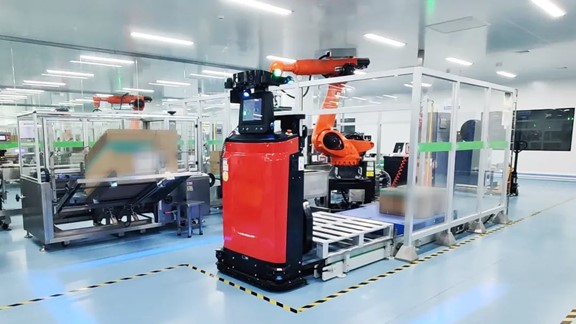
A May 2024 pharmaceutical case makes the arrangement tangible. An unnamed listed antibiotics manufacturer installed two VNSL14 autonomous pallet stackers, linked through RCS2.0 dispatch software to three roller lines. Their work covered raw materials, finished products, and empty pallets.
Workers verified material locations with handheld devices. Software dispatched a forklift to the feed point. After processing, the empty pallet went to collection; packaged goods moved from the conveyor to storage. People also checked empty-pallet placement and stack height. Human checks remained part of the automated workflow.
For a manufacturer, this is a practical entry point: a repeatable journey with identifiable beginnings, endings, and exceptions. The lessons are transferable. Map the entire loop, including the empty carrier. Decide who confirms readiness. Connect dispatch to the process that actually needs the material.
the material
the vehicle
the load
the pallet
The second attempt is the product
In May 2026, VisionNav announced a precision-stacking configuration for cages up to 8.8 feet wide, weighing up to 6,150 pounds, at heights up to 22 feet. These are vendor specifications for that configuration. Its more interesting feature has a modest name: Smart Retry.
When the system detects misalignment or an unsuitable post position, it can abort and retry without waiting for an operator. The announcement also describes protection that responds to load dimensions and turning geometry, plus detection of other forklift forks. As sales director Ahmad Stokes put it, “automation doesn't happen in isolation.”
“Automation doesn't happen in isolation.”Ahmad Stokes, VisionNav Robotics · May 2026
The economic implication is straightforward. Every recoverable interruption that summons a person consumes attention elsewhere. An illustrative calculation makes that visible: 100 interventions lasting five minutes each require eight hours and twenty minutes of human time. Those are hypothetical inputs, not measured VisionNav results.
The fleet has to agree
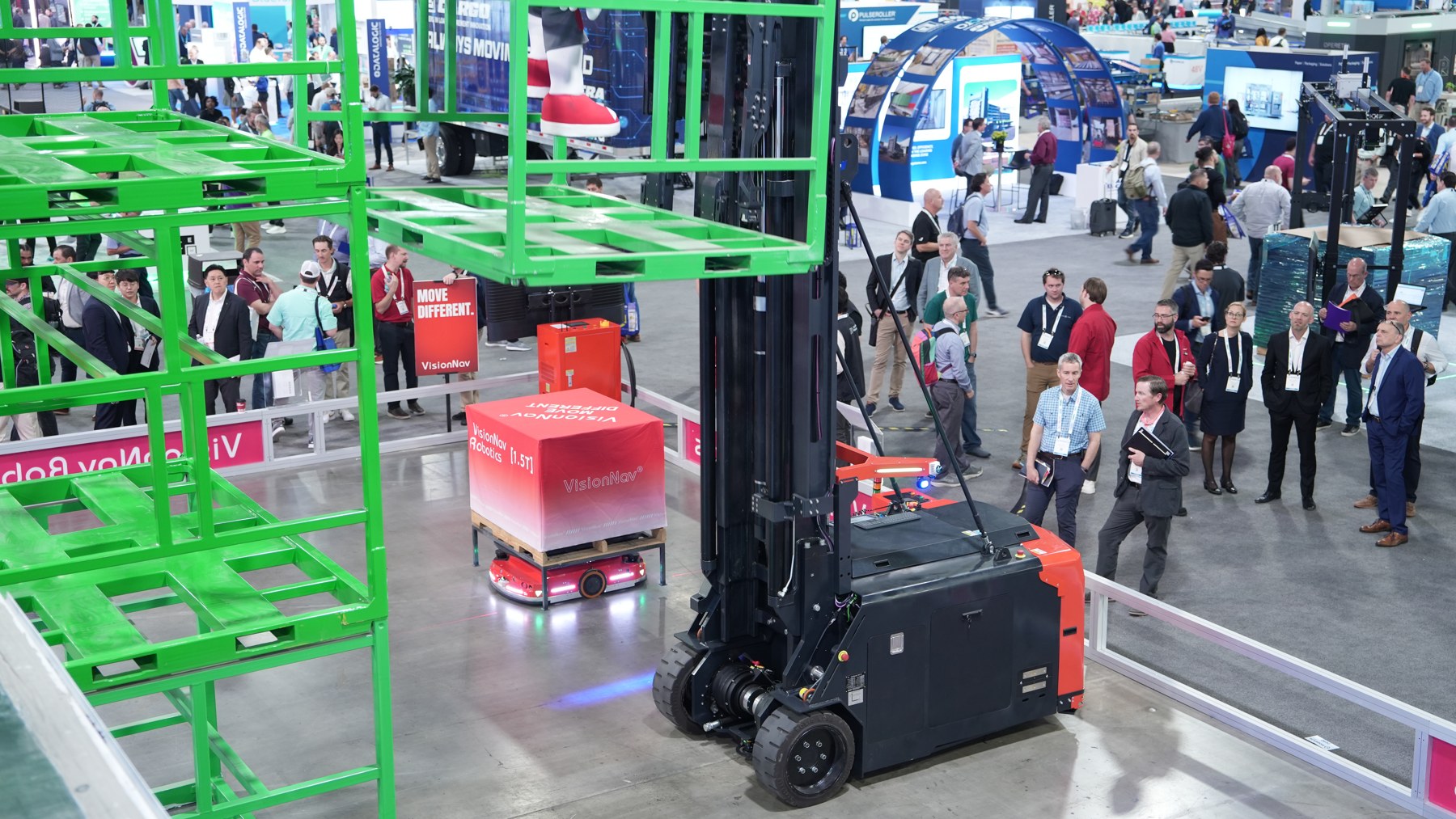
VisionNav's range includes counterbalance stackers, reach trucks, pallet jacks, tuggers, and mobile robots. Its customers operate factories and warehouses in automotive, food, chemicals, pharmaceuticals, and third-party logistics. The current company overview reports more than 800 projects across over 30 countries.
Different jobs need different machines. A reach truck serves a different purpose from a tractor pulling materials. The RCS software coordinates tasks, locations, vehicle status, and exceptions. That combination places VisionNav in industrial material handling, alongside autonomous forklift suppliers assessed by ABI Research, including BALYO, Seegrid, and Vecna Robotics.
Its competitive proposition is the combination of handling variety, perception, and orchestration. Buyers should test that combination against their own loads and interfaces. A long product list becomes useful only when the vehicles and surrounding equipment can complete work together.
Money for the unglamorous work
VisionNav announced a $50 million Series C in September 2021, followed by a Series C extension of more than $80 million in April 2022 led by Meituan and 5Y Capital. The extension's stated priorities included stability, standardization, and localized delivery. Those priorities describe the distance between a working machine and a repeatable installation.
The commercial model combines vehicles, control software, integration, and lifecycle services. Partnerships help deliver it: Convergix and BlueSkye agreements were announced in 2024; a September 2026 announcement added Texas warehouse-solutions supplier HTX Material Handling. Installation and service capacity belong in the product discussion because customers must keep production moving after commissioning.
Buy the shift, not the demonstration
The useful test starts with awkward particulars. Ask a supplier to handle your carriers, show an offset pickup, report unsuccessful missions, and explain recovery. Specify the conveyor interfaces and the person responsible when an exception exceeds the system's limits.
Then check the physical fit. VisionNav's VNR16 specifications explicitly note that taller masts, attachments, and load dimensions can reduce capacity. The inference for buyers is plain: demanding lifts, incompatible carriers, constrained aisles, or frequent interventions can undermine the case. Measure completed work across a representative shift.
In guidance published in October 2026, VisionNav widened the return-on-investment discussion to include injuries, training, retention, and workforce development. These categories make a useful worksheet. Record the operation's actual costs before estimating benefits. Include training for people supervising the new system, too. Moving someone away from repetitive driving creates another assignment; the business case depends partly on whether that assignment produces useful work. Savings need to survive comparison with what happened on the floor.
Build the budget around vehicles, integration, commissioning, support, and the human work that remains. A second attempt is useful when it finishes the job. The warehouse manager still has to count how many jobs get finished.
Watch the forks work
Explore the machines, the operating details, and the demonstrations.