Orazio Pater had a useful joke about the speed of success. He described GTreasury as an overnight success that had taken 32 years. In software, where a product can be declared obsolete before the office furniture arrives, that is an unusually patient punchline. It also gives his career a better starting point than the billion-dollar transaction that eventually attached itself to the company he co-founded.
Start earlier. Start with a cash manager at Honeywell, a job in which money had to be accounted for before it could become anybody’s growth strategy. Pater helped develop an early automated treasury management system there. He later led National Data Corporation’s cash-management division. Only after those chapters did he and his wife, Peg, establish Gateway Systems in 1986. The business became GTreasury.
There is something pleasingly practical about this sequence. The customer’s problem came first; the company came later. A treasurer needs to know what money is available, where it sits and what demands are about to arrive. An impressive computer is welcome. A dependable answer is more useful.
The cash manager before the company
Pater’s Honeywell years ran from 1969 to 1974. His work on treasury automation belonged to a period before a personal computer on every desk could be taken for granted. Software for managing corporate money had to operate within the computing arrangements of the time. The work nevertheless addressed a recognisable need: making financial information usable by the people responsible for cash.
From late 1974 to 1984, he led the cash-management division at National Data Corporation. Its treasury systems reached more than 12,000 corporations worldwide through time-sharing and data-exchange services. That places a substantial operating chapter between the Honeywell work and the founding of Gateway. Pater arrived at his own business with experience of both the treasury function and a service used far beyond one corporate department.
Time-sharing carries the faint atmosphere of a museum label now. In its day, it was a way to make computing available without requiring every customer to own the whole machine. Pater’s career spans that arrangement and the later expectation that software should be accessible through the cloud. The underlying question survived the change of address.
Honeywell cash management. A company of his own. A handover to the next CEO.
Two founders, and a machine that kept changing
Gateway Systems began with Orazio and Peg Pater. He became CEO; she served as general manager. Both names belong in the origin. A company that sells systems to organise other people’s operations also has operations of its own, and the general manager’s title deserves to remain visible beside the chief executive’s.
The first Gateway system went to American Express Bank in Europe in 1986. The company adopted the GTreasury name in 2008. Those two details put useful distance between the beginning of the business and the name by which it became known. They also give its international history an early marker, well before the later investment announcements.
The software travelled through MS-DOS, Windows client-server architecture and cloud delivery. Each stage changed how a customer encountered the product. The long continuity was treasury work. Pater’s professional biography follows that sequence from his early cash-management roles to the business he founded, making the technology changes part of a working career rather than a parade of fashionable labels.
For a software founder, such a history creates an awkward balancing act. Customers buy a system because it can do a job reliably. Computing changes, and the reliable system must change with it. Stand still for long enough and reliability starts to look like age. Change carelessly and a customer has a more immediate complaint.
- 1969-74Honeywell
Cash management and early automation - 1974-84National Data Corporation
Cash-management division leadership - 1986Gateway Systems
Orazio and Peg co-found the business - 2019GTreasury succession
CEO role passes to Renaat Ver Eecke
What the $42 million was for
In October 2017, GTreasury announced a $42 million investment from Mainsail Partners. The business was already more than three decades old. The stated uses of the capital were product development, international expansion and customer service. Pater described a partnership intended to help the company grow while preserving its close relationships with clients.
That last ambition is easy to applaud and difficult to organise. More customers mean more demands on the people who implement and support a product. International expansion adds geography to the problem. GTreasury had also announced its first international office, in London. Growth was becoming a question of how to serve a wider business, as well as how to sell to it.
The product was embedded in consequential work: cash management, funds transfers, accounting, banking relationships and financial instruments. These are the jobs that make a customer’s request for dependable service entirely reasonable. A treasury system may attract attention with an attractive dashboard. Its users still need the balances and transactions behind that dashboard to make sense.
“We are very much a client-driven organization.”
Orazio Pater
Pater’s description of client influence on the product gives a more concrete meaning to that sentence. Customers helped shape the roadmap. In a field built around recurring operational tasks, listening can become part of product development. The interesting question is whether the requests turn into work that makes the next day easier.
Cash acquired a risk partner
In April 2018, GTreasury acquired Sydney-based Visual Risk. Cash management and financial risk management were being brought together. Pater discussed the integration alongside colleagues Terry Beadle and Alok Tyagi later that year. The ambition was a combined system, with the convenience of cloud delivery and the capabilities treasury teams needed across their work.
Beadle’s explanation was practical: separate cash and risk systems can leave a team maintaining two sets of information and spending time reconciling them. Combining the work promised a more coherent view. Pater, meanwhile, emphasised investment in senior people and the importance of service during integration. Acquiring software was only one part of making the combination useful.
He also appeared with Tyagi in a May 2018 video discussion of the integrated treasury and risk-management approach. Their presentation covered a single solution, a modern software delivery process and continuous development. It is a useful glimpse of Pater’s business at a particular moment: a long-established cash-management company explaining how it intended to broaden its offering.
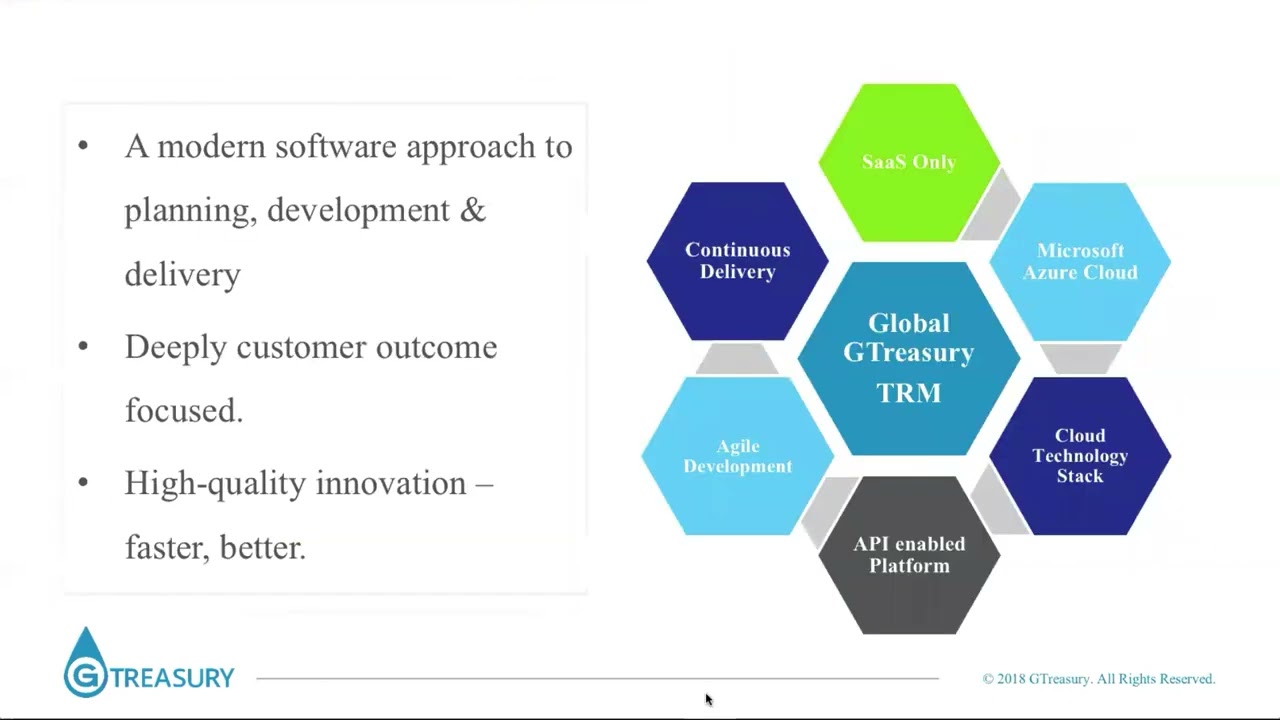
The expansion required people who could explain the new capabilities as well as build them. In August 2018, GTreasury announced risk specialist Peter Seward as vice president of market development, risk. Pater welcomed his combination of treasury knowledge and SaaS experience. The appointment makes the integration story more tangible: the company was adding expertise around the product it had bought.
A founder makes room for a successor
On January 21, 2019, GTreasury announced Renaat Ver Eecke as its new CEO. Pater retired from that role and became executive chairman. The handover followed an eighteen-month succession programme that included investment, senior hiring, Visual Risk and the combined treasury and risk offering.
The company reported 64% year-over-year revenue growth for 2018. It was a busy moment to pass the job on. Pater expressed confidence in Ver Eecke’s ability to lead both the software business and its service operation. His comments returned to client needs, the same concern that had accompanied the growth investment.
Ver Eecke brought experience leading a global SaaS business at Teletrac Navman. He identified scaling and customer service as linked priorities. Early demand for the integrated product was encouraging: after its beta phase, 90% of new clients signed up for both cash and risk functionality. The combined proposition was moving from an integration plan to something customers were choosing.
There is a temptation to treat a founder’s exit from the CEO role as a full stop. Here it works better as a change in authorship. Pater had helped build the business and prepare the transition. The decisions that followed belonged to a company with a new chief executive.
The company’s next chapter has different signatures
Hg announced a majority investment in GTreasury in May 2023, with management and Mainsail continuing as investors. The announced priorities included further product development and geographic expansion. In October 2025, Ripple announced a $1 billion acquisition; by December, Ripple confirmed that the transaction had closed.
The business now operates as Ripple Treasury. In April 2026, it launched Digital Asset Accounts and Unified Treasury, bringing digital and traditional liquidity into the same system. September brought expanded GSmart AI capabilities, with financial calculations handled by deterministic engines and proposed financial actions subject to human approval. These are later company developments, after Pater’s CEO tenure.
Read backwards from those announcements and the early cash manager’s work acquires a particular resonance. The assets and interfaces have changed. The desire to see a dependable financial position remains familiar. Pater’s career offers a long view of that problem: first encountered inside a treasury function, then pursued through a service business, a founding partnership and successive generations of software.
The joke about overnight success survives because the calendar is so plainly in on it.