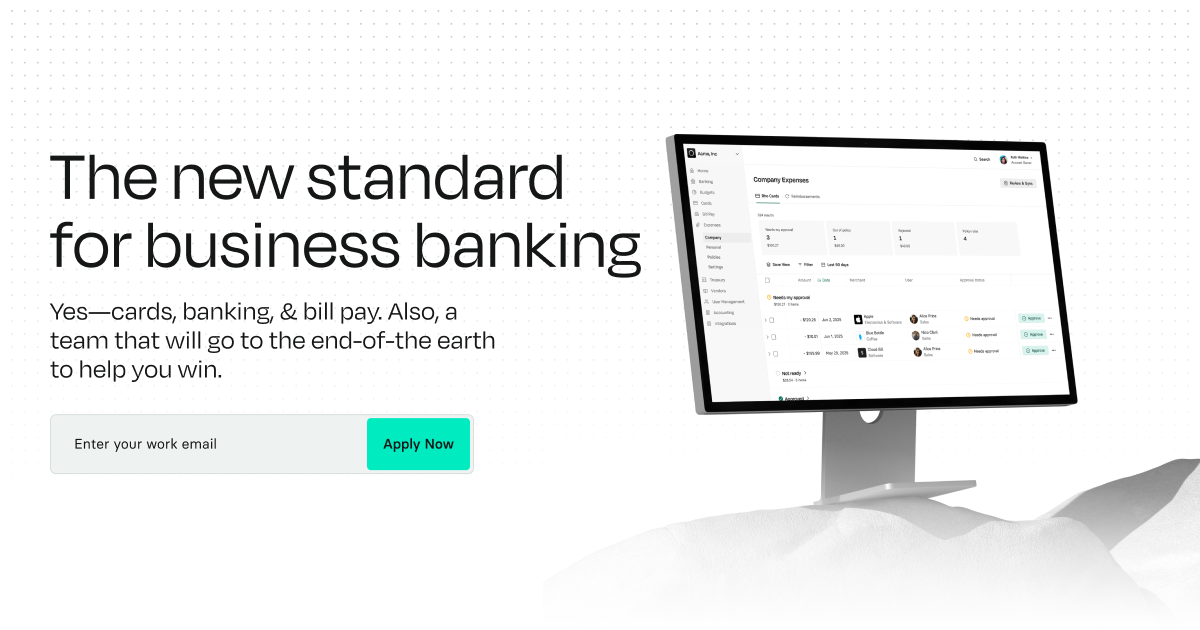
One login. The whole money stack.
A finance lead at a 60-person startup opens a laptop on a Tuesday morning. There is one tab. Inside it: the checking balance, the corporate cards, the cash earning yield in treasury, the stack of vendor invoices waiting on approval, and last month's expenses already matched to the accounting ledger. No spreadsheet bridge. No three-bank login routine. No "let me export a CSV and get back to you."
That tab is Rho. The company calls it a financial operating system, which sounds like the kind of phrase a marketing team workshops on a Friday. But strip the jargon and the claim is concrete: the things a growing business does with money - hold it, spend it, grow it, pay with it, and account for it - should live in one place, and they should not cost a monthly fee to use.
Banking built for everyone except the people running a company
Here is the unglamorous truth about business finance: it is mostly busywork. Reconciling cards by hand. Chasing approvals over email. Logging into one portal for deposits, another for cards, a third for bill pay, and a fourth for whatever the treasury desk uses. Each tool was built in a different decade by a different vendor, and none of them was built to talk to the others.
The legacy banks were not exactly racing to fix this. Why would they? A hundred-year-old commercial bank makes money whether or not the founder enjoys the experience. The fees were quiet, the software was old, and the customer had nowhere better to go.
Everett Cook and Alex Wheldon had lived it. They built the platform they wished they had when they were running their own companies - which is the kind of origin story that sounds like a cliche until you realize most finance software is built by people who have never had to close a month-end.
A Wall Street alum, a serial founder, and a category that didn't exist
Everett Cook came from Point72 and Deutsche Bank - a proper Wall Street resume. But the more telling line on it is from earlier: at 18, he produced the first hip-hop concert at Lincoln Center and talked Jay-Z into performing. That particular brand of nerve - convincing an institution to do something it had never done - turns out to be useful when you decide to challenge century-old banks.
Alex Wheldon, the British-Canadian co-founder who serves as President and Chief Product Officer, had already founded four startups, three of which were acquired. Damian Kimmelman rounds out the founding group. Together, in 2018, they made a bet that sounds obvious now and sounded reckless then: that businesses would switch financial providers if someone finally made the whole stack work as one product.
Everett Cook
Co-Founder & CEO. Former Point72 and Deutsche Bank. Once convinced Jay-Z to play Lincoln Center - at eighteen.
Alex Wheldon
Co-Founder, President & CPO. Serial entrepreneur, four startups, three exits. Owns the product vision.
What you can actually do with it
Rho is not a bank. It is software that sits on top of FDIC-insured partner banks like Webster Bank and card networks like Mastercard. That distinction matters more than it sounds - it is what lets Rho offer fee-free accounts and spread deposits across multiple banks for up to $75M in FDIC coverage. When one bank has a very bad week, that arithmetic becomes a selling point.
Banking
Fee-free, FDIC-insured checking and savings through partner banks. No monthly fees, no ACH fees.
Corporate Cards
Physical and virtual cards with spend controls, real-time tracking, and policies baked in.
Treasury
Put idle cash to work in treasury products like T-bills and money market funds.
AP Automation
AI scans invoices, routes approvals, reconciles, and pays bills - then syncs to your books.
The AI piece, launched in 2023, is the part finance teams quietly love: scan an invoice, let the system route it for approval, move the money, and watch it reconcile against the ledger automatically. It is the difference between a finance team that does the work and a finance team that reviews it.
The Rho milestone reel
The receipts: funding, partners, and a very bad week for a competitor
The clearest evidence that Rho's bet was sound arrived uninvited. In March 2023, Silicon Valley Bank failed, and a generation of startups discovered their treasury strategy had a single point of failure. Rho's pitch - deposits spread across partner banks, up to $75M in FDIC coverage - suddenly read less like a feature and more like a fire exit. New customers followed.
Funding by round
The investor roster - Dragoneer, DFJ Growth, M13, Inspired Capital, Torch Capital - is the sort that does diligence. And the partnerships tell their own story: Webster Bank for deposits, Mastercard for cards, and in 2026, Stripe. Rho was also the first member of the Coalition for Financial Ecosystem Standards, an industry group later joined by Stripe, Block, and Mercury - which is a polite way of saying competitors followed Rho to the table.
Less busywork, more profit
Rho's stated mission is almost suspiciously plain: free businesses from finance busywork so they can be more profitable. There is no talk of disrupting civilization or reinventing money. The ambition is narrower and, frankly, more honest - take the hours a finance team loses to reconciliation and approvals and chasing logins, and hand them back.
That is also the harder thing to build. Anyone can open another bank account. Making banking, cards, treasury, and accounts payable behave like a single product - one that actually closes the books - requires the unsexy work of integration that legacy providers never bothered to do.
Things that are true and slightly fun
- CEO Everett Cook produced the first hip-hop concert at Lincoln Center at age 18 - and got Jay-Z to perform.
- Co-founder Alex Wheldon has founded four startups; three were acquired.
- Rho is not a bank. It is software that partners with banks - a distinction its lawyers care about deeply.
- The $75M FDIC figure comes from spreading deposits across many partner banks, not from one very generous one.
- Rho was first to a standards coalition that Stripe, Block, and Mercury later joined.
The Tuesday morning, redrawn
Go back to that finance lead on a Tuesday morning. A decade ago the laptop would have had a browser full of tabs, a spreadsheet acting as duct tape, and an inbox full of approval requests. The work was real, but most of it was the work of moving information from one system that couldn't talk to another.
Now there is one tab. The invoices route themselves, the cards reconcile themselves, the cash earns yield without a phone call, and the books are closer to closed than they were yesterday. The finance lead is not doing less important work - they are doing the important work, because the busywork got automated out from under them.
That is the whole bet, and it is a quiet one. Rho is not promising to change what money is. It is promising that running a company's money should take a morning, not a week. In a market full of louder claims, betting on "boring, but it actually works" might be the most contrarian move of all.