On Monday, the cash forecast began. On Thursday, the chief financial officer received it. At Peak Toolworks, a manufacturer of cutting tools, the finance team spent five hours a week reconciling cash and assembling a 13-week forecast. The spreadsheet did its job. Unfortunately, so did everyone required to feed it.
That interval is a useful way into GTreasury. Treasury software sounds like something purchased by people who enjoy purchasing treasury software. Its appeal is easier to understand when a report consumes the opening days of the week it is supposed to illuminate. Money moves; the picture of the money arrives later. A CFO can have a perfectly respectable spreadsheet and a distinctly imperfect view.
- The work: connect bank and business-system data, forecast cash, control payments and manage financial exposures.
- The deal: Ripple announced a $1 billion purchase of GTreasury in October 2025. The business now operates as Ripple Treasury.
- The useful lesson: automate one expensive reporting chore before shopping for an entire finance transformation.
A Thursday answer to a Monday question
Peak’s cloud-based forecasting project brought weekly reconciliation and forecast preparation down to at most an hour. Its CFO, Ben Stilwell, reported receiving the forecast by the end of the first business day rather than the fourth. The process covered more than 30 reporting entities. Those are customer-reported results, rather than a promise to every buyer, but they identify the product’s appeal: a smaller gap between collecting information and using it.
“Our old process was very manual and time consuming as it was entirely excel-based.”
Lisa Ngo, accountant, Peak Toolworks

The attraction here is wonderfully unromantic. A company does not need a more beautiful bank statement. It needs to know which balances belong to which entities, how those balances compare with expectations, and whether upcoming payments will leave enough room to breathe. GTreasury packages that work into software for CFOs, treasury departments and accounting teams.
Two people. More than 200 accounts.
Waterton, the Chicago real-estate investment and property management business, offers a second view. Two treasury employees managed more than 200 accounts and as many as 12 bank relationships. Their existing portal served one bank. They wanted a wider picture and a rolling 12-month forecast.
Waterton selected cash-management and forecasting modules, linked accounting data into the process, and reported roughly 90% less information-gathering time from a baseline of about ten hours a month. Its buying decision matters as much as the percentage: the team chose capabilities it needed, keeping the purchase bounded. A single-bank tool had become too narrow; a complete suite was more than the team wanted to buy.
For a prospective customer, that is an excellent place to begin. Count the portals. Count the files. Time the reconciliation. Identify the report that repeatedly arrives too late. These are editorial recommendations drawn from the customer examples, and they make a better buying brief than a wish list of every feature anyone has ever demonstrated.
The man who knew the problem before the cloud
GTreasury’s origins help explain its preoccupation with the details. Orazio and Peg Pater co-founded the business in 1986. Orazio had previously been a cash manager at Honeywell and led National Data Corporation’s cash-management division. Gateway Systems, the original business, offered an MS-DOS product, then moved through Windows client-server software to cloud delivery.
The interesting continuity is the work itself. Interfaces changed. Distribution changed. Corporate cash still had to be found, organized and accounted for. The founder had encountered that problem from inside a treasury function, long before “fintech” became a convenient answer to the question of what industry a company occupied.
The expansion came in stages. A $42 million Mainsail Partners investment was announced in 2017 to support product development, international growth and customer service. In 2018, GTreasury acquired Australia’s Visual Risk, bringing specialist risk capabilities together with cash management. Renaat Ver Eecke became CEO in 2019 as Orazio moved to executive chairman. Hg took a majority stake in 2023, with Mainsail and management continuing as investors.
Capital invested to develop a company and consideration paid to acquire it belong in separate columns.
A suite you can enter through one door
GTreasury sits in the enterprise treasury-management market. Its modular SaaS model allows customers to select parts of a broader system: cash visibility and liquidity planning, forecasting, payments, financial instruments, risk management, hedge accounting and intercompany netting. Implementation and support accompany the software. Waterton’s experience illustrates how that modular approach can affect the buying decision.
The specialists accumulated around it tell their own story. Visual Risk strengthened risk analytics. CashAnalytics, acquired in September 2024, added forecasting and receivables/payables analysis. Coprocess is associated with its netting offering, which helps groups settle obligations between subsidiaries with fewer transfers. Solvexia, acquired in January 2026, extended reconciliation and regulatory-reporting automation.
Underneath those applications sits connectivity. ClearConnect links banks, ERP systems and other providers. The published partner network includes Swift, J.P. Morgan, Goldman Sachs and BNY Mellon; integrations range from account-balance retrieval to investment workflows. The bank feed is a humble thing to celebrate, but a forecast is difficult to trust when assembling yesterday’s cash position remains today’s principal occupation.
Bring bank balances, transactions and ERP data into a common treasury view. Confirm that the feed covers the accounts you actually use.
Illustrative buying workflow, not a product implementation guarantee.Competitors occupy much of the same territory. Kyriba provides liquidity and treasury tools. ION’s Reval combines cash, payments, risk and accounting capabilities. GTreasury’s positioning rests on modular adoption, its collection of specialist tools and, now, access to Ripple’s digital-asset infrastructure. A sensible comparison would test those differences against actual bank coverage, financial instruments and reporting needs. A long feature list alone settles very little.
What Ripple bought for a billion dollars
Ripple announced its $1 billion acquisition on October 16, 2025, and subsequently described the deal as closed. The acquisition disclosures put GTreasury’s reach at more than 1,000 customers across 160 countries. The current website calls the business Ripple Treasury and says existing tools, workflows and service relationships carry forward.
The strategic interpretation is straightforward: Ripple acquired an established place inside corporate finance. A treasury system is where teams observe balances, plan funding and administer financial controls. Connecting digital-asset infrastructure to that environment gives it a familiar operating context. Whether a customer should use a particular digital asset remains a separate decision.
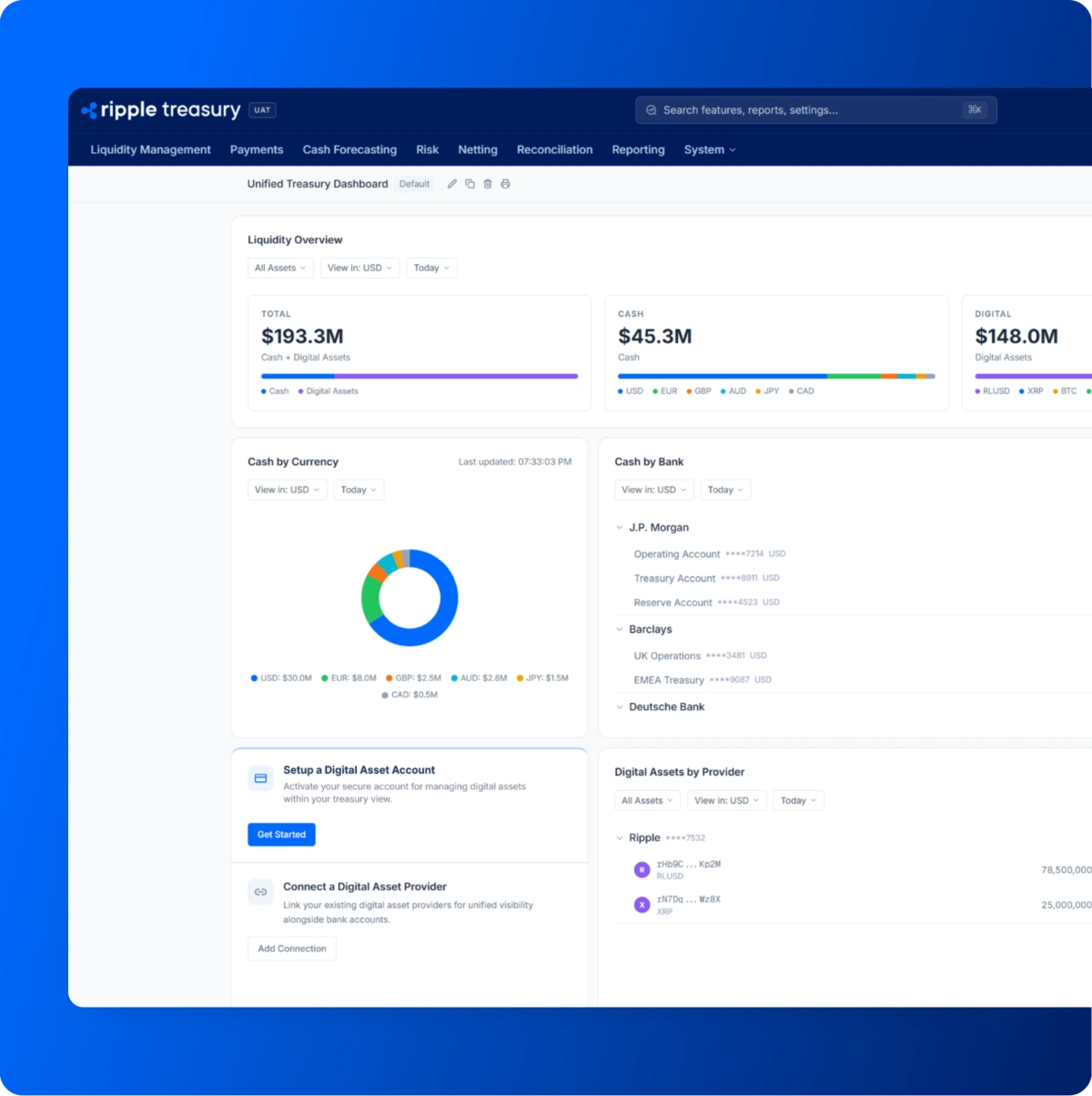
In April 2026, Ripple launched Digital Asset Accounts and Unified Treasury. The features bring digital holdings and fiat liquidity into the same treasury environment, with transaction records and valuation. Ripple reported $13 trillion in customer payment volume for 2025. That figure describes financial activity facilitated for customers; it is not the software company’s revenue.
There are practical boundaries. Ripple says product and service availability varies by geography. Its April announcement also described further settlement and yield capabilities as forthcoming. Seeing assets together, moving them and earning on them are separate capabilities. Buyers should check the specific service available to their legal entities rather than treating the whole roadmap as delivered.
The AI has to wait its turn
GSmart launched in June 2025. Its September 2026 expansion makes a revealing distinction: deterministic engines perform financial calculations, while AI interprets policy, identifies patterns and explains recommendations. Agents propose actions and cite the policy behind them. Treasury teams retain approval authority over every financial action.
Knowledge Studio supplies the policy layer; Analytics Studio includes the Ask GSmart assistant. Ripple reported that 60% of eligible customers had enabled Risk Insights and 44% were using Forecast Insights. Those are adoption figures for eligible customers, rather than percentages of the entire customer base or evidence of a universal financial return.
The copyable idea is a design principle: make the calculation dependable, make the recommendation explainable, and make responsibility explicit. It applies beyond treasury. A system entrusted with consequential work should allow the person approving it to understand what is being proposed and why.
The earlier customer stories supply the other half of that principle. Automation needs usable source data, a defined reporting process and people who maintain it. For a business with one bank and simple cash needs, the coordination benefit may be modest. For a small team juggling many entities and accounts, the hours spent gathering information provide a concrete case to investigate. GTreasury’s long career has been built around that arithmetic. The new name adds possibilities; the old question still earns its keep: where is our money, and what can we safely do with it?