The first product covered three California cities. It estimated what an earthquake might cost and arrived at customers’ offices on 17 five-and-a-quarter-inch floppy disks. Its name was IRIS, and its maker was Risk Management Solutions, or RMS. The disks are now museum material. The question on them has become more urgent: when the ground moves, the river rises or a shared computer network fails, who pays, and how much?
The short version
- RMS sells models, data and cloud software that estimate losses from disasters and other severe risks.
- Its customers are insurers, reinsurers, brokers and other institutions with large exposures to protect.
- The company’s earliest consumer product failed; paid work with insurers revealed the repeatable business.
- Moody’s bought RMS for about $2 billion in 2021. Its products now carry the Moody’s RMS name.
A fax machine is a poor business model
The idea came out of Stanford earthquake research. Hemant Shah, an engineering student, developed a business plan in a class; his father Haresh Shah’s seismic research helped give it scientific footing. Hemant and fellow researcher Weimin Dong built the early company from an apartment. In a 2014 Stanford talk, Shah recalled patching Dong into customer calls so the tiny operation sounded more like a firm with departments. He also described asking one prospective client to advance travel money for a demonstration, refundable against a purchase.
An early attempt to sell $100 earthquake reports to Palo Alto homeowners was instructive. Customers faxed details of their houses; staff entered the information and assembled reports by hand. It was laborious, and Shah later called the experiment “a complete disaster.” The insurer, by contrast, had thousands of buildings, repeated decisions and money at stake every time a policy was written. RMS spent days inside customers’ offices learning what data underwriters collected and how they used it. This was the valuable part of the small company’s consulting work: each engagement taught the team what its software had to do.
That intimacy created a second problem. By the early 1990s, Shah recalled roughly 22 or 23 paying clients and about 23 or 24 software versions. A tailored answer pleased a customer but multiplied the engineering burden. Around 1993, RMS raised about $3 million in venture capital and brought in experienced management. The roadmap widened from California earthquakes to natural hazards across countries, and from a single insurance task to several kinds of exposure.
“A complete disaster.”Hemant Shah, on the $100 homeowner report
The valuable unit was a decision
A catastrophe model does not claim to know which hurricane will hit next Tuesday. It combines possible events, local hazard, a building’s vulnerability and the financial terms of its insurance. The result is a distribution of possible losses. An underwriter can use it to price a policy; a reinsurer can decide how much risk to accept; a portfolio manager can see whether too many insured buildings sit in one floodplain.
The output can be an exceedance probability curve: a line showing the chance that losses pass a given amount in a year. It is an awkward phrase for a useful object. In his Stanford talk, Shah used an example with a 1% annual chance of losses reaching $200 million or more. That is not a promise of accuracy to the dollar. It is a way to compare what might happen with what an institution can afford.
After Hurricane Sandy flooded New York’s subway system, RMS analyzed storm surge exposure to help the Metropolitan Transportation Authority structure a catastrophe bond. The model helped translate a physical danger into a trigger investors could price. It is an unusually literal example of the company’s trade: moving disaster risk from infrastructure accounts to capital markets.
The subscription bought time to improve the science
RMS first imagined selling software for roughly $15,000 to $25,000, then charging maintenance. It changed to annual licenses for its models and analytics. That suited a product which had to be revised as better data arrived and new hazards entered the catalogue. In 2014, Shah described a business serving hundreds of institutional customers, with some consulting alongside the subscriptions. Moody’s projected roughly $320 million in RMS revenue for fiscal 2021 when it announced the acquisition.
The most interesting cost was not the early flight to an East Coast prospect. It was the continuing expense of being current. Catastrophe models need hazard science, engineering, exposure data and enough computing power to run many simulated events. Customers also need to know what assumptions sit under the number. A cheaper black box can be an expensive bargain when a reinsurer must defend a decision after the storm.
The model learned to share the stage
RMS had another moment of dangerous comfort. By the late 1990s, it had grown to around $30 million in annual revenue, and its leaders thought the specialty market might be maturing. It sold to Daily Mail and General Trust. Shah later argued that the ceiling was partly imaginary. The team expanded into more places, more perils and deeper work inside customers’ processes. By the end of the following decade, he said revenue had reached around $250 million.
Then the installed model itself began to look constraining. Huge analyses demanded huge compute capacity, and clients wanted faster workflows. RMS moved toward cloud delivery, a transition Shah described as technically expensive and culturally difficult. The current Intelligent Risk Platform houses Risk Modeler for catastrophe analysis, UnderwriteIQ for underwriting, TreatyIQ for reinsurance treaties and ExposureIQ for portfolio concentrations. It offers APIs and can run third-party and in-house models alongside Moody’s RMS models. Moody’s says Risk Modeler provides access to more than 700 models in all.
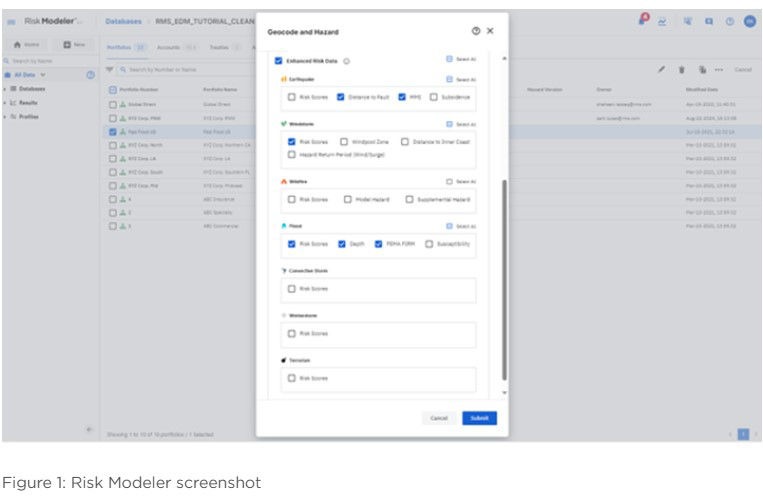
This openness is a practical distinction from a closed model catalogue. An insurer may need several views of the same peril, including its own. Tokio Marine HCC, a long-time RiskLink customer, moved toward the cloud product to reduce manual transfers and automate modeling steps. Howden’s HX Analytics integrated the platform into its own data environment. These examples also show the constraint: the product works best where a large organization has exposure data, modelers and decisions worth automating. It is not a $100 report for a single house.
Verisk’s Extreme Event Solutions, formerly AIR Worldwide, and other model vendors remain alternatives. That competition matters. A model is a set of assumptions, not an oracle. Different views can make an underwriter ask a better question about a coastal warehouse or a network outage. Moody’s RMS continues to update the answers: in 2026 it introduced Cyber Solutions Version 10.0, focused on how dependence on shared technology providers can concentrate losses, and previewed rebuilt hurricane and earthquake model suites.
A useful idea for anyone building expert software
RMS’s most portable lesson is its order of operations. Begin with a narrow, difficult problem. Get paid to watch experts use an imperfect answer. Notice where bespoke work stops teaching and starts trapping the team. Then build the common product. RMS did not discover a way to make uncertainty disappear. It built a business by making uncertainty legible enough for someone to act.