When Maggie Judge joined Sequoia Telehealth in the summer of 2020, the patients were doing their part. They were adopting remote patient monitoring. The care team, however, was struggling with its existing tool. Here was a peculiar kind of technological success: the information could travel, but the people receiving it could not comfortably put it to work.
- The job: connect home readings to clinical follow-up between appointments.
- The buyers: medical practices and larger healthcare organizations.
- The offer: software, connected devices and optional nurse-led services.
- The update: Optimize Health’s website now leads to Vivo Care.
That small mismatch is a useful way into Optimize Health. Remote care sounds like a question of distance. Its harder questions concern responsibility. Who reviews the readings? Who calls? Who documents the conversation? A blood pressure cuff can be admirably punctual. It cannot organize a practice.
First, a bottle. Then, a bigger question.
The business began in 2015 with Jeff LeBrun and Chuks Onwuneme and a narrower concern: getting people to take their medicine. Their product, Pillsy, was a smart pill bottle that chimed when a dose was due. It joined a familiar domestic object to software, giving medication adherence a digital trail.
By 2019, the founders were integrating other devices to understand the effects of adherence. Medicare’s expansion of remote monitoring reimbursement made a broader offering more attractive. The change was practical: there was now a payment route for providers doing some of this work. Optimize Health widened the business from remembering the pill to observing the patient.
The lesson is less romantic than the usual startup conversion story. A product direction can change because the customer’s economics change. The founders had experience with connected health; reimbursement helped make a larger job commercially plausible. Hardware supplied the observation. A provider still needed a workable system around it.
The alert was not the answer
At Sequoia, Optimize Health brought customizable patient information into one place. The company’s case study reports a 210% increase in patient billability two months after implementation. That is an operational result reported in a vendor case study, rather than a finding that every practice should expect.
“We’ve gone from chasing alerts in the previous RPM tool to calling our patients once a week”
Maggie Judge, RN · Sequoia Telehealth
Judge’s description is more revealing than the percentage. What failed first was the previous tool’s fit with the care team, even while patients were willing to participate. The change allowed more organized contact and coordination across clinicians. Her account turns the buying question around: can the staff use what the devices produce?
There is a distinction here between a measurement and a service. The measurement is a number at a moment. The service includes noticing a pattern, asking a question and routing the answer to the right person. A dashboard crowded with alerts can leave all that work waiting politely in a queue.
A software company with a nursing shift
Optimize Health sells to providers: physician practices, hospitals, health systems and organizations coordinating care across populations. Its current successor brand also names federally qualified health centers and value-based care groups. Primary care, cardiology and nephrology are among the specialties it addresses. These buyers need ongoing contact with patients whose conditions persist after the appointment ends.
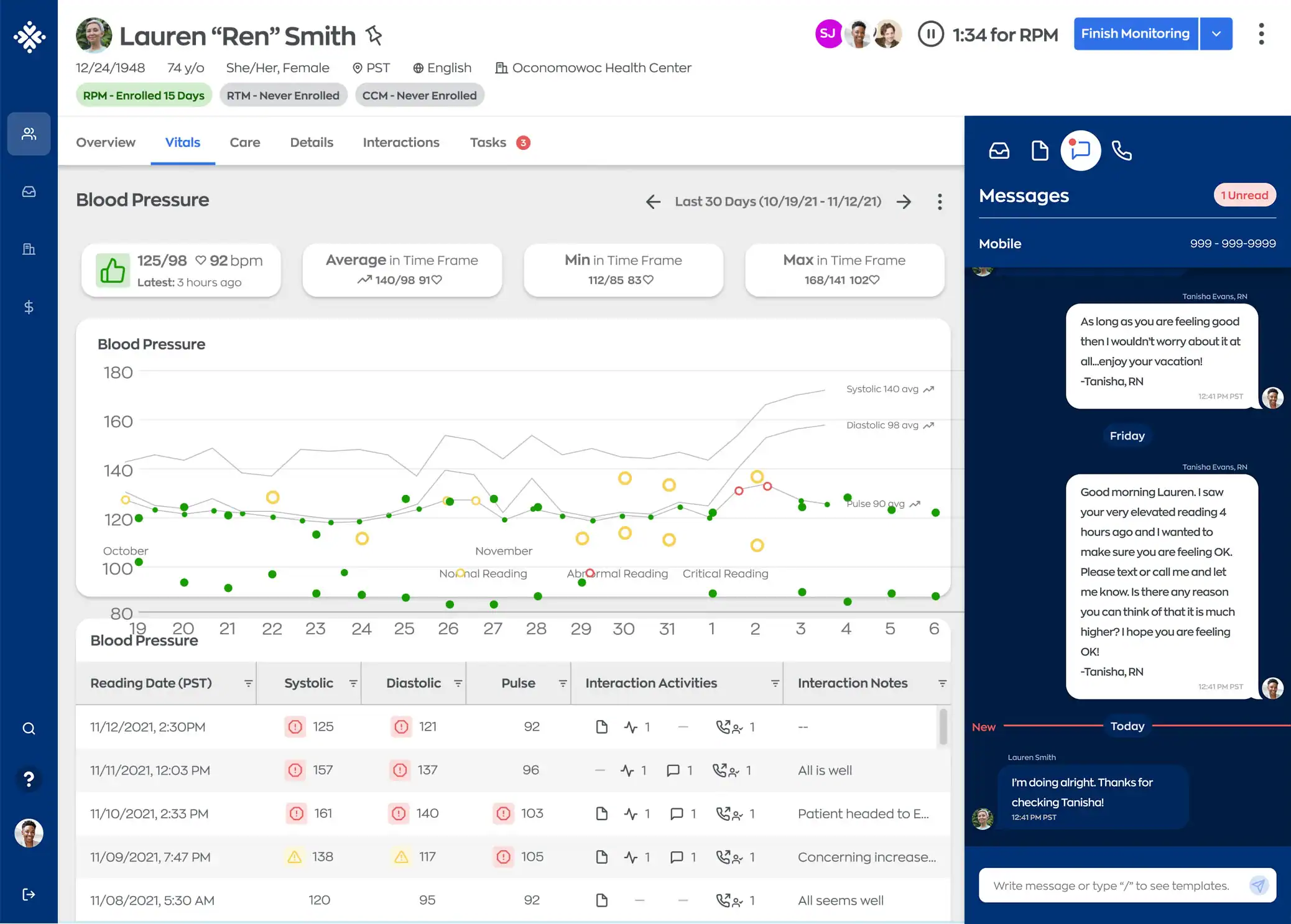
The offer has several connected parts. Devices send measurements such as blood pressure, glucose and weight. Software presents trends and threshold-based alerts. Clinical services can support identification, eligibility checks, shipping, onboarding and monitoring. A practice can keep work with its own staff or buy help with the work.
- 01Measure at home
- 02Transmit the reading
- 03Review the trend
- 04Contact the patient
- 05Escalate and document
Cellular devices reduce dependence on patients pairing equipment with a phone. That is a modest design choice with consequences for usability. The current platform also supports chronic care management, which includes care plans, coordination and documented engagement beyond collecting vital signs. The product stretches from the patient’s kitchen to the practice’s administrative desk.
Its nurse-led option makes the staffing proposition explicit. Kat Baker, Vivo Care’s clinical operations director, puts it plainly: “We act as an extension of the practice.” The expertise required spans software, clinical monitoring and the logistics of getting patients started. Each step can spoil the experience if handled badly.

HealthSnap offers integrated RPM and chronic care management too. Connected readings and reimbursement support therefore do not establish a monopoly on the idea. Optimize Health’s useful selling proposition is the combination of software and flexible clinical help. Buyers should compare staffing, integration and escalation arrangements as carefully as interface screenshots.
The bill has several authors
Remote monitoring consumes devices, setup effort, staff time and documentation. Optimize Health’s commercial model sells software and services to organizations delivering care. Reimbursement can support that investment, but coverage and completed work matter. Its 2024 eligibility-verification announcement addressed a decidedly unglamorous obstacle: knowing which patients’ insurance covers the program before enrollment.
A sound purchasing conversation therefore asks for the full cost of the chosen configuration and who owns each task. It also asks what happens when patients stop taking readings or coverage is unsuitable. Provider revenue is not vendor pricing, and a reimbursable activity is not automatically a profitable program.
The company announced a $15.6 million Series A in September 2020, led by U.S. Venture Partners. In October 2023 it announced more than $18 million in Series B financing, led by Foundry and Escalate Capital Partners. The stated plans included scaling operations and expanding products. Those sums describe expansion capital, not the cost to a practice.
The number still needs a person
The current chapter carries a new name. Optimize.health redirects to Vivo Care, whose team page reports more than 100,000 patients supported and engaged. That is a cumulative company-reported figure. In May 2026, Vivo Care announced an Onpoint Healthcare Partners collaboration connecting monitoring infrastructure with AI-enabled panel management and workflow support.
The practical idea readers can copy is to map the entire journey after the machine produces an answer. Assign the review, the call and the escalation. Check enrollment friction before celebrating adoption. If connectivity, participation or clinical staffing is inadequate, the chain loses its usefulness. The cuff can send its number faithfully; somebody still has to make the reply count.