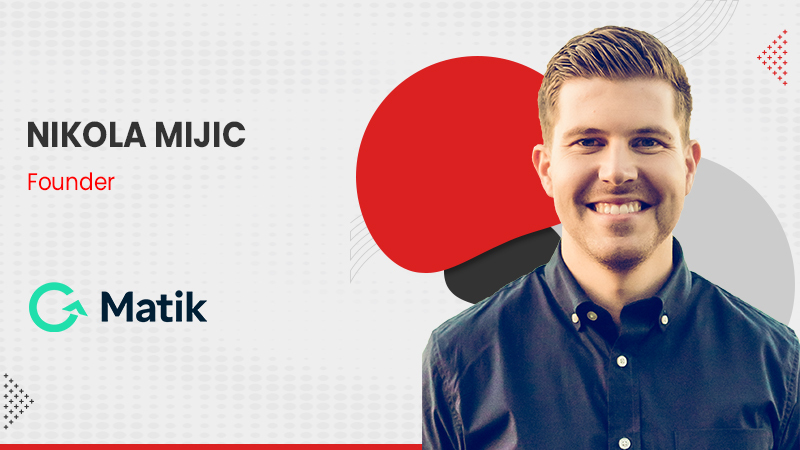
Profile
The Last Mile Problem Nobody Wanted to Solve
The quarterly business review is a peculiar ritual. A customer success manager spends two hours pulling numbers from Salesforce, another hour reformatting them in Google Slides, and thirty minutes color-correcting the charts to match brand guidelines - all to produce a deck that gets reviewed for maybe twelve minutes on a Tuesday. Multiply that by 300 accounts. That is where Nikola Mijic saw his company.
Nik (most people use the short version) was a program manager at LinkedIn when he built internal tooling that let sales and CS teams auto-populate data-heavy decks with LinkedIn data. The feedback was immediate and enthusiastic. The tool stayed internal. The problem - which he started calling the "last mile dilemma" - stayed unsolved at every other company those LinkedIn alumni moved to.
"We're not trying to replace dashboards. They still have a purpose - there's always the last mile dilemma."
- Nikola Mijic, Co-Founder & CEO, Matik
In January 2019, Nik and co-founder Zak Stein - an early Box engineer who had been there through the company's IPO - started working out of Nik's apartment with no outside funding. They had spent five to six months before that testing the idea: is the problem real, is it technically solvable, and can these two people actually work together? Only after all three cleared did they commit.
What Matik became is a no-code platform that connects to data sources - Salesforce, Snowflake, Google Sheets, Tableau, Looker, Hubspot - and turns them into personalized, auto-generated presentations. A CSM managing 400 accounts can send each customer a quarterly business review deck populated with their specific usage data, renewal timeline, and health score, generated in minutes instead of hours. Not a template. A live, personalized document.
Origin Story
Sarajevo, 18 Months Old, and Moving
Nik was approximately 18 months old when the Bosnian civil war forced his family out of Sarajevo. They spent about 18 months in Hungary, then four and a half years in Germany. Unable to obtain German citizenship - the migration pressures of the early 1990s made that path closed - his parents applied to Canada, Australia, and the United States. They picked Salt Lake City, Utah, partly for the cost of living, partly because family friends had already landed there.
He grew up watching his parents navigate a country where everything was new and nothing was guaranteed. The immigrant work ethic was not a phrase he heard - it was something he watched happen every day. When he eventually told those same parents that he was leaving a stable, well-compensated role at LinkedIn to start a company, they did not push back. They offered to sell their house if he needed capital to get started.
He told his parents he was quitting LinkedIn to start a company. They said: go for it. And offered to sell their house if he needed the money.
Anecdote - The Leap
He studied accounting and economics at Westminster College in Salt Lake City, started in financial services roles, moved into business intelligence, and eventually landed at Bluenose Analytics in 2013 as the company's first non-engineering hire. Bluenose was building predictive analytics for customer retention - identifying the early signals that a customer was about to leave. The experience planted a specific seed: the data and insights existed everywhere in B2B SaaS. Getting them out of a database and into a conversation with a customer was the bottleneck nobody was addressing systematically.
The Founding
Zero Sales Experience, First Customer at Dinner
Neither Nik nor Zak had a sales background. Their first paying customer arrived at a dinner party. Someone introduced Nik to her company's sales enablement team - they saw the prototype, they wanted to buy. There was no purchase order template. There were no legal terms. Nik made up a price on the spot - $2,500 - and spent the next day scrambling to create a DocuSign contract. That dinner party customer is still a reference.
The early customer acquisition strategy was sharp: target LinkedIn alumni who had moved to other companies. These were people who had already used the internal tools Nik had built at LinkedIn. They recognized the value instantly because they had lived without it. That approach alone seeded 15 to 20 early paying customers before Matik ever ran a formal outbound motion.
"I like to call it data-driven trust - it's trust built by sharing data as proof."
- Nikola Mijic
A former roommate - who had previously sold his own company to Autodesk - provided a $200,000 SAFE, which funded enough prototype work to land a $3.1M seed round from Menlo Ventures. The seed provided two things Matik needed: capital to hire, and the institutional credibility to answer the most common early objection from enterprise prospects: "Will you still be around in six months?"
The Series A came in October 2021: $20M led by Andreessen Horowitz, with Menlo Ventures, BoxGroup, and Ocean Ventures participating. a16z General Partner Kristina Shen joined Matik's board. Total raised crossed $26M. By 2024, Matik had reached $10.7M ARR - up 51% year-over-year from $7M in 2023 - and grown the team to over 70 people.
How He Leads
Even-Keeled by Design
Nik does not believe in getting too high on the wins or too low on the losses. In a company with venture funding and a growth target, the emotional weather inside the office often tracks too closely to last week's numbers. He thinks that is a mistake - the highs destabilize your judgment and the lows destabilize your team. The goal is to stay even-keeled enough to make clear decisions in both directions.
He approaches mentorship with unusual structure. He maintains three types of mentors simultaneously, and rotates all of them every six to twelve months: a "sibling" - a peer he can vent to and get honest feedback from; a "parent" - someone two to three years ahead on the same journey, for tactical guidance; and a "grandparent" - a founder who has built multiple companies and can provide the 50,000-foot view. The rotation is intentional: the advice you need changes as the company changes.
On hiring, he advocates bringing on pairs. Two account executives at the same time, two SDRs at the same time. If one outperforms and one underperforms, you have a signal about individual capability. If both underperform, you have a signal about your process. One data point tells you almost nothing.
"Ruthlessly prioritize - your users and customers are gonna want the world, and it's your job to decipher what is valid and what is habitual."
- Nikola Mijic
He has kept himself involved in deals even after hiring a head of sales. Not because he distrusts the team - because he believes a founder who fully exits selling loses the market pulse that keeps the product honest. The conversations where a prospect explains why they almost didn't buy are not optional intelligence. They are the product roadmap.