A customer needs a labeling system. The search begins with Google, wanders through a technical page, pauses at a calculator, moves into live chat and eventually reaches a salesperson. The order is worth about $14,000. It closes through another channel. Inside many companies, that ending would ignite a familiar quarrel: who gets the credit? Nicole Westenberger sees a more useful answer. The customer got what they needed, and every digital handoff helped them get there.
That story contains the operating philosophy behind Westenberger's career. She is the Vice President and CMO for Global Marketing at Brady Corporation, the Milwaukee manufacturer whose labels, printers and safety products turn up in factories, laboratories, data centers and places where ambiguity can be expensive. Her job spans marketing, e-commerce and brand strategy. Her recurring subject is less glamorous than a campaign launch and more consequential: how a business behaves when the customer refuses to follow its org chart.
Westenberger arrived at that question by an indirect route. She studied political science at Marquette University, began in agency work and entered commerce when catalogs still carried much of the load. In 2001, a Sears release identified her as the catalog business manager for Room for Kids, a coordinated children's furniture and décor concept offered both in print and online. The web was present, but the catalog still supplied the grammar: assemble a world, explain what belongs together and make a complicated choice feel navigable.
The catalog learned to move
She spent more than 15 years at Sears Holdings as e-commerce shifted from an interesting channel to the nervous system of retail. Her roles included VP and general manager of softlines, divisional vice president of digital strategy, general manager of hardlines and chief of staff. A biography prepared for a B2B commerce conference credits her with helping Sears.com and Kmart.com grow beyond $2 billion by expanding online assortment, improving the user experience and tuning digital marketing.
Those titles describe a wide-angle apprenticeship. Merchandising taught her that availability is part of persuasion. Website optimization taught her that tiny frictions compound. P&L responsibility made digital accountable to the business. Stores offered the lesson that online research and offline revenue are often members of the same family, even when the reporting system gives them different surnames.
“The customer does not care.”Nicole Westenberger, on internal channel conflict
After Sears, she moved to CDK Global, the automotive technology company formed from ADP's dealer-services business. A former colleague publicly described her as a change agent who built a marketing and communications function after the spinout, while another recommendation emphasized her analysis, persistence, team building and quick wit. The praise is useful chiefly because it matches the method she later described in detail: change the system, but bring the people who must use it into the room.
In 2017, Westenberger joined Brady as vice president of global e-commerce and marketing for its Identification Solutions business. The move took her from retail and automotive technology into industrial manufacturing. The products were different. The customer's wish to understand them before buying was not.
A website with several jobs
Manufacturing e-commerce is a particularly good place to learn humility. A buyer may need a printer, but first they need to know which material survives heat, chemicals or repeated washdowns. They may need a label, but the real problem is traceability, compliance or keeping a worker safe. The page that earns trust may not be a product page. It may be a guide, calculator, demo, sample request or order-history screen.
Westenberger has argued for a broad definition of digital commerce. Transactional revenue matters, but a website also builds relationships, carries the brand, supplies self-service and prepares conversations that close elsewhere. In that view, content is not decoration around the cart. It is part of the product's route into use.
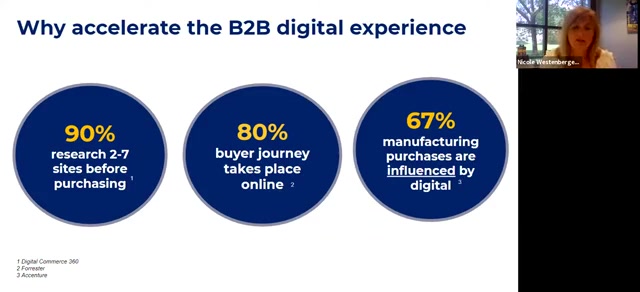
The distinction becomes clear in her coffee-maker example. A shopper may research on the manufacturer's site and buy at a convenient retailer. The shopper does not pause in the aisle to worry about attribution politics. Industrial transactions add more steps, larger stakes and specialized advice, but the underlying behavior is recognizable. People gather confidence wherever it is available, then purchase where circumstances make sense.
This is why channel conflict looks, to Westenberger, like an internally focused issue. It is real because incentives, territories and partner relationships are real. Yet it becomes dangerous when the company designs around its own discomfort. Her preferred response is evidence: show how digital touchpoints influence other channels, then give sales and distribution practical reasons to participate.
Invite the field into the build
Brady's virtual showroom offers a compact case study. The project began when in-person trade shows disappeared. A digital environment could display Brady products across ten industries, letting customers explore on their own or with a salesperson. The important choice was organizational before it was technical: salespeople helped select the industries, shape realistic environments and decide what information belonged inside.
Late in development, sales asked for live chat. It was added. Once launched, the showroom revealed uses beyond the original brief. Sales could guide prospects through applications. Distributors could use it for training. New employees could learn where Brady products fit. One customer-facing asset became a prospecting space, meeting aid and classroom.
The pattern is repeatable. Start with the problem rather than the novelty. Recruit the people who understand the setting. Build a path from education to human help. Then watch for useful behavior the original plan did not predict. Digital leverage often appears after launch, provided the team is paying attention.
“I am really passionate about customer feedback.”Nicole Westenberger, on Brady's real-time response loop
At Brady, customer feedback from digital tools has flowed into a shared chat monitored by digital and engineering teams. A serious bug can be escalated. A customer-service concern can reach the people equipped to respond. A recurring request can validate or raise the priority of an item on the roadmap. Feedback becomes operational material rather than a quarterly slide.
This is where Westenberger's appetite meets her discipline. She has joked that e-commerce teams carry tens of thousands of ideas and too little time. Her own team asks her to prioritize because she wants everything done. The answer is a weighted scorecard: connect each possible improvement to the goals it serves, estimate its impact and choose. Ambition supplies the list. Operations supplies the order.
The operator returns to campus
Her Milwaukee story loops back to Marquette. In April 2025, Westenberger served as a judge for the university's Brewed Ideas Challenge, a pitch competition in which student founders presented ventures ranging from a bread-recipe app and automated meal planning to fragrances and a nature-aquarium business. The event followed workshops mentored by Brady leaders and offered seed awards, including a Brady Innovation Award.
There is a pleasant symmetry in a political science graduate returning with decades of commercial pattern recognition. A student pitch and an industrial product page share a ruthless requirement: name the customer, identify the problem and explain why this route deserves attention. Cleverness helps. Clarity closes the distance.
Westenberger's recent public activity also points outward from the dashboard. She highlighted a Milwaukee returnship program for experienced professionals coming back after time away from work. She celebrated her marketing team's volunteer work with Hunger Task Force. When Brady became a finalist for an enterprise B2B e-commerce manufacturing award in 2024, her post focused on the team exploring ways to use platforms and technology to improve growth and experience.
That instinct is consistent with the comments colleagues have left across her career: team building, mentorship, persistence and humor. Even a small webinar interruption fits the portrait. While she was explaining Brady's digital roadmap, the office motion-sensor lights clicked off. She noted the company's sustainability efforts, trusted that the lights would return and continued. It is difficult to invent a tidier metaphor for transformation: the system behaves unexpectedly; the operator acknowledges it; the work goes on.
Follow the customer, keep the credit
The thread from a children's-room catalog to industrial identification is not a particular platform. Platforms arrive, age and are replaced. The durable craft is arranging information so that a person can move from uncertainty to a sensible next step. Sometimes that step is checkout. Sometimes it is a sample, a chat, a distributor or a call.
Westenberger's contribution is to make that messy journey legible inside large organizations. Marketing can educate. Sales can add context. Distributors can carry the relationship. Engineering can hear the feedback. E-commerce can connect them without insisting on owning every transaction. The result is less theatrical than the phrase “digital transformation” suggests. It is a long sequence of useful handoffs.
The catalog once tried to place the whole room on two facing pages. The modern customer journey will not sit still so politely. Westenberger has built a career by following it anyway.