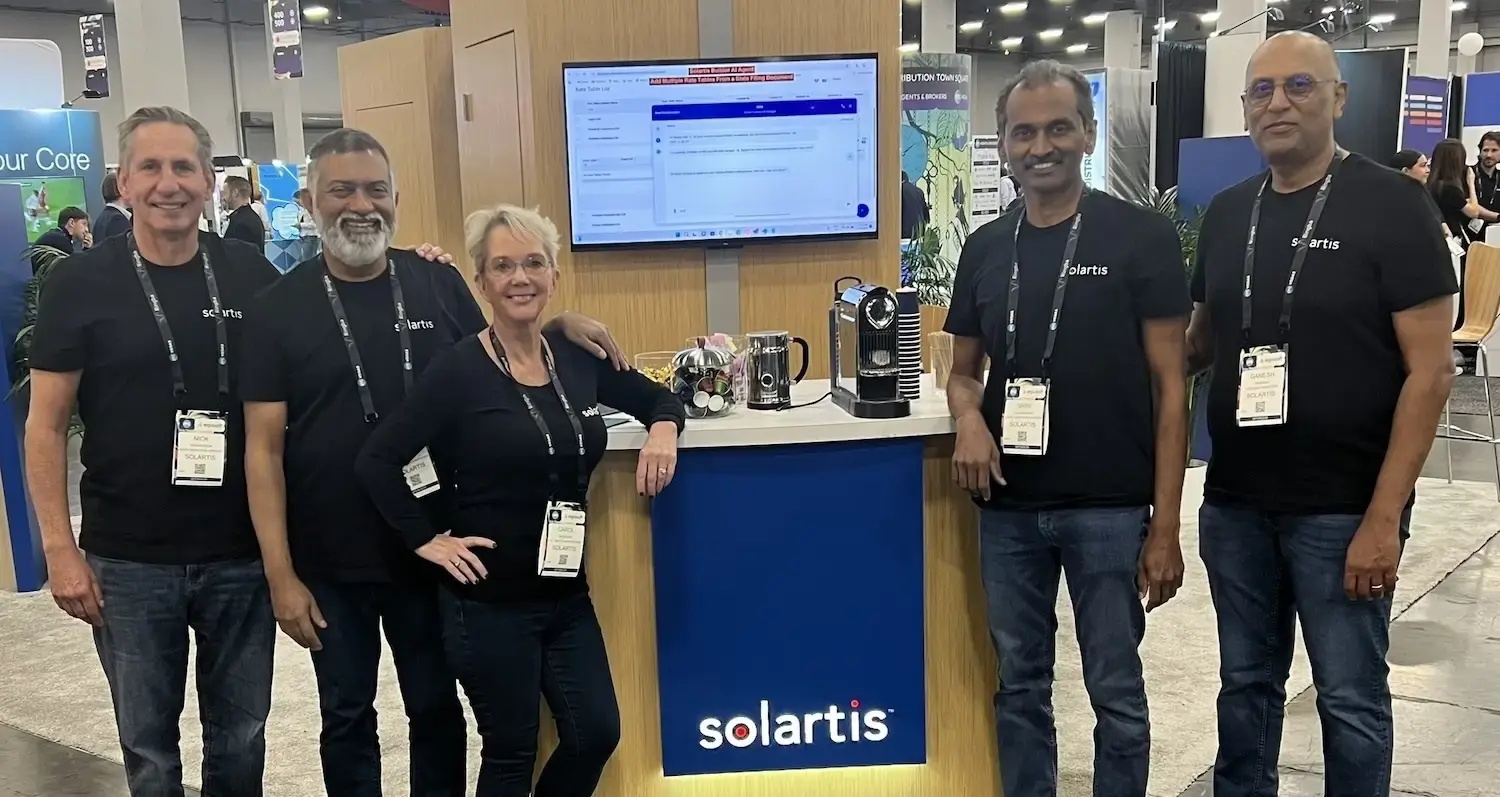
There is a coffee machine in the middle of the Solartis leadership photograph. Five colleagues stand around a demonstration booth, with software on a screen behind them and cups within reach. Nick Richardson is on the far left, wearing the same black company shirt as everyone else. It is a useful introduction to a chief executive whose working subject is the unglamorous business of getting things processed. Even the photograph has made provisions for the next transaction.
Richardson co-founded Solartis in 2004. Based in Manhattan Beach, California, he has spent the years since helping insurers handle the work between an application and a functioning policy. That includes calculating a price, producing a quote, issuing documents, making changes, and renewing the contract. The customer may remember a premium. Someone has to make all the steps behind it agree.
His career offers a particular view of entrepreneurship: an established industry, a stubborn operational problem, and a company built to keep working on it. Alongside that business runs another commitment, to schools and young entrepreneurs. The two strands meet around a practical question: what should people be able to do for themselves, and what support makes that possible?
A career inside the machinery
Before Solartis, Richardson worked at McKinsey & Company as an associate principal focused on insurance clients. Later, he became a senior vice president at ePolicy Solutions, which supplied insurance quoting and policy management software. Consulting and enterprise software placed him on different sides of the same desk: deciding how a business should operate, then confronting the systems through which it actually operates.
He earned a BS from the University of London and an MBA from Harvard. His Harvard Business School years were 1988 to 1990. Those qualifications sit behind a career concentrated on insurance processes and technology, rather than a sudden excursion into the sector when it became fashionable to append “tech” to its name.
At Solartis, Richardson oversees corporate operations and develops business strategy with the leadership team. His fellow founders include Siby Nidhiry, who leads technology and innovation, and Srinivasan Alagarsamy, the chief operating officer. Their responsibilities put software architecture and transaction processing in the same leadership conversation. A policy system has to work on a diagram and on an ordinary working afternoon.
The small pieces that permit a bigger move
Solartis's approach uses microservices: separate software capabilities that can be called through APIs and combined into a working process. In insurance, that permits a company to use a rating capability or document service inside its own technology. It can also adopt a fuller policy administration platform. The business proposition gives customers choices about how much machinery they take on at once.
For Richardson, the point extends beyond the architecture. In a Solartis discussion of insurance's changing possibilities, he put the destination simply: The ultimate winner will be the customer.
The sentence is modest enough to survive outside a software presentation. A quicker or more adaptable internal process becomes valuable when it changes what someone can buy or how easily they can buy it.
He has discussed that approach at an InsureTech Connect workshop with Starr Companies technology executive Mike Toran and Celent research director Donald Light. Separate clips explore differentiation and the move away from monolithic systems. These are implementation questions: where to begin, what can coexist, and how to change a working business while it continues to serve customers.
“The ultimate winner will be the customer.”
Nick Richardson, on microservices and insurance
In 2016, a decidedly practical announcement
On June 12, 2016, Solartis announced an initiative to integrate ISO Electronic Rating Content into its platform. It was the kind of announcement unlikely to interrupt a dinner party. Within commercial insurance, however, getting rating content into a usable system is consequential work. Rates and rules have to arrive where transactions happen, and an insurer's own variations have to fit alongside them.
Richardson described the integration as a way to combine digital content with customers' product modifications and exceptions. The intended benefits were faster product delivery, greater efficiency, and improved compliance. The details reveal his company's chosen territory: recurring work that becomes expensive when it must be interpreted, transferred, and maintained repeatedly.
That focus also makes the company's story more legible. The ambition was tied to something specific that an insurance organization had to do. An interface can be handsome while the work behind it remains laborious. Connecting the content to the process addresses a less photogenic part of the problem, and one that remains after the demonstration ends.
The startup's shopping list
By November 2018, Munich Re's Digital Partners had selected Solartis as a preferred policy administration technology provider. The relationship had developed through Embroker and then Buckle, a rideshare insurance startup. Both used Solartis microservices through their own technology platforms. Their businesses differed, but both needed insurance functions without constructing every component themselves.
The choice brings Richardson's proposition into focus. A startup has plenty to invent already. Purchasing a working capability can leave its own team more time for the parts of its business that require original work. Software procurement rarely carries the romance of a founder's first sketch. It can determine whether that sketch ever becomes something a customer can use.
Richardson welcomed the Digital Partners relationship as a partnership with two companies already using the platform. That detail matters. The formal relationship followed actual deployments, giving the announcement a basis in work already under way. It is a quieter kind of business development: a useful connection grows out of solving a particular customer's problem.
- 2004Co-founds Solartis
- 2016ISO rating-content initiative
- 2018Digital Partners relationship
- 2023Joyn's Spark receives Celent recognition
- 2025AAIS partnership announced
Eight months, then more work
The Joyn Insurance project provides a concrete example. Joyn and Solartis began building the platform in October 2020. In March 2021, Joyn publicly announced its selection of Solartis for policy administration. Joyn wanted to concentrate its team on its own underwriting solution, with the underlying quote and policy processing supported by an outside platform.
The minimum viable product arrived eight months after the build began. A more fully integrated submission, rating, quoting, and binding experience across its product lines followed in June 2022. That sequence is useful precisely because it includes a second stage. An initial release is a beginning; the integration and improvement continue after there is something to launch.
In 2023, Joyn's Spark received Celent's Model Insurer Award for Digital and Emerging Technologies. The recognition belonged to Joyn's platform, built using Solartis Insure. For Richardson, it was an example of a customer combining its own underwriting and workflow work with supplied insurance technology. Keeping those contributions distinct makes the achievement easier to understand.
From the start of Joyn and Solartis's platform build to its minimum viable product.
October 2020 build start · Reported in April 2023
There are people behind the process
Richardson's public work also includes explaining Solartis Administer, the company's business process outsourcing offering. Here the object is administrative activity: work performed alongside an insurer's operational and underwriting staff. It brings the discussion back from APIs to tasks, queues, and the people responsible for moving them along.
That is a useful complement to the software business. A system can make a task possible; an organization still needs a way to get the task done. Richardson's responsibilities span a company concerned with both. It helps explain why an account of his work keeps returning to process rather than stopping at the software's feature list.
The current platform extends the modular approach into configuration, transactions, analysis, and operations. Solartis describes more than 200 microservices and AI assistance for activities including configuration and testing. These are company capabilities, rather than personal inventions credited to the CEO. Richardson's job is to lead the business that brings the different skills together.
Rules & products→Transact
Quote & issue→Analyze
Data & reporting→Operate
Tools & people
A different kind of boardroom
Outside Solartis, Richardson served as chair of the Roessler-Chadwick Foundation Group from July 2015 to June 2022. The educational organization has schools in the Los Angeles area and in South Korea. Seven years in that role put another kind of institution on his calendar, one measured through education rather than insurance transactions.
From October 2022 to June 2023, he was a business mentor at Harvard Innovation Labs. Youth Investors Corp identifies him as its 2022-23 mentor through the lab, and he joined its board in January 2024. The progression from mentor to board member is a specific commitment beyond the familiar executive biography line about giving back.
It also broadens the picture of what he does with business experience. The same career that equips him to discuss insurance administration has taken him into supporting a younger organization's development. The connection is practical and documented: time spent mentoring, followed by a formal governance role. It needs no invented speech about the next generation.
The next change still needs an operator
In August 2025, Solartis joined the American Association of Insurance Services partner program. Richardson described the collaboration in terms of bringing AAIS content together with Solartis's platform to simplify product configuration and delivery. It returned to familiar ground: connecting insurance content with the technology used to put it into production.
AI now appears in that work, alongside the microservices and configuration tools. The continuity is more interesting than the new vocabulary. Across the rating-content initiative, startup partnerships, and Joyn implementation, Richardson's company has kept addressing the distance between a product someone wants to offer and the operational work required to offer it.
The leadership photograph supplies a fitting final detail. Richardson stands with colleagues, beside an actual demonstration, in a shirt with the company name on it. His career has settled around a business that helps other businesses get on with theirs. The coffee machine has a supporting role. Anyone who has sat through a software demonstration will appreciate the foresight.