Ten minutes is an awkward length of time. Too short to do something useful, too long to pretend nothing is happening. In Solartis’s published Starr Companies case-study summary, an insurance quote that once took ten minutes took three seconds. For anyone buying software, the tempting response is to admire the stopwatch. The more interesting response is to ask what had been making it wait.
- What it sells: policy administration software and back-office services for property and casualty insurance.
- Who buys: carriers, managing general agents, wholesalers and insurance startups.
- The useful distinction: adopt individual policy services or the whole platform, with your own interface if you prefer.
- The practical lesson: test a change against real business before congratulating yourself on launching it.
Starr’s small-business initiative used Solartis microservices to support multiple rating calls. Instead of treating policy administration as one enormous application, the approach divided its work into callable services. A customer’s application could ask for a calculation, receive the result and move on. The reported improvement belongs to that implementation, rather than every insurer who signs a contract. Still, it makes a wonderfully compact introduction to a company whose subject matter is usually anything but compact.
Insurance remembers everything
Solartis works on the machinery that turns an insurance proposition into a functioning product: rates, quotes, underwriting rules, documents, issuance and the transactions that follow. An endorsement changes an existing policy. A renewal carries it forward. A cancellation ends it. Each apparently simple action has to respect the product’s rules and the policy’s history.
That history is the difficulty. A rate introduced today does not politely erase yesterday’s business. State requirements differ. A carrier may follow an industry bureau’s rating framework while applying its own exceptions. The software must accommodate both the common foundation and the deliberate departure. Insurance has an unusually good memory, and poor software makes that everyone else’s problem.
The company’s 2017 ISO rating API illustrates the detail. It consumed ISO Electronic Rating Content and kept carrier deviations above the countrywide and state versions. Subsequent bureau updates could arrive without wiping away those deviations. This is less photogenic than a new sales portal. It is also the sort of arrangement that makes a sales portal worth having.
The front door is yours
Solartis Insure now advertises more than 200 policy lifecycle microservices. “Headless” means those services do not bring a compulsory set of screens with them. A carrier can build its own portal, use Solartis-generated screens, or combine the two. The distinction gives an insurer room to decide which experience it wants to own and which processing functions it wants to purchase.
This flexibility has attracted both established insurers and newer businesses. Solartis’s customer pages list names including Starr, Seneca, Embroker and BriteCo. In 2018, Munich Re’s Digital Partners selected it as a preferred policy administration provider after work involving Embroker and Buckle. Those businesses called Solartis services from their own technology platforms. The arrangement made buying policy machinery compatible with building a distinctive customer experience.
- 01Your portalCollect the submission
- 02Validate + rateApply the configured rules
- 03Quote + issueComplete the transaction
- 04DocumentsReturn the policy packet
Solartis occupies the policy administration market alongside alternatives such as Guidewire PolicyCenter and Duck Creek Policy. SaaS and low-code configuration are shared territory: Duck Creek markets both. Solartis’s particular proposition is the combination of selectable services, bureau-content handling, product maintenance tools and operational delivery. The buying decision turns on which functions and responsibilities a carrier wants the vendor to take.
The product is never finished
Solartis Builder is where business analysts and technical teams configure coverages, rates, eligibility rules, forms and interfaces. Its layered model starts with bureau content and a platform foundation, then adds carrier products and individual programs. Reusing a base avoids retyping the common material while leaving room for the things that make a program different.
“Every version is retained, and nothing is ever replaced.”Solartis Builder product description
That sentence deserves more attention than the fashionable words around it. Builder keeps applicable and effective dates for product content. Teams can prepare future changes while preserving versions needed to service existing business. Rating, documents and rules can be worked on separately, then tested together. A product launch is the beginning of its maintenance obligations, and the toolkit treats it that way.
Solartis also offers initial configuration and training. Customers can shadow its team before taking over maintenance. That handover matters: control is only useful when someone knows how to exercise it. Complex integrations, custom interfaces and advanced orchestration still require technical expertise. A configuration screen cannot settle an underwriting question its owner has not answered.
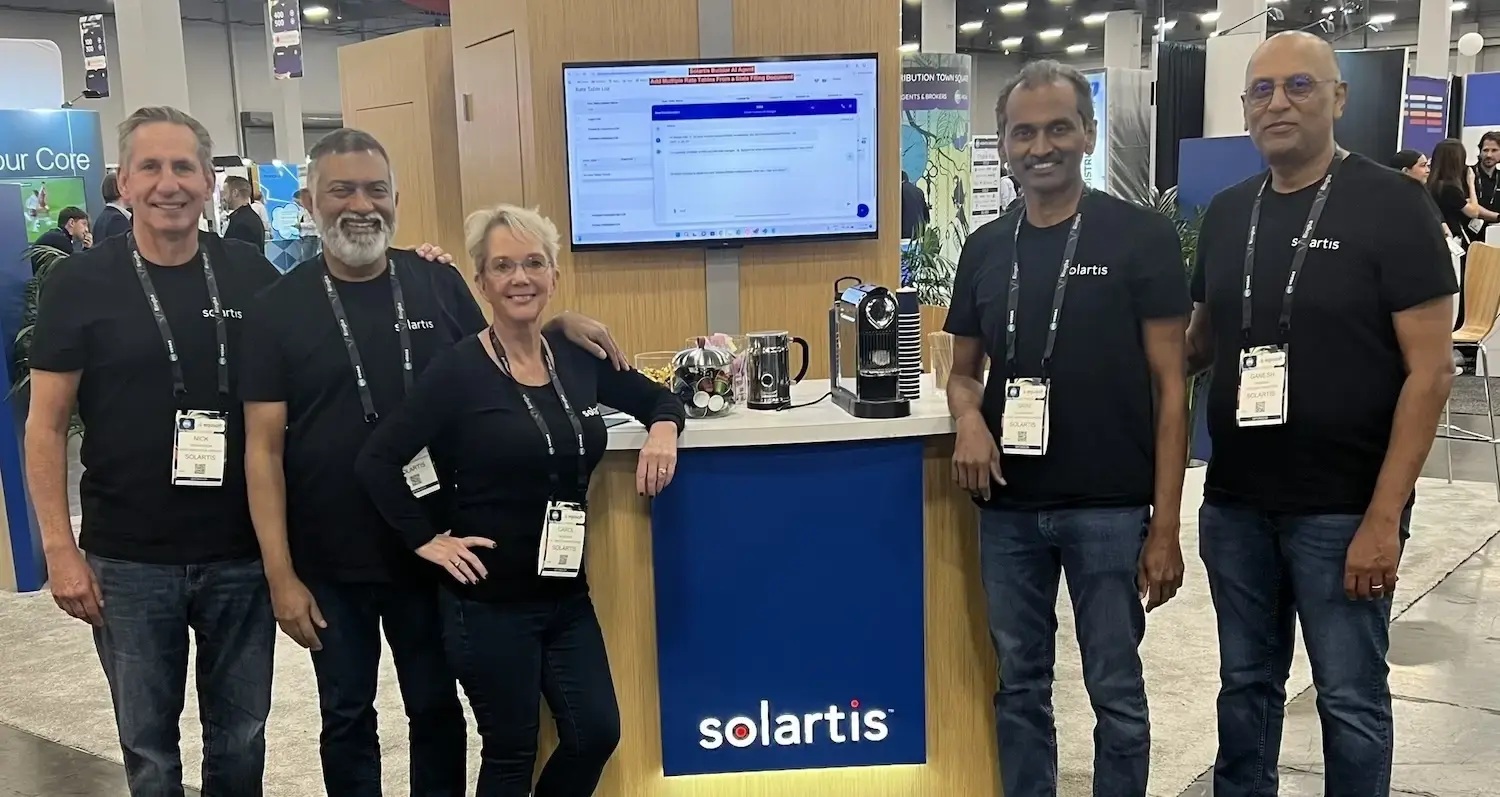
The founders bring different parts of that job. CEO Nick Richardson previously worked at ePolicy Solutions, Kaiser Permanente and McKinsey. Siby Nidhiry leads technology and innovation. Srinivasan Alagarsamy oversees operations. Their biographies connect enterprise systems with insurance processing, which helps explain the company’s interest in both software and the work surrounding it.
A bowling insurer changes the plan
The most instructive Solartis story may involve bowling. Western Bowling Proprietors Insurance used Solartis Explore to analyze a proposed rate structure. CEO Cameron Linder says the detailed simulation exposed the need to file new company loss-cost multipliers. He also says the original proposal would have been damaging for larger accounts and could have jeopardized the existing book.
What changed the decision was the distribution of the results. A rate change can look reasonable in the aggregate while treating a segment of customers badly. Explore operates at the book-of-business level, modeling changes across accounts rather than forcing an analyst to inspect policies one at a time. In this example, the company reconsidered its plan before putting it into practice.
That is a habit readers can borrow: run the proposed rules against the business already on the books. Look for the uncomfortable accounts, then investigate them. The software also supports bulk processing and aggregate management, but this modest use of simulation makes its value unusually clear. A useful analytical tool occasionally tells its buyer to slow down.
Eight months, then another year
Joyn’s Spark provides a second view of adoption. The MGA and Solartis began building in October 2020. An MVP followed eight months later; a fully integrated submission, rate, quote and bind experience across product lines arrived in June 2022. Spark won the 2023 Celent Model Insurer Award for Digital and Emerging Technologies.
Joyn’s CTO Ed McGough described the premise as “underwriters’ time is the most valued commodity.” Manual processes and handoffs between systems were consuming that commodity. Spark brought the workflow together. The sequence is useful: first deliver a working version, then expand the connected experience. The award went to Joyn’s initiative, with Solartis providing policy administration technology behind it.
Compare the recurring bill and the initial project against your own volumes, integration work and maintenance responsibilities.
Solartis describes a subscription covering infrastructure, platform maintenance, support, disaster recovery and monitoring, with implementation priced separately. In its 2023 Spark announcement, Joyn expected to break even within three years of project launch. That was a forecast. A buyer should give its own assumptions the same examination it gives its rating rules.
Automation still has colleagues
Solartis Customer Delivery combines policy-processing staff, robotic process automation and a workflow engine. It can support legacy operations or a new book that is not yet ready for full automation. Submissions, endorsements and other administrative work continue while the technology changes. The services address a practical truth: a software project does not stop today’s queue from arriving.
More recently, Solartis joined the AAIS Partner Program in August 2025. The collaboration connects bureau forms, rating and statistical content with product configuration. Its current AI offering also targets configuration drafts, testing and system diagnosis, with experts reviewing outputs before production. These are specific jobs inside the insurance workflow, rather than a promise that expertise has become optional.
For a carrier with defined P&C requirements and people ready to own configuration, Solartis offers several sensible starting points: a rating service, a new program or a complete policy platform. Claims and billing integrations need their own scope. The transferable idea is to pick a bounded problem, measure it and keep the history intact. Three seconds is a pleasing number. Knowing precisely what happened in those three seconds is the better purchase.
Open the machinery
Explore Solartis, Builder and the customer stories. Read company news or follow its LinkedIn, X and Facebook accounts.
WatchNick Richardson, Mike Toran and Donald Light on differentiation ↗Breaking a core system into services ↗Policy administration delivery models ↗