The software crash came late in the trouble. A gastroenterology group and surgery center had already decided to leave its billing company after more than 15 years. Then the old vendor resisted handing over data. Medicare payments were on hold because a revalidation application had expired. Coding mistakes were producing denials. Finally, the practice’s EHR crashed.
This is a customer story NextServices published in 2016. It is also a useful introduction to the company. A practice can have doctors, patients and a full appointment book while the machinery connecting them quietly comes apart. NextServices works on that machinery.
- The customer: GI practices, surgery centers, labs and health-tech businesses.
- The work: billing operations, enki software, integrations and AI automation.
- The useful idea: give every handoff an owner and every exception a destination.
The bill came due before the software crashed
In that transition, NextServices says it transferred available billing data, checked records against the next day’s patient schedule, repaired Medicare enrollment and corrected coding practices. After the crash, it moved the practice to its cloud EHR, enki. The repair crossed several job descriptions. A software installation alone would have left the Medicare problem sitting there.
Another company-published case, concerning a New Jersey surgery center, makes the financial stakes concrete. Reimbursements had fallen by $700,000 in 2012. The review covered roughly 10,000 explanations of benefits, the documents showing how insurers processed claims. NextServices reports recovering about $250,000 from old accounts receivable within three months. That is a historical customer result, rather than a forecast for the next practice.
Old receivables recovered in three months at one New Jersey surgery center.
A company built around the handoff
Satish Malnaik and Praveen Suthrum founded NextServices in 2004. The company says it began on the University of Michigan campus. Today, Malnaik, the CEO, is based in Ann Arbor; Suthrum, the president, is based in Mumbai. One oversees sales, finance and legal functions. The other oversees operations, technology and marketing.

Internally, the company calls its people iNexters and lists respect for knowledge, client focus and openness among its values. These are the company’s descriptions of its culture. Its multidisciplinary staffing fits the task: a reimbursement problem can require billing knowledge, software work and a conversation with the practice.
The offering combines people who run healthcare operations with people who build the software. Its revenue-cycle service covers coding, eligibility, prior authorizations, claim submission, denials and patient balances. Its Digital Health Studio handles custom applications, integrations and data projects for startups and established enterprises.
That puts NextServices between a billing outsourcer and a healthcare software vendor. A practice can buy operating help; a technology business can buy development expertise. The common material is the awkward exchange between clinical information, administrative work and payment. Understanding what a field means can matter as much as moving it between databases.
The paperwork has a product
Consider an endoscopy report. It records what happened during a procedure, but it also feeds billing, referrals, quality reporting and future recalls. NextServices’ enki Endoscopy Report Writer brings those activities together through operative notes, image capture, coding support, referral letters and recall tools. Its EHR adds customizable clinical workflows, prescribing and connections to other healthcare systems.
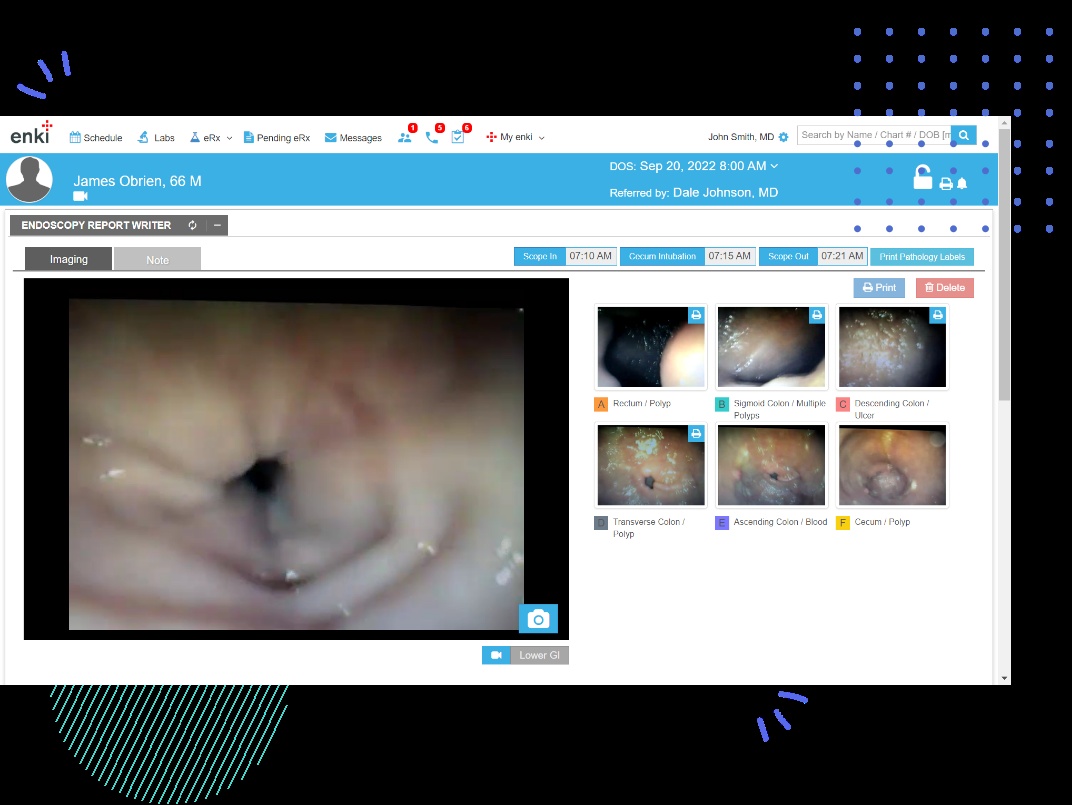
The commercial model matches that mix: managed services, software subscriptions and custom technology engagements. Published terms for the endoscopy report writer describe monthly charges based on doctors and endoscopy rooms. They also describe a 60-day refund offer requiring at least 300 captured images. That condition makes the trial an exercise in actual use, with enough repetition to test a working routine.
The competitive field is busy. ModMed’s gGastro also serves GI documentation and endoscopy workflows, and ModMed offers revenue-cycle services. NextServices’ case rests on its combination of operating work, adaptable software and custom integration. Those capabilities must earn their place inside a particular practice.
What changed the doctor’s mind
One New York gastroenterologist initially resisted an EHR because he feared disruption and a poor fit with his clinical work. NextServices’ published account describes a practical response: train the administrator as a super user, then build templates around the practice. The company reports completing implementation in less than a week.
The administrator is the telling detail. Someone nearby could answer the next question. Adoption had a human point of contact, while the software reflected the physician’s routine. Readers introducing new tools can copy both choices: prepare a local expert and adapt the workflow before asking people to trust it.
Now the phone can do some of the work
In January 2026, NextServices announced a collaboration with One GI and 100ms. The initial patient-access work includes colonoscopy recalls and referrals, with 100ms providing AI capabilities. NextServices’ role includes operational planning, integration and a unified dashboard bringing financial and operational data together.
“Our role is to help organizations move from AI aspiration to AI execution.”
Satish Malnaik, CEO / January 2026
The distinction worth watching is completion. A voice agent’s conversation has to produce an appropriate next action inside an existing system. NextServices describes defined workflows, operational controls and exceptions routed to people. That approach gives the phone call somewhere to land.
- 01 Reach the patient
- 02 Update the system
- 03 Track the result
There is an education business beside the operational one. Suthrum hosts The Scope Forward Show and leads GI Mastermind. In April 2026, Scope Forward and the American Gastroenterological Association announced a self-paced virtual program covering innovation, business strategy and leadership. It gives the company another connection to the physicians making these decisions.
Copy the sequence
The useful lesson is procedural. Make the work visible. Connect the systems. Choose a bounded task. Decide who handles an exception. Then measure what completes. This is an inference from NextServices’ operating approach, and it applies well beyond gastroenterology.
It also explains the limits. Unreliable records, broken integrations or nobody available for an exception can undermine the design. Buyers should test the entire journey, including the handoff back to staff. A patient reached is one milestone. An appointment properly arranged, documented and followed through is the job.