The problem was hiding in a default setting. At a California urgent-care practice, the billing system kept generating outdated diagnosis codes. A mistake could be corrected on one claim and return on the next. Elsewhere, charges had never reached insurers because of a technical snag. The patients had been treated. The financial record of that treatment was getting lost on its way out.
- NYX combines outsourced billing teams with automation and analytics.
- Its case studies trace unpaid revenue back to specific workflow failures.
- The useful lesson: fix the recurring input, then track the payment.
NYX RCM Partners took over the account in October 2018. In its case study, the company describes $532,000 in accounts receivable and 90 receivable days. Its reported after picture: $155,000 outstanding and 26 days. Those are company-reported figures for one practice, rather than a forecast for the next customer. Still, the repair list makes an unusually concrete introduction to what this business does.
The error that kept coming back
Revenue cycle management is the work of turning delivered healthcare into collected payment. NYX handles coding, charge capture, claims, patient collections, payment processing and insurer follow-up. It assigns an account manager and a team of billing, coding and accounts-receivable specialists. Its coding team includes AAPC-certified coders. A provider is buying people to do the work, supported by technology and reporting.
In California, the trouble had accumulated across that chain. Denials were not being worked promptly. Patient statements lacked a regular schedule. Copayments were allocated incorrectly. Modifiers and procedure codes needed correction. An electronic medical record made clinical information accessible, but accessibility alone had not produced a dependable billing routine.
NYX’s response involved conversations with the client about the record system, coding rules for the office, reviews of rejected submissions and scheduled statements. It worked with the software team to fix the diagnosis-code default. It also identified claims with shorter filing limits and handled appeals with medical records. This is a business of finding the next necessary action and making sure someone takes it.
“Knowledge about billing and claims is excellent.”
An unnamed customer in NYX’s urgent-care case study
Twenty-one branches. One billing problem.
A second case, involving a North Carolina durable medical equipment provider, shows how far upstream billing work can reach. The assignment, handed over in November 2018, covered 21 branches with a constraint of six full-time-equivalent staff. The client wanted reimbursement research and billing knowledge at a competitive price and with a quick turnaround.
NYX describes missing authorizations, skipped branch billing, out-of-network claims and more than $150,000 in unbilled charges. Many payers were receiving paper claims. Some failures began before a product was delivered, making later collection work an expensive place to discover them.
The team created a shared drive for branch documentation, initiated electronic funds transfer and electronic claim submission, and addressed payer network participation. Benefits and authorization checks moved before delivery. Field representatives received training every two weeks. In the company’s account, total receivables fell from more than $1 million to $500,000.
That mix helps explain NYX’s medical equipment specialty. Its service spans pre-order review, eligibility, order validation, cash posting and denial analysis. Medicare, Medicaid and commercial reimbursement rules are part of the assignment. The practical insight is portable: when several locations feed one billing operation, the quality of each handoff matters.
Give the robot the repetitive part
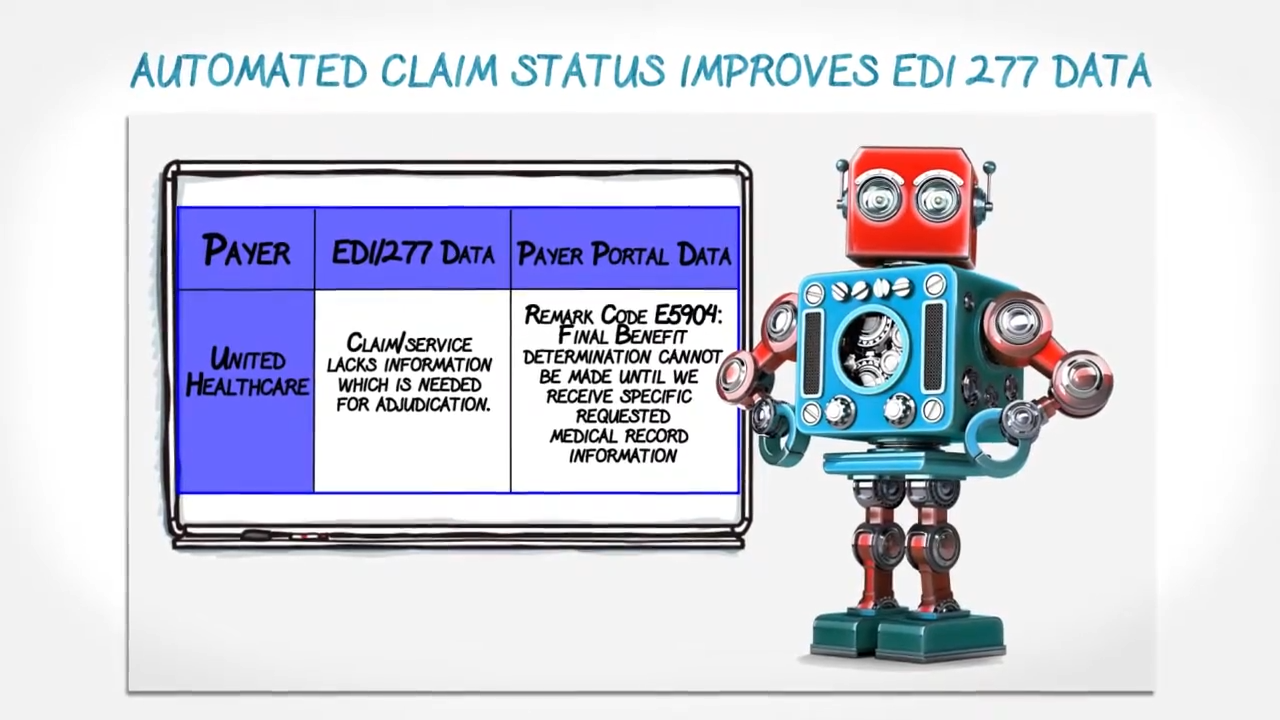
NYX’s technology offering addresses another repetitive chore: checking payer websites for claim status. Its Automated Claim Status product is presented as a way to reduce manual updating of open claims. Its denial-management offering advertises a 30-day trial using six months of top-payer denials to identify lost revenue and improvement opportunities.
 ▶ Watch the claim-status demo
The reporting side includes custom dashboards, key performance indicators, scheduled reports and drill-through analysis. These tools are meant to expose obstacles in billing and show staff performance. A useful dashboard, in this context, should send someone toward a claim that needs attention. Looking at a queue and working the queue are separate tasks.
The service operation remains visible behind the software. NYX describes in-house training, quality audits and round-the-clock staffing. Its careers form recruits trainees, billing specialists, coders and quality analysts. It lists locations in the United States, India and Dubai. The proposition combines specialist capacity, process management and automation.
- 01 Capture
- 02 Check
- 03 Submit
- 04 Follow up
Feed recurring errors back to the people and systems that create them.
The cost of changing who does the work
Regional Eyecare supplies a different reason to call. NYX says the group had managed billing internally and sought help to scale, reduce internal costs and improve collections. The case lists internal revenue-cycle costs moving from $360,000 to $260,000. That is a $100,000 difference in the stated figures; it does not establish total savings after vendor fees or specify the accounting period.
For a buyer, that distinction matters. NYX sits in the market for outsourced healthcare financial operations, alongside other billing providers and the option of keeping the work in-house. Its public offer brings billing expertise, medical equipment knowledge, proprietary automation and analytics into one relationship. The commercial question is what those capabilities cost against the work they replace or improve.
NYX’s own discussion of outsourcing acknowledges that stable internal teams with predictable payer mixes can work well. An outside team also depends on communication and alignment. The California repair required the office and software team to change their inputs. The North Carolina repair required branch training. A contract cannot make those responsibilities disappear.
The lesson an operator can copy is quite modest: inspect missed submissions, correct recurring coding errors, schedule statements and trace denials back to their origins. Then measure whether payment follows. In NYX’s cases, the revealing work happens where an ordinary administrative habit meets a very real balance outstanding.