At Rush SurgiCenter in Chicago, an operation could be finished while the bill was still waiting to leave. In a customer account published by Surgical Notes in 2020, the center had been working with another billing company when its financial measures began sliding. The problem appeared in a peculiar unit of time: ten days to bill. The surgical work was done. The financial work had barely begun.
- Surgical Notes handles billing, coding, transcription, and chart management for surgery centers.
- Its advantage is connecting specialist staff with the documents those staff need.
- SIS acquired the company in 2024; SNChart remains in its documentation lineup.
The second clock
After Rush brought in Surgical Notes’ SNBilling service, the company reported that days to bill fell from ten to five within six months. Days to pay dropped from 52 to 28. The share of accounts receivable older than 90 days fell from 41% to 24%. These are vendor-published results from one center, rather than a forecast for every customer. Still, they identify something worth watching: the clock that keeps running after the patient leaves.
Surgical Notes manages the sequence from insurance verification and authorization through claims follow-up and patient billing. Rush director Wendy Stark-Riemer described the connection plainly: “the faster they get out, the faster we get paid.” Getting a claim out requires several people to finish several different jobs.
The signature is part of the product
Jeff and Courtney Blankinship founded Surgical Notes in 1997. Before that, Jeff had built a network of pain management surgery centers. By December 2012, Becker’s described a transcription business serving more than 450 centers and 6,500 physicians across 42 states. The company’s starting point was a document. Its opportunity grew around everything that document needed to become useful.
Consider the physician’s signature. In a 2014 interview, then-COO Randy Bishop explained that centers wanted faster signatures on operative notes. Surgical Notes’ mobile app let physicians dictate, review, edit, and sign reports from their devices. Moving a familiar task into a physician’s hand addressed a specific delay. A beautifully transcribed report still has work left to do if nobody signs it.
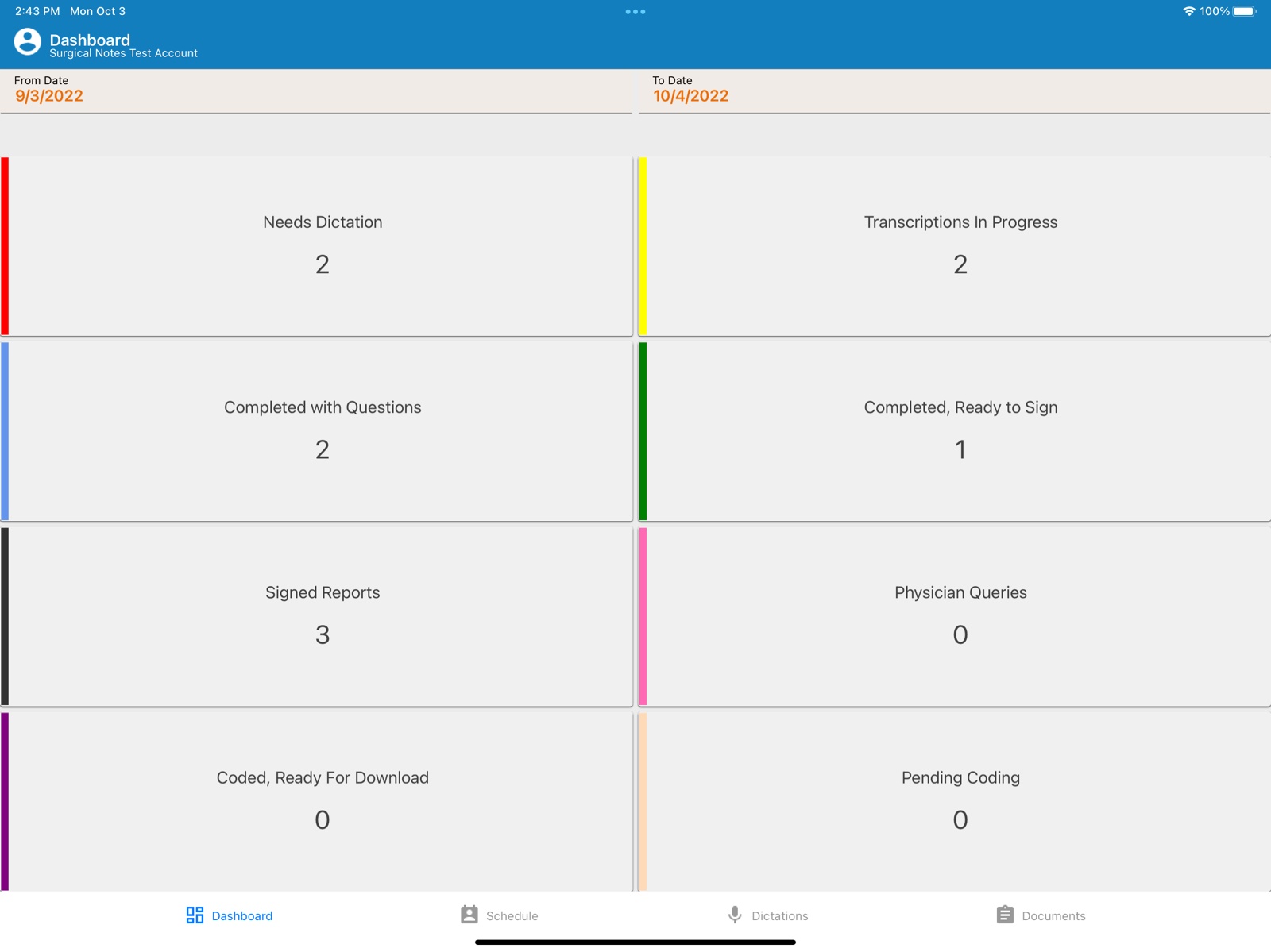
The product names sketch the expanding job. SNChart manages transcription. SNCoder supplies coding and audits. SNBilling takes on revenue cycle operations. ScanChart ASC organizes medical records. Surgical Notes sells this combination to ambulatory surgery centers, surgical hospitals, and management companies: software accompanied by people who know the work. Customers can use individual services or hand over a broader operation.
For a buyer, the competitive question is how much of that chain a partner will own. An internal office needs staffing and coverage; a transcription service addresses one piece; a broader revenue cycle engagement adds billing and follow-up. Surgical Notes’ ASC focus makes the center’s particular workflow the organizing principle. A proposal becomes more useful when it specifies who resolves missing documentation, who checks contract payments, and who chases an aging claim.
Paper has overhead
At Sequoia Surgery Center in Visalia, California, better transcription and coding did not eliminate the expense of paper charts. The center had implemented SNChart and SNCoder in November 2016. Printing and storage remained a problem. Office manager Desirae Vazquez then examined ScanChart ASC, returning to the demonstration several times before proceeding.
ScanChart’s trick is practical. It prepares customized chart packs, uses barcodes to identify scanned forms, and makes records retrievable through a web portal. Its audit function flags missing forms. Scanning alone gives you pictures of paperwork. Indexing gives the office a way to find the particular document somebody needs. For an administrator, that distinction can occupy a surprising amount of the day.
- 01Dictate
- 02Review + sign
- 03Code
- 04Bill + follow up
A delay at one step travels downstream.
The vacation test
Princess Anne Ambulatory Surgery Center had another problem: coverage. Its business office manager, Charmayne Harrington, explained in a 2021 customer case that billing and collections slowed when a full-time employee was away. A sick day or holiday could become a financial event. The center interviewed four revenue cycle companies before choosing SNBilling.
Surgical Notes had an advantage that a feature comparison would miss. Princess Anne had already used its transcription services since 2015 and coding since 2017. Familiarity helped win the larger assignment. During the transition, the teams aligned workflows, exchanged questions, and loaded managed care contracts into the practice management system. The purchase included coordination, contract interpretation, and a team behind the claims.
“an extension of my own team”Charmayne Harrington / Princess Anne customer case, 2021
Outsourcing also moves sensitive records across an organizational boundary. In November 2022, Surgical Notes announced a SOC 2 Type II examination covering security, availability, and confidentiality. Its workplace announcement that December described an almost entirely remote workforce. Together, those details explain a less visible part of the service: organizing distributed specialists while putting controls around the information they handle. The person doing the work may be elsewhere; the obligation to protect the record remains close to the center.
From the note to the whole office
The company’s ownership history follows that expansion. Capstreet announced a majority recapitalization in August 2019, when Bishop became CEO. In its later account of the investment, Capstreet described building technology and service delivery capabilities and completing three add-on acquisitions. Surgical Notes was becoming a broader revenue cycle business.
Automation joined the mix. A June 2023 agreement expanded the company’s relationship with Aidéo Technologies: Surgical Notes would use Gemini AutoCode in its coding operations and resell Gemini Coder Platform to larger management companies. The proposition paired coding tools with an existing service organization.
SIS announced its acquisition of Surgical Notes in November 2024. The deal connected Surgical Notes’ specialist services and ScanChart ASC with a larger surgical software portfolio. By May 2026, SIS was introducing its AI-powered SIS Scribe while still listing SNChart Transcription as a documentation option. The older service had a place alongside the new product.
Steal the measurement habit
The useful lesson for another business is to measure the spaces between jobs. How long does completed work wait for review? Who covers an absence? Which documents repeatedly arrive incomplete? An ASC comparing its own staff with an outsourced service needs to count supervision, coverage, printing, storage, and transition work alongside the vendor’s fee.
That comparison also needs context. Payer mix, contract terms, and documentation quality affect collections. A specialist cannot finish a claim without the necessary information and access. The sensible starting point is a baseline for billing lag and old receivables, followed by named responsibility for each handoff. The next useful improvement may be hiding in work everybody assumed somebody else had finished.