At Innovative Pain Care Center, the work was getting done. The Nevada practice had expanded to three locations. Patients were being treated. Yet, in Transcure’s account of the engagement, millions of dollars sat in aging accounts receivable. The practice’s A/R measure had reached 95 days. Growth had brought more care, more claims, and a larger pile of unfinished financial work.
- Transcure runs billing for US practices, hospitals, and laboratories.
- It combines specialist staff with automation inside existing EHR systems.
- Its outsourcing offer advertises a fee of 5% of collections.
The company says its team helped bring that measure below 35 days. Treat the result as a vendor-published customer story. Even with that qualification, the underlying problem is instructive. A busy medical practice has two clocks: the clock measuring when care happens, and the clock measuring when somebody pays for it. Transcure works on the second.
A practice with two clocks
Revenue cycle management sounds like something confined to an accounting department. In practice, it reaches into the appointment itself. Is the patient covered? Does the procedure need approval? Does the documentation support the code? Was the claim submitted correctly? If it comes back denied, who follows it until the problem is resolved?
Transcure sells responsibility for that chain. Its customers include solo physicians, group practices, ambulatory clinics, hospitals, and labs. It offers eligibility checks, medical coding, claims submission, payment posting, appeals, and receivables follow-up. The attraction for a practice manager is concrete: fewer loose ends competing with the next patient’s arrival.
First, the ordinary things went wrong
A second customer story offers an unusually useful list of failures. At the Texas psychiatry practice MD TruCare, Transcure described late charge submissions, duplicate payment posting, contract problems, coding inefficiencies, and a substantial receivables backlog. These are the everyday errors that make administration expensive. Each leaves someone with a repair job.
Transcure introduced robotic process automation to repetitive billing tasks. Its 2022 case study reports a 30% increase in collections and an 88% reduction in the denial rate. Those figures describe that engagement, rather than a forecast for the next buyer. The instructive detail is the task list: automation was aimed at identifiable work already going wrong.
“We improved our overall collections by 30% with RPA implementation.”
Dr. Imran S. Khawaja
MD TruCare, company-published case study
At IPCC, the company’s account places the decision to outsource after problems in the internal billing department had allowed receivables to accumulate. Founder Dr. Daniel Burkhead wanted more attention available for patient care. The problem had become large enough to change who did the work.
Seven names for the unfinished work
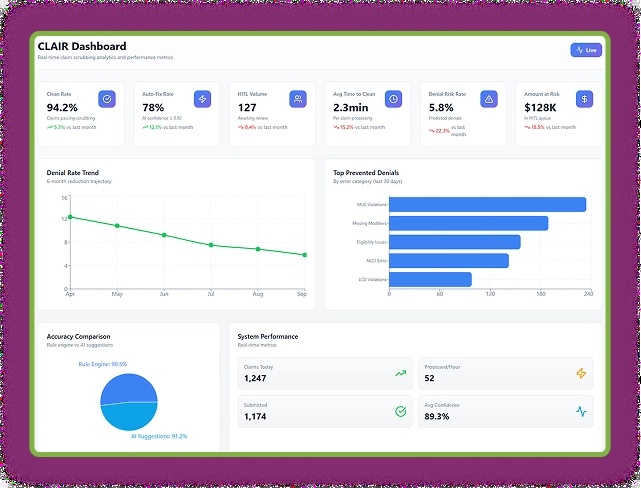
Today, Transcure presents that work through seven named AI agents. ELIXA checks eligibility. PRIA handles prior authorization. CODIN supports coding. CLAIR checks and submits claims. DEXA addresses denials, ARIA follows receivables, and REMITA reconciles and posts payments. The names make a complicated service easier to inspect: each belongs to a particular stage.
The company describes specialists working alongside the automation. Its laboratory service, for example, includes certified coder review for high-value molecular and toxicology claims. That is a revealing boundary. Some tasks repeat predictably; others require judgment about the record, the test, and the payer’s requirements.
A missing ordering-provider identifier or collection date can stop a laboratory claim before clever follow-up becomes useful. Transcure says it checks requisitions and flags gaps early. The point extends beyond laboratories: a billing operation inherits the quality of the information entering it. Faster processing cannot supply a clinical fact nobody recorded.
Keep the system. Hand over the chase.
Another part of the offer concerns what a practice has already bought. Transcure says its staff can work within existing EHR and practice-management systems, including Epic, athenahealth, and AdvancedMD. For an office reluctant to change its clinical workflow, that matters. Hiring billing help can become a change in responsibility without becoming a wholesale software migration.
This places Transcure in the market for outsourced billing and RCM services. A buyer can compare it with an internal billing department, another specialist service, or RCM offerings from healthcare technology vendors. Its pitch bundles people, specialty knowledge, and automation around the existing operation. The useful comparison is the work covered and the collections achieved after fees.
The price follows the payment
Transcure’s outsourcing page advertises 5% of monthly collections, with no upfront or onboarding fees. At that advertised rate, $100,000 collected would mean a $5,000 billing fee. That is arithmetic, not a customer invoice. A practice still needs a quote establishing what counts as collections and which services the agreement includes.
Scope matters because credentialing is separately priced per provider. Verifying a clinician’s qualifications and enrolling that clinician with a payer are distinct jobs. A practice adding providers or locations should establish who owns both. A collection-based billing fee does not automatically answer every administrative question.
Count what actually arrives
The practical lesson to copy is to trace one claim through the whole operation. Record where it stops. Assign the repair. Then watch collections, denial patterns, and days in receivables together. A clean submission is an intermediate event; the practice still needs payment.
Transcure’s newer partnerships follow that same chain upstream. It lists Boston Health AI for clinical AI and documentation, and Macralytics for MIPS reporting. A May 2026 announcement expanded its gastroenterology billing support around coding and modifier errors. The recurring idea is to catch the problem closer to its origin.
For a practice with incomplete records, uncertain payer access, or little recoverable billing leakage, outsourcing has limits. The fee must earn its place in the economics. Transcure’s most persuasive proposition is the observable work: check the coverage, correct the claim, follow the denial, reconcile the payment. In a growing practice, somebody has to finish those jobs.