In July 2016, a medical billing company called MediGain had something handsome to put in a sales presentation: a 1,044% return on investment. Nucleus Research had examined its use of GoodData’s analytics software and named it a Technology ROI Award winner. On October 3, substantially all the company’s operating assets passed to MTBC through strict foreclosure. The interval was less than three months.
- MediGain handled the work between medical treatment and payment.
- Its reporting bottleneck became a customer-facing analytics product.
- An award-winning deployment coexisted with losses and debt defaults.
- MTBC bought the operating assets for $7 million in 2016.
There is no mathematical contradiction here. A project can work beautifully inside a business that cannot meet its obligations. But put the award beside the foreclosure and a more useful question appears: what, exactly, had MediGain learned to do well?
A report with a waiting room
MediGain occupied an awkward stretch of American healthcare: getting providers paid after they had done the work. Its customers included independent physician groups, provider networks, hospitals and ambulatory surgery centers. Its services covered eligibility checks, credentialing, coding, reimbursement and collections. A July 2016 description put its client base above 400.
The proposition was practical. Let clinicians concentrate on care while a specialist team manages the financial machinery. In a 2008 interview, co-founder Mel Gunawardena described the assignment plainly: “We process the claim on behalf of the ‘providers’ (hospitals and physicians).” By February 2016, management described six U.S. operations centers and three company-owned overseas locations, with time zones extending working coverage.
Yet processing claims generated another kind of work. Customers wanted to understand their money. Blue Hill Research’s 2015 account described a staff of 20 consolidating records from hundreds of practice-management solutions into monthly reports. Adding people had been an early response. The resulting reports were laborious to assemble and static when delivered.
Think about that from a practice manager’s chair. A report is useful only when it arrives soon enough to inform a decision. A monthly compilation may describe the business accurately while leaving the manager waiting to investigate a problem. MediGain already handled the underlying information. The opportunity was to shorten the distance between recording it and using it.
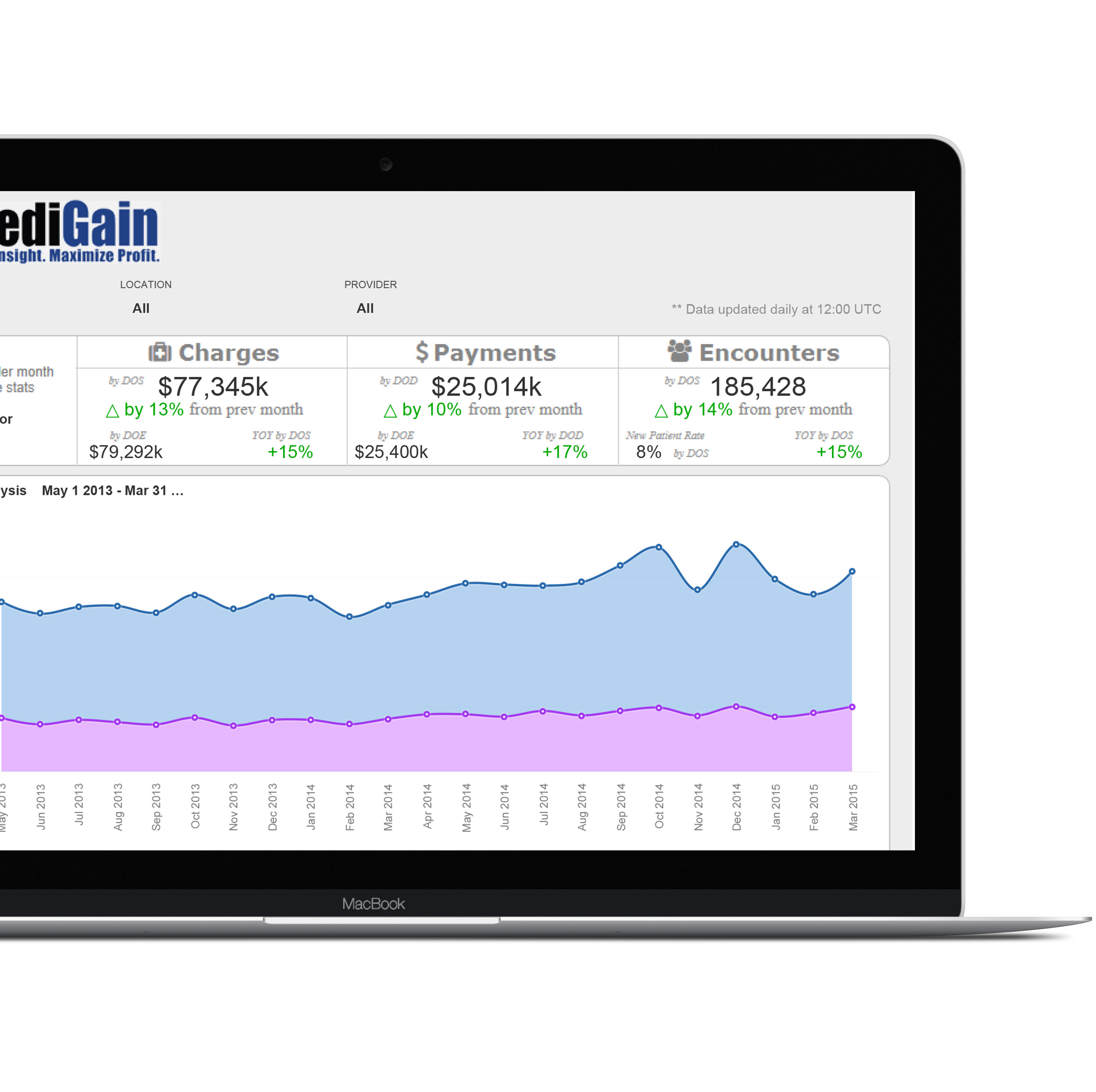
MediGain partnered with GoodData to put analytics into a client-facing service. InSights offered cloud-based reporting and predictive cash-flow analysis. GoodData’s case material says the first customer was onboarded within 30 days of the partnership. Advanced analytics also supported tiered pricing. A task that consumed internal effort could now help distinguish the service customers bought.
The numbers that do different jobs
The company had already demonstrated an appetite for expansion. It reached No. 269 on the 2009 Inc. 5000. In 2014, it announced $38 million in growth financing from Prudential Capital Group and acquired New Jersey-based Millennium Practice Management Associates. Management presented the acquisition as a way to extend nationwide coverage.
ANNOUNCED 2014
REPORTED 2016
OCTOBER 2016
Financing, project return and asset price measure different things. They are not a valuation series.
Those numbers need their labels. Nucleus reported a 0.1-year payback and an average annual benefit of $997,285 for the analytics deployment. Its 1,044% figure described that project’s return. It did not describe MediGain’s corporate profit margin, the return earned by every client, or the company’s ability to repay its lenders.
The audited accounts supplied a less comfortable view. MediGain recorded approximately $24.94 million in net revenue in 2015 and a $17.44 million net loss. That loss included substantial noncash impairment charges, so it should not be mistaken for cash burned. Nevertheless, the accounts reported debt-covenant defaults in both 2014 and 2015. Financial trouble predated the analytics award.
Its billing model made the operating details especially consequential. Customers were generally billed monthly in arrears, with fees typically calculated as a percentage of their net collections. Getting a practice paid helped generate MediGain’s own revenue. The economics still required enough collections-related income to cover the people, systems and overhead needed to deliver it.
A project return answers one question. A balance sheet asks another.
THE EDITOR’S READING
The buyer bought a different cost base
MTBC’s transaction was specific. It purchased senior secured notes from Prudential entities and then foreclosed on the assets securing them. The $7 million purchase price covered substantially all the medical billing business and assets of MediGain and Millennium. It was an asset transaction, rather than a clean bill of health for the old company.
What transferred included customer relationships, intellectual property and offshore operations in India and Sri Lanka. MTBC’s subsequent disclosures described client attrition and declining revenue before the acquisition. The buyer saw an opportunity to run those accounts through a different operating structure.
Its integration measures included reducing subcontractor use, personnel expenses, facilities costs, outside software requirements and separate administrative overhead. Those measures explain the buyer’s thesis more clearly than any acquisition slogan. A customer account may be worth more to an operator that can service it at a lower sustainable cost.
The business ultimately became part of the company now called CareCloud. MediGain’s original domain redirects there, and CareCloud’s later trademark schedule includes the MediGain and MediGain InSights names. The historical analytics offering belongs inside that ownership story.
Start with the report people keep requesting
For another service company, the transferable idea begins with an ordinary question: which information do customers repeatedly ask employees to assemble? MediGain found a product opportunity inside that recurring request. Partnering for the analytics infrastructure let it package access to information it already helped produce.
That approach depends on usable data, permission to handle it and customers who can act on the results. Fragmented records or a report nobody uses can leave the expensive assembly work intact. A healthcare buyer should also examine collection workflows and vendor finances alongside the dashboard. MediGain’s record makes the reason concrete: better information can improve a service while the company delivering it still struggles to pay its own bills.