An account is active in one system and suspended in another. Each service has produced a perfectly respectable answer. Together, they have produced a problem. This fictional example in the Semantic Conflicts Benchmark captures something familiar about office life: the trouble often begins where two sensible statements meet.
AI Automation points its audience toward precisely this territory. Its public LinkedIn presence brings together agentic AI, software quality and responsible AI. The interesting question running through that combination is almost embarrassingly practical. Before a machine acts on what it reads, can it notice that the instructions disagree?
- Follow the conversation: AI Automation shares applied AI research and software-quality updates.
- Try the test: its linked, independently hosted benchmark checks contradictions across six domains.
- Steal the habit: test agreement and uncertainty alongside obvious errors.
A community with a quality obsession
AI Automation presents itself on LinkedIn as a Seattle-based nonprofit, founded in 2022, inviting people to promote applied AI solutions and research for free. Its audience is roughly a quarter of a million followers. That figure measures attention, rather than paying customers or software installations.
The public offering is a stream of discoveries: research, testing discussions, technical demonstrations and community opportunities. Engineers, quality specialists and researchers have an obvious reason to browse. They can encounter work outside their own tool stack without first becoming customers of another platform.
That places AI Automation in the crowded market for professional attention. A specialist research feed competes with newsletters, developer communities and the posts already arriving from colleagues. Its editorial emphasis on quality gives readers a reason to return: how should these new systems be tested before somebody trusts them?
Two passages walk into a benchmark
The page’s About section links to the Semantic Conflicts Benchmark, a public repository under the GitHub account vivekkrishna. This is a concrete resource readers can inspect. It should be understood as linked research, with its own code and documentation, rather than automatically treated as an AI Automation commercial product.
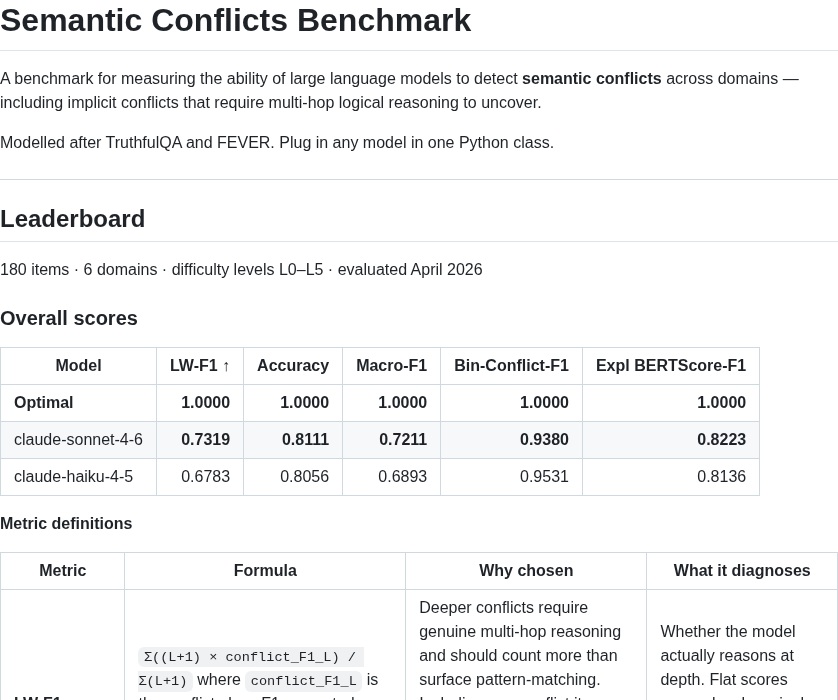
The benchmark contains 180 cases across philosophy, software, law, science, content and teams. A model reads two passages, then decides whether they conflict, agree or leave something unresolved. Some examples are fictional workplace situations; others draw on paraphrased philosophical or scientific material, or combine real law with invented contracts.
The twist is depth. At level zero, the disagreement sits on the surface. Higher levels are designed to require a chain of inferences. Two passages can avoid contradicting each other’s words while still committing their authors to incompatible consequences. That is an awkward skill to assess with a spelling check or a tidy demonstration.
The third answer earns its keep
The dataset contains 108 conflicts, 48 consistent pairs and 24 ambiguous pairs. Those last two groups do important work. A system that discovers a dispute in every paragraph would be an exhausting colleague. A system that resolves every uncertainty with confidence would be worse.
Ambiguous means the supplied information cannot settle the relationship. The annotation guide asks reviewers to identify the missing fact. This gives uncertainty a specific meaning. It also makes evaluation harder: spotting possible trouble and knowing exactly what kind of trouble it is are separate abilities.
The published April 2026 Sonnet report illustrates the distinction. Claude Sonnet 4.6 achieved 81.11% overall accuracy, but its ambiguous-class F1 was 0.4314. F1 balances precision and recall; it is not an accuracy percentage. A respectable headline result can coexist with difficulty recognizing when the evidence will not support a clean verdict.
The examiner gets examined
The repository’s most revealing reading is its own audit. An improvements document identified problems with reasoning-step counts, uncertain language in supposedly certain deductions, and metrics that could flatter weak behavior. The roadmap put data integrity ahead of more elaborate scoring.
“A benchmark with wrong labels is worse than a benchmark with fewer labels.”
Semantic Conflicts Benchmark development roadmap
The dataset card now reports that all 180 items pass structural validation. That means checks on the required fields, chain lengths and prohibited language. It does not establish that every judgment is correct. Independent annotation agreement and external domain review are still listed as unfinished work.
This distinction matters when reading the leaderboard. Eighteen conflict cases at each reasoning level leave considerable uncertainty, and the published baselines cover two Anthropic models. The material supports investigating particular weaknesses. It offers a much shakier basis for declaring a universal winner.
Borrow the experiment
A developer can download the repository, install its Python dependencies and run the command-line evaluator against a selected model. Built-in adapters cover OpenAI, Anthropic and Hugging Face; an example shows how to connect a local Ollama server. Reports preserve scores and failure examples for inspection.
The repository uses the Apache 2.0 license. Running it still consumes something: hosted-model API usage, or local computing resources, plus the time needed to review outputs. For a team considering document review or conflicting service records, the sensible experiment is small. Assemble representative pairs, decide the expected answers with domain experts, then examine the misses.
The transferable lesson is to keep the three verdicts separate. Count false alarms. Ask what missing information would resolve uncertainty. Check the reasoning behind a correct label. Those steps make a purchasing conversation much more useful than another polished chatbot exchange.
Attention is only the beginning
AI Automation’s appeal lies in connecting a large professional audience with inspectable work like this. Its invitation to share research for free fits a community distribution model. For a reader, the immediate benefit is access to ideas and tools; the work of evaluating them remains firmly on the reader’s desk.
The linked benchmark also draws a useful boundary around ambition. Synthetic cases cannot reproduce every messy corporate document. A judgment based on missing context needs human review. The most productive response is to test on the disagreements your own organization actually has. Somewhere, two perfectly sensible systems may already be giving incompatible answers.