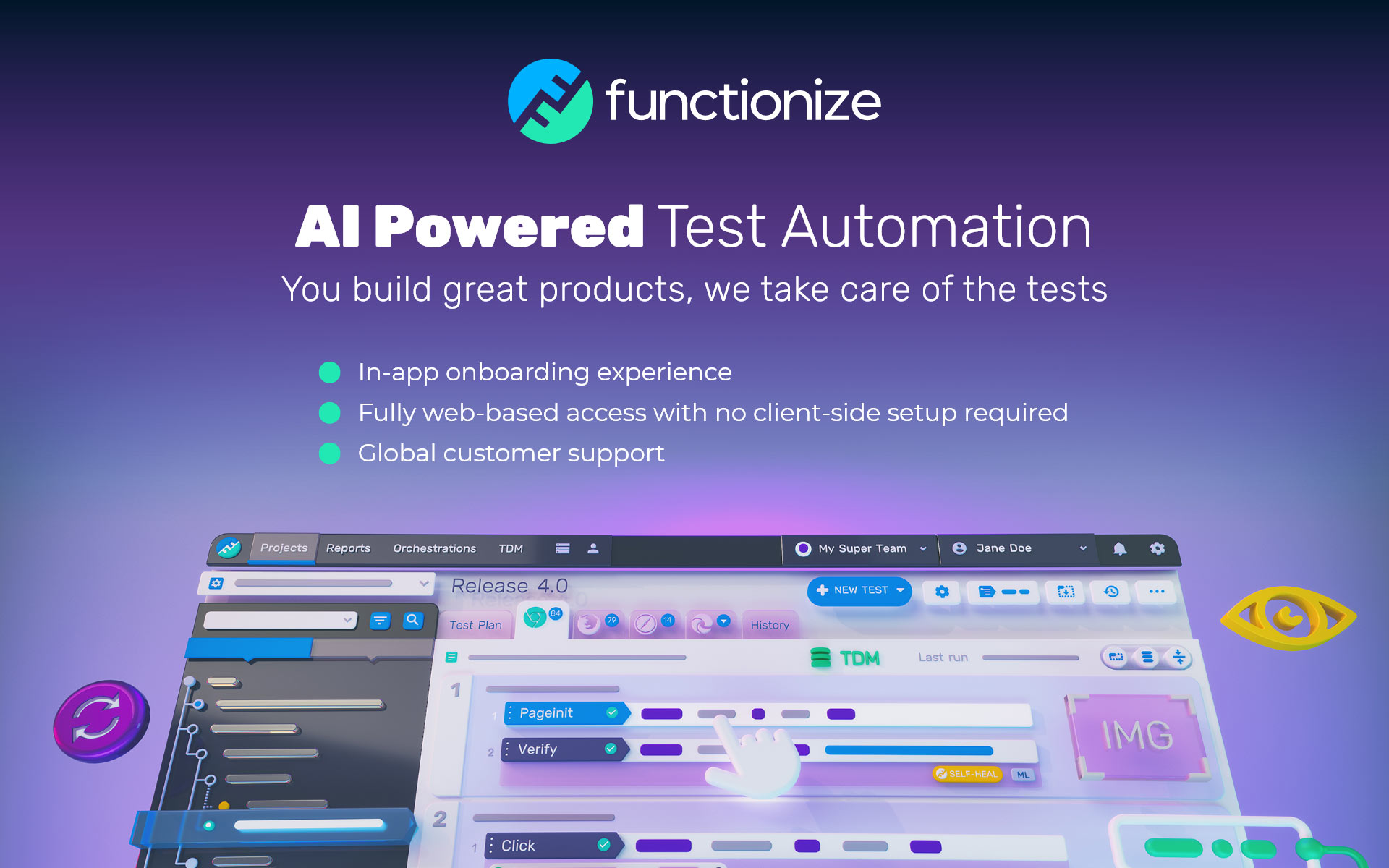
An AI lab that happens to ship a QA product.
On any given weekday, somewhere inside a bank you've heard of, a Functionize agent is opening a browser, clicking through a mortgage application, and quietly noting that a button shifted 14 pixels overnight. It writes the fix itself. Nobody pages the QA engineer. Nobody files a ticket. The release goes out.
That, more or less, is the company. Functionize is a 120-person, San Francisco-headquartered software-testing platform that has been steadily eating the work nobody at any enterprise wants to do: keeping thousands of automated tests alive while the application under test changes every week. The pitch is unfashionably narrow - autonomous QA for big, ugly enterprise applications - and that narrowness is precisely why it's working.
The company closed a $41 million Series B in August 2025, bringing its total raised to roughly $60 million. Annual revenue is around $17 million. Customers include Salesforce, HPE, Honeywell, Cigna, GE Healthcare, McAfee, ServiceNow, PwC, Farmers Insurance and Markel. None of that is meant to dazzle. The number that matters - the one Functionize's customers cite when asked why they signed - is 90%. As in: ninety percent off the test-maintenance bill.
Software testing was - and is - terrible.
Every enterprise of meaningful size sits on a bonfire of brittle tests. A team writes 4,000 automated checks to cover a banking portal. Engineering ships a redesign. Sixty-three percent of the tests fail by Tuesday, not because the app broke, but because a CSS class renamed itself. QA spends the rest of the sprint untangling false positives. The release slips. A vice president buys a vendor pen.
This is the silent tax on every software release. It does not appear on a board deck. It does appear, exhaustively, in the calendars of senior QA engineers. The industry's traditional answer was record-and-playback tools that broke on contact with reality, plus armies of contractors paid to nurse them. The newer answer was Selenium scripts, which require engineers, who have other things to do.
Tamas Cser ran a software consulting business in the 2010s. He watched the bonfire from the inside. He concluded that the problem was not the scripts. It was the assumption that humans should be the ones repairing them.
A violinist walks into a test framework.
Tamas Cser's biography is, frankly, the kind a journalist makes up. He grew up under a communist regime in Hungary, was identified as a child violin prodigy, and ended up at the University for Music and Performing Arts in Vienna. He toured the world playing the violin before deciding, more or less on a whim, that he wanted to write code instead. He spent the next fifteen years in the software industry. He then founded Functionize in 2014 because, as he tells it, nobody else was going to.
His bet was twofold and, at the time, considered slightly insane. First: machine-learning models, not deterministic scripts, would soon be good enough to understand a software application the way a human tester does - by looking at it. Second: enterprise QA budgets were so bloated and unhappy that a credible alternative would sell itself. He was right on both counts, but on a longer timeline than his early investors hoped.
What he was not betting on, in 2014, was generative AI. When the LLM wave broke in 2022, Functionize had spent eight years building a computer-vision engine, a self-healing test runner, and a deep-learning model for inferring user intent. The new tools slotted into the existing stack like they had been ordered in advance. Architect, the natural-language test designer, ships in 2023. Smart Fix, the self-healing agent, scales. By 2024, customers run a billion agentic actions on the platform. The bet pays.
Five agents, one job.
Functionize sells one platform. Underneath, it's a small zoo of specialized agents, each handling a piece of the QA lifecycle that used to require a human, a chair, and a great deal of caffeine.
Architect
Write a test in plain English. The platform generates the script, locators, and assertions.
Smart Fix
Self-healing tests that adapt to UI changes without anyone reopening the script.
Automation Cloud
Elastic execution across browsers, devices, and packaged enterprise apps.
Test Diagnosis
Root-cause analysis that explains why a test failed - and proposes the fix.
Visual AI
Computer-vision verification that catches pixel-level regressions humans miss.
The platform integrates where enterprises actually live: Salesforce, Workday, SAP, Oracle, Jira, TestRail, Zephyr Squad. It works on web, mobile, APIs, and packaged applications. It runs in the cloud or, for the banks, in tightly-scoped private deployments. None of this is revolutionary on its own. What is revolutionary, or at least uncomfortably useful, is that all of it works together without a forty-page integration guide.
A eleven-year arc, abbreviated.
Functionize is founded
Tamas Cser starts the company in San Francisco. The thesis: AI-driven software testing for the enterprise.
Seed round closes
Roughly $3M from Resolute Ventures and Skyview Capital. Heads-down ML work begins.
$16M Series A
Canvas Ventures leads. The platform graduates from clever demo to Fortune 500 procurement cycles.
Generative AI arrives, conveniently
Eight years of vision and ML investment lock in with the LLM wave. Architect ships shortly after.
A billion agent actions
Customers cross 10 figures of in-platform AI actions in a single calendar year.
$41M Series B
Mumford Investments and LHH Investments lead, with Canvas and Wipro Ventures following on.
A timeline shaped less like a rocket and more like a slow, deliberate hand turning a screw.
Numbers that QA directors actually care about.
Marketing decks love three-digit percentages. The Functionize ones happen to be defensible. GE Healthcare reports test cycles falling from 40 hours to 4. McAfee cuts regression time 40-70% depending on the suite. Aggregate test-maintenance savings across the customer base run as high as 90%. None of this is going to thrill a science journalist; all of it is going to thrill a head of QA looking at next year's budget.
Customer-reported impact
- Salesforce
- HPE
- Honeywell
- Cigna
- GE Healthcare
- McAfee
- ServiceNow
- PwC
- Farmers Insurance
- Markel
- Conduent
Autonomous QA, stated plainly.
Functionize publishes something it calls the Agentic Automation Manifesto. The short version: testing should not be a human-staffed function. It should be an AI-staffed function with humans setting the strategy. The company's mission, distilled past the marketing copy, is to make that future the default in enterprise software within the decade.
What "agentic QA" actually means here
The platform's agents don't just run tests. They design them from English-language descriptions. They watch the app for change. They fix themselves when they break. They explain failures in human language. They suggest the patch. A QA engineer becomes a director of an automated workforce - not a script janitor.
// Janitorial work, deprecated.
This is also, not incidentally, a good positioning for an AI company in 2025 that needs to justify its valuation without claiming to have invented AGI. Functionize is not promising to think for you. It is promising to handle a specific, expensive, universally-hated workload extremely well.
QA is about to get a lot louder.
The reason this matters is that the software supply chain is about to get significantly weirder. Code-generation models are pushing more code into more pull requests, faster, by people closer to and farther from the business logic in equal measure. The traditional check on all of this - human-written tests run by human-staffed QA - is already strained. It will not survive the next twenty-four months intact.
Functionize's argument is that the only durable answer is AI defending against AI: agentic test automation tall enough to keep up with agentic code generation. The argument is convincing. It is also, awkwardly for competitors, the only one most CTOs have heard that comes with a billion in-production agent actions attached.