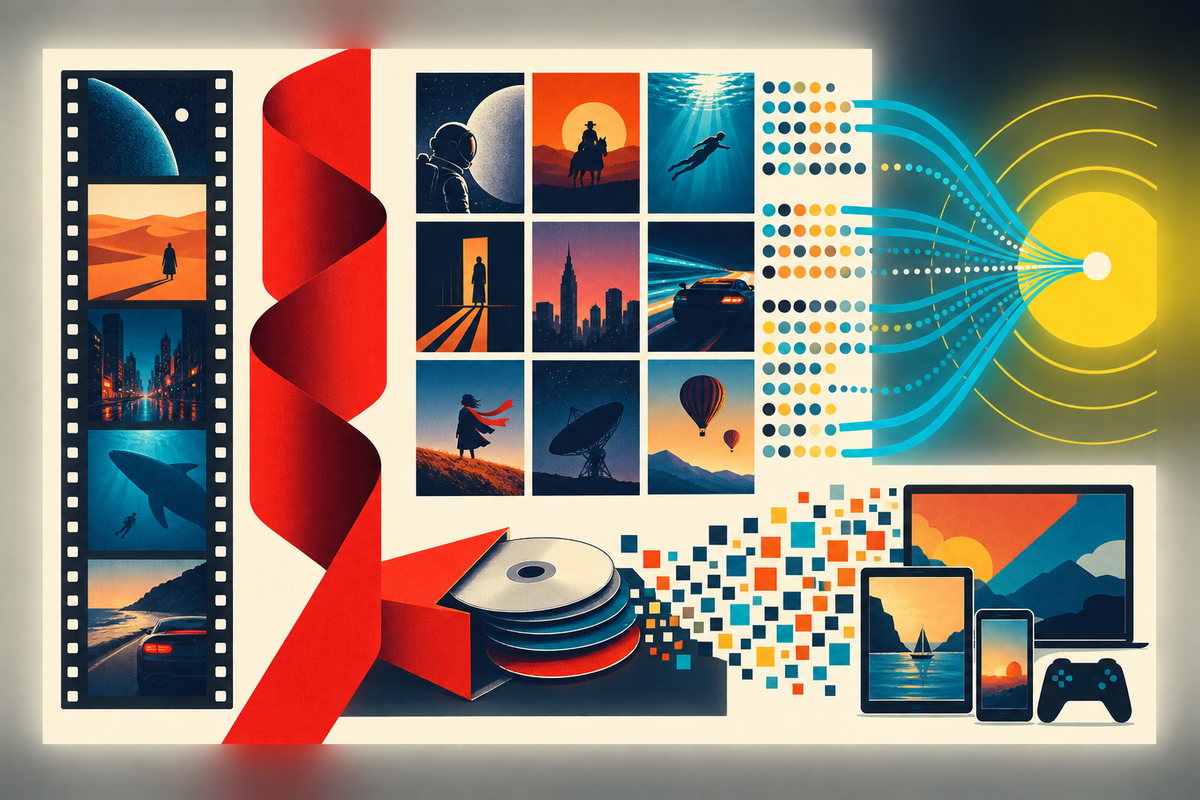
A red envelope once made a small promise: pick a movie online and the mail would bring it home, with no due date and no late fee. Netflix's larger promise has barely changed. Entertainment should arrive with less friction. Everything around that promise has changed repeatedly - the plastic disc, the delivery network, the screen, the studio system, the release calendar and even the insistence that the service would remain free of advertising.
This is why Netflix is best understood not as a streaming catalog but as a company built to replace its own delivery mechanism before someone else does. It mailed DVDs, then introduced streaming in 2007. It licensed other studios' work, then became a major commissioner and producer. It defined on-demand viewing, then added live comedy, wrestling and football. It offered one clean subscription relationship, then added a cheaper advertising-supported plan. Games, merchandise, restaurants and physical fan destinations now sit around the same account.
The transitions are not tidy, and not every experiment survives. But the pattern explains how a California DVD company became an entertainment service with more than 325 million paid memberships by the end of 2025. Netflix says that household co-viewing puts the audience near one billion people. That is not simply scale. It is a daily laboratory for learning what people open, finish, abandon and recommend.
A reliable reason to press play
Viewers pay for access to series, films, documentaries, animation, stand-up, live programming and games across phones, computers, televisions, tablets and consoles. The practical problem is obvious: buying or renting each title is expensive and inconvenient. The deeper problem is abundance. An evening disappears quickly when every service offers an endless wall of choices. Netflix attempts to compress rights, delivery, payment and discovery into a single familiar action.
Its recommendation system is therefore part shop window, part editor and part concierge. The rows, rankings and even artwork can respond to a profile's viewing behavior. This does not eliminate the blank-screen problem - anyone who has scrolled past bedtime knows that - but it gives Netflix a way to find small audiences for many different titles, not only to market a few blockbusters to everyone.
Advertisers are the other customer. Netflix's lower-priced ads plan lets households exchange some attention for a smaller bill, while brands buy access to a large, engaged audience. In May 2026, Netflix said the plan reached more than 250 million global monthly active viewers and that more than 80 percent of ad-plan members watched each week. The in-house Netflix Ads Suite handles targeting, formats, buying and measurement, with programmatic connections to large advertising platforms.
“At Netflix, we aspire to entertain the world, thrilling audiences everywhere.”Netflix culture memo
Hollywood taste, internet plumbing
Netflix occupies an unusual market position because it must be competent at two businesses that distrust easy formulas. Entertainment requires instinct, talent relationships and a tolerance for expensive misses. Software requires repeatability, instrumentation and constant iteration. The company has built an organization where a period drama, a Korean competition series and a network-routing system all contribute to the same product.
On the creative side, Netflix commissions and acquires work across many countries and languages, then supports it with dubbing, subtitles and worldwide distribution. A title no longer has to prove itself through a long chain of territory-by-territory sales before it travels. The service can put it in front of likely viewers across borders almost immediately. The result has been a series of cross-cultural hits that made subtitles feel less like a specialist preference and more like an ordinary setting.
On the engineering side, Open Connect places content close to viewers through appliances located within or near internet service-provider networks. Adaptive streaming responds to bandwidth and device conditions. Netflix also created VMAF, an open-source system for estimating perceived video quality. These are invisible products with a visible consequence: when someone presses play, the picture should start quickly and keep moving.
That combination creates the company's central loop. Subscription and advertising revenue fund content. Content attracts attention. Recommendations find audiences. Fandom makes selected titles larger than their viewing hours through conversation, merchandise, games and experiences. Those touchpoints supply more reasons to maintain the membership, which finances the next slate. The individual hit matters, but the portfolio and its distribution system matter more.
From “anything, anytime” to “watch it now”
For years, Netflix's most useful contrast with television was time. Broadcast told viewers when to arrive; Netflix waited. Live programming reverses that relationship. WWE Raw creates a weekly appointment. NFL games create a communal spike. Comedy specials, awards and fan events create moments that are more valuable when watched with everybody else.
Live changes the service technically and commercially. Streams must withstand simultaneous global demand. Advertisers gain scarce inventory around events. Viewers get a reason to open Netflix on a particular evening rather than at some vague point later. It also places Netflix closer to broadcasters and sports platforms, where rights are costly and reliability is judged in real time. A buffering wheel during an old sitcom is annoying. During the decisive play, it becomes the story.
Games follow a similar logic. They are included with membership and increasingly borrow from Netflix worlds. The company has tested mobile titles, television play using a phone as controller and family-focused collections. The proposition is not that Netflix will replace a dedicated console. It is that a familiar character or competition can turn a viewer into a player without another transaction. In 2026, the company connected this idea to the FIFA World Cup and expanded Netflix Playground for families.
The viewer job
Find something worth the next hour, play it on the nearest screen and continue elsewhere without managing files, schedules or separate purchases.
The advertiser job
Reach opted-in, attentive streaming audiences with measurable campaigns while borrowing the cultural energy around specific titles and live events.
A subscription business with studio economics
Netflix's business model remains primarily recurring membership revenue. Prices vary by country, features and whether advertising appears. The ads plan introduces a second revenue stream from the same hour of viewing. Consumer products, licensing and physical experiences add smaller extensions. In 2025, total revenue reached $45.183 billion, while operating income was $13.327 billion.
The expense structure is less like ordinary software. Netflix pays to acquire, license and produce programming years before some of that work is released. Content commitments are large and often fixed. A weak slate cannot be repaired with a minor interface patch. The company balances this risk across genres, budgets, countries and release dates, then uses global reach to give each project more possible routes to an audience.
Its competitors include Disney+, Prime Video, Max, Hulu, Paramount+, Peacock and Apple TV+. Yet the larger contest is not confined to paid streaming. YouTube, TikTok, gaming, broadcast television, cinemas and sleep all compete for the same finite leisure time. Netflix differs through the breadth of its multilingual slate, direct global distribution, recommendation data, delivery infrastructure and sheer scale. Rivals have pieces of that system; few have the same arrangement of all of them.
Freedom, with a sharp edge
Netflix's culture memo is nearly as famous in management circles as its shows are in living rooms. The current version centers on four ideas: the Dream Team, People over Process, Uncomfortably Exciting, and Great and Always Better. Employees are expected to share context, exercise judgment, give candid feedback and avoid rules that exist only to protect against rare mistakes. The company describes itself as a professional sports team rather than a family.
The useful idea to steal is not “remove every policy.” It is the connection between freedom and information. Autonomous decisions improve only when people understand the strategy, economics and tradeoffs around them. Netflix's model also carries pressure: high performance is explicit, feedback is direct and continued membership on the team is not assumed. Its approximately 16,000 full-time employees as of the end of 2025 operate across creative, technical and commercial disciplines that often pull in different directions.
The company's next problem is therefore one of coherence. A service containing prestige films, reality dating, live wrestling, mobile clips, children's games and brand campaigns can become more useful, or merely more crowded. Netflix has to make each addition feel like another answer to “what should we do tonight?” rather than another tab seeking attention.
The red envelope offers a clue. Netflix did not win because an envelope was glamorous. It won because the envelope removed a small, recurring irritation. Its best future products will do the same: reduce the distance between curiosity and enjoyment. The technology may be a recommendation model, a delivery appliance, a phone acting as a controller or a live vote from the couch. The standard is simpler. Pressing play should still feel easier than deciding not to.