Closter, New Jersey
The portfolio did not exist. This was inconvenient because Kurt Haiman had just asked to see it. Juan Carlos Pagan was in his final semester at Parsons when he wandered into an exhibition at the Art Directors Club in New York. An older gentleman approached, asked what he thought of the art and learned that Pagan was a design student. Then came the request for a business card. Pagan, despite having no business, happened to carry one. Haiman liked it and invited him to bring his work to the office the following week.
There was a small structural problem. Pagan had no comprehensive book to show. He responded with the optimism particular to young designers and people standing too close to a deadline: he stayed awake for nearly a week, drank coffee and built one. When he arrived, exhausted, Haiman looked through the freshly assembled pages and delivered a verdict that compressed an entire hiring process into a sentence.
You have great work. When you graduate, you have a job.Kurt Haiman to Juan Carlos Pagan
Pagan took the job. He spent more than three years at G2 Branding & Design before postgraduate study at Cooper Union and a move to MTV. Later, after becoming a designer, typographer and creative director in his own right, he called Haiman brilliant and a mentor. He said he learned simply by watching him. One can build a career out of such moments, although only in retrospect do they acquire the lighting of a fable: the student with a business card, the missing portfolio, the sleepless week, the employer who could see enough.
An eye trained for two worlds
Haiman’s judgment had been trained over a long stretch of American commercial design. After studying at Pratt Institute from 1953 to 1956, he entered the professional culture of New York art direction. By 1965 he was chairing a classification committee for the Art Directors Club’s annual exhibition. He joined Grey Advertising in 1968 and stayed for 29 years, rising to vice president and creative director. This was not the short hopscotch résumé of the modern agency world. It was closer to an occupancy.
Grey gave him scale, clients and the sharp constraints of persuasion. It also placed him inside the city’s dense guild of people who worried about pictures, type, hierarchy and the unnerving distance between what a message means and what an audience actually sees. Haiman joined the Type Directors Club in 1982. From 1990 through 1992, he served as president of the Art Directors Club, an organization built on the proposition that commercial work deserved standards, argument and exhibition walls.
When Haiman left Grey, he founded G2 Branding & Design and led its New York operation. The name now creates a minor historical trap. His G2 was a branding and design studio, not the Chicago software-review marketplace whose digital footprint dominates a search today. Haiman’s firm is gone. Its more interesting residue is human. Pagan remembered it as the place that took a chance on him and taught him how to think about making things.
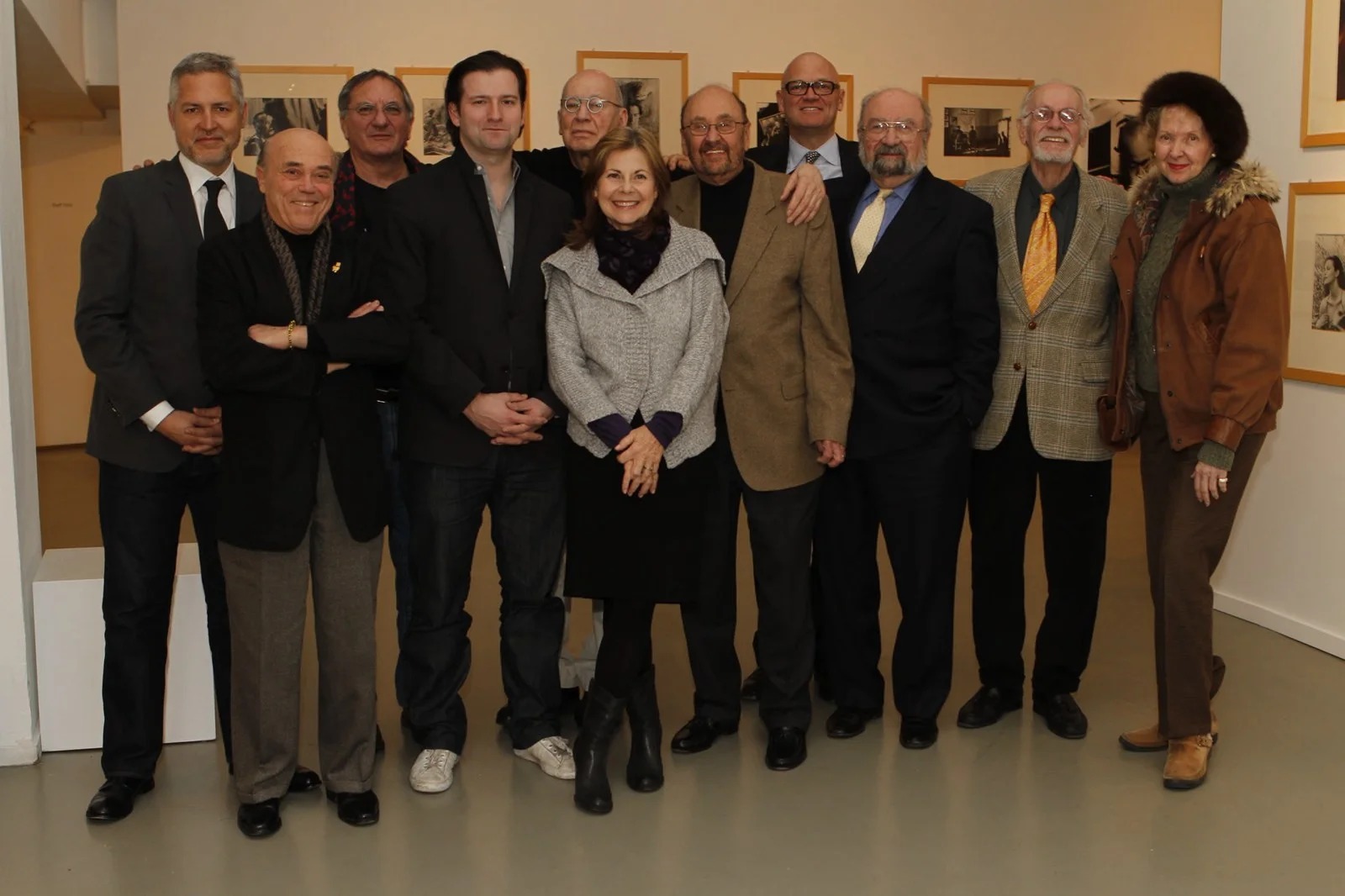
The club mattered because it gave a competitive profession a common room. Art directors who usually met across pitches, agencies and award tables could become stewards of the field itself. Haiman’s relationship with it stretched across decades: committee responsibility in the 1960s, the presidency in the early 1990s and, later, the informal authority of a past president. The 2011 gathering pictured above brought former leaders together around the current administration. It is a photograph of continuity, but also of maintenance. Creative institutions do not remain alive by having splendid archives. People must keep arriving, judging, arguing and introducing one generation to another.
That last task suited Haiman. His professional memberships were not ornaments on a biography. The Art Directors Club supplied the room in which Pagan met him. The Type Directors Club joined him to colleagues for whom a letterform was worthy of scrutiny. Haiman’s own teaching carried the same conversation into schools. Across these settings, the recurring activity was evaluation: deciding what worked, explaining why, and recognizing the moment when a student’s raw effort became professional promise.
The pattern extended beyond one hire. Haiman taught advertising concept and design at Parsons and at the School of Visual Arts. Teaching the subject requires a peculiar balance. Technique can be demonstrated; taste can only be argued into focus. A teacher must explain why one arrangement speaks and another merely clears its throat. Haiman occupied that territory as a working executive who continued to make art himself.
The second life was there all along
“Retired art director” described only the payroll portion of his later life. Haiman worked in watercolor, pastel, pencil and pen and ink. His pictures appeared at the Pomegranate Picture Gallery and New Century Artists’ Gallery in New York, the Forbes Magazine Gallery, Fairleigh Dickinson University’s gallery, the Bergen Performing Arts Center and a series of northern New Jersey venues. The list is revealingly mixed: corporate, academic, commercial and local. He did not require art to live in one district.

In 2015, the Belskie Museum of Art & Science in Closter included him in MADMEN-NYC ADVERTIZING ARTISTS, a title whose cheerfully wayward spelling suggested the exhibition understood both nostalgia and showmanship. In 2017 he served as a juror for the museum’s Personal Renaissance exhibition. A year later, the museum gave him the walls.
A Lifetime of Pen & Ink opened on October 7, 2018. The show assembled 32 plates on archival stock and ran for three weeks. Pen and ink is an apt medium for an art director: decisive, economical and poorly disposed toward excuses. Every line risks becoming evidence. The exhibition’s title did not separate Haiman’s studio work from his career. It joined them. A lifetime is allowed to contain client meetings, classroom critiques, private drawings and the white hush of a gallery before visitors arrive.
One line, sixty-five years of practice
A civic brief, delivered at council
Haiman did not merely exhibit at the Belskie. He served as its president, which meant accepting that culture arrives with minutes, budgets, attendance problems and officials who have other appointments. At a Closter council meeting in November 2010, he asked members of the governing body to participate in museum openings. He pointed to empty stores in town and proposed a public-relations campaign. Residents, he argued, needed more information, presented positively.
It is easy to hear the adman in that request. He saw disconnected facts - vacant shops, a museum, residents who might attend - and looked for the message that could put them in the same frame. But the appeal was not slick. It was stubbornly local. The audience was a town council; the media plan included a brochure and email notices; the desired conversion was a neighbor walking through the museum door.
Haiman returned to public meetings. He asked about the condition of Closter Plaza and pressed for attention to the museum’s shows. His civic concerns were practical and visible. A plaza could embarrass a town. An unattended opening could diminish a museum. Design, in this view, was not decoration applied at the end. It was care made legible.
The elegant lesson in Haiman’s career is that noticing people is also a form of design.A life read through its work
That idea gives the Pagan story its staying power. Haiman noticed a student at an exhibition. He noticed the business card. He created the occasion for a portfolio to come into being. The job offer was generous, but it was not sentimental; it followed a judgment about the work. Attention opened the door and standards decided what happened next.
What the line leaves behind
By March 2019, Closter had formally recorded Haiman’s passing while appointing a new representative to the Belskie Museum. The bureaucratic phrasing was plain. Elsewhere, memory supplied the color. Pagan repeatedly called him “the late great Kurt Haiman” and placed him among the people who shaped both his work and his life. In 2025, writing about vanished agencies and an industry accelerating through consolidation and artificial intelligence, Pagan said Haiman’s sense of craft still sat on his shoulder while he worked.
Companies close. Names get reused. Websites decay into error pages, and the search engines confidently introduce one G2’s founder with another G2’s statistics. A person’s record can become surprisingly delicate. Yet certain decisions prove durable. Ask for the card. Invite the student. Look at the work. Say yes when yes is deserved.
Haiman’s career could be counted in years, titles, committees and exhibitions. Its shape is more interesting. The line begins at art school, travels through the agency, loops into his own firm, passes through classrooms and professional clubs, then reaches a small museum and the council chamber down the road. It never quite chooses between commerce and art, because Haiman seems not to have believed the choice was necessary. He kept drawing, and he kept looking.