A river is an unusual place to begin a story about private equity. Yet when Neil Auerbach explained the name of his investment firm at a community event in Queens in 2019, he pointed to the Hudson. He had been inspired by its restoration. There was a second, less elaborate explanation, too: he was a New Yorker.
“I was inspired by the restoration of the Hudson River, hence the name.” It is a useful detail about someone whose professional vocabulary runs to structured capital markets and renewable energy finance. A river’s recovery supplies a picture of change that a spreadsheet cannot. It also makes a rather better company name than an acronym assembled by committee.
Auerbach is now based in Miami, leading Hudson Sustainable Group as CEO and chairman. The move south has left his working subject intact: the difficult passage from an energy technology that looks promising to an enterprise that can attract money, build something and keep going. His career contains early investments, company building, public policy arguments and a conspicuous setback. The setback deserves its place beside the successes.
The lawyer arrives before the solar panels
Auerbach’s route into energy began with legal training. He earned a bachelor’s degree at the University at Albany, a law degree at Boston University and an LL.M. in Taxation at New York University in 1984. Taxation is an unglamorous opening act for a career in solar. It does, however, teach a person to read the part of a transaction that everyone else hopes someone has checked.
His early work included tax law at firms such as McDermott, Will & Emery, Shearman & Sterling and Cahill Gordon & Reindel. He also served at the Internal Revenue Service. The banking roles followed: Morgan Stanley from 1995 to 1997, then Barclays Capital from 1997 to 1999, where he headed structured capital markets.
Those jobs placed him among derivatives, debt and the design of financial transactions. At Goldman Sachs, he worked in debt capital markets and credit derivatives before turning toward renewable energy. The sequence matters. He arrived at the sector with experience in arranging money around complicated circumstances. That is a different apprenticeship from inventing a better panel or developing a wind turbine, and a useful one when an unfamiliar industry needs investors.
A technology’s appeal and a lender’s willingness to finance it are separate questions. Auerbach’s subsequent work would repeatedly bring them together. The legal education was no longer just an item near the bottom of the biography.
When renewable energy entered the balance sheet
In 2003, Auerbach founded Goldman’s alternative energy investment business. Its investments included SunEdison, First Solar and Horizon Wind. He was putting institutional money into businesses whose growth depended on more than a clever piece of equipment.
At an NYU renewable energy finance symposium in 2013, he described the conditions that had helped the sector grow between 2002 and 2008: fiscal stimulus around the world, higher energy prices and greater concern about climate change. His explanation had several moving parts. The technology mattered; so did the price of competing energy and the rules governments chose.
That combination helps explain the shape of his career. Energy investors work with decisions made elsewhere, from a legislature to a customer’s purchasing department. A promising machine can still meet a bad market. A strong market can still be undermined by an awkward financing structure. His work increasingly occupied the space where those conditions had to be made compatible.
In 2007, he founded Hudson Clean Energy Partners. By his June 2011 congressional testimony, the firm had more than $1 billion in assets under management and invested across wind, solar, hydroelectric power, biofuels, biomass, smart grids, electric vehicles, efficiency and storage. The portfolio was a reminder that a cleaner energy economy would need considerably more than sunshine.
Electricity, with a side of laughter
In June 2014, Auerbach joined a debate about whether distributed solar would threaten the traditional utility business. His former Goldman colleague Larry Kellerman argued the opposing case. Auerbach defended a future in which customers could generate more of their own electricity.
He recalled the high prices of his early solar investments and contrasted them with the much lower costs available by 2014. But his attention had moved beyond the panel. Financing, installation and finding customers were becoming central to the remaining cost of a rooftop system. Home Depot featured in the discussion as a route to reaching homeowners and arranging installations.
The exchange also showed that he could make a room laugh. Discussing his first wind investment, he teased his former colleagues for their doubts about producing electricity without burning something. It was a banker’s joke with a technological dispute tucked inside it.
Read as a moment in his career, the debate captures his interest in the business surrounding the invention. A household needs a way to purchase a system. An installer needs to be paid. An investor needs a return. The roof may receive the sunshine; the paperwork has to travel a longer route.
A lender reaches the stock exchange
The year of that debate was also the year Auerbach co-founded Sunlight Financial. He served as its founding CEO, then executive chairman and chairman. Residential solar finance brought his subject close to the individual homeowner: a large purchase, an installer and a loan.
Sunlight went public in July 2021 through a transaction with an Apollo-affiliated special purpose acquisition company. In October 2023, it filed for Chapter 11 bankruptcy. A deal with a consortium of investors provided for the business to continue under private ownership. The public-market chapter had lasted little more than two years.
That short interval puts a useful limit on the celebratory photograph that accompanies almost every stock-market debut. A listing records a transaction at a particular moment. It cannot certify the durability of the business that follows. The photographs do tend to suggest otherwise; nobody rings a bell for a well-managed interest-rate exposure.
For Auerbach, the company remained part of his public story even after his departure. An enterprise he had helped start had encountered a very different ending from the one its arrival on the exchange appeared to promise.
The next company remembers
In July 2026, Auerbach published his own account of Sunlight’s rise and failure. He said he had stepped down as chairman and left the board at its public debut. He described pride in building the lender and argued that later underwriting and interest-rate decisions had weakened it. That explanation is his assessment of what went wrong.
He described the company’s demise as painful for himself and his firm, and its lessons as lasting ones.
His essay then turned to SolSource Solutions, his subsequent venture in residential solar and battery finance. He described working with partners including Enphase, CED and TriBeam, and applying stricter attention to financial structure and risk.
The return to the same market gives the account its interest. He has chosen to build again in a field where he has already seen both expansion and failure. In his telling, the next company carries a more demanding set of rules about growth. Experience has supplied material that an early business plan could never contain.
“But the lessons are seared into my memory.”
Neil Auerbach, July 2026
A conservative makes his case
Auerbach has also spent years taking his investment perspective into public policy. In congressional testimony in September 2011, he identified himself as a conservative who believed in limited government. He argued that renewable energy support should be designed to reduce the costs of getting public assistance into actual projects.
His preferred approach included reverse auctions, with market competition helping determine the level of support. It was a discussion about mechanisms, rather than an invitation to admire an industry from a safe distance. For someone trained in tax and structured finance, the mechanism was familiar territory.
He remains a senior advisor to the American Conservation Coalition. In a November 2024 essay, he argued that clean energy investment belonged within an agenda of American manufacturing, energy independence and competition with China. He supported a broad mix of generation, alongside expansion of transmission and distribution.
In March 2025, Hudson released his case for retaining the Inflation Reduction Act’s clean energy tax incentives. The argument emphasized jobs, private investment and energy security, including benefits in Republican communities. His position was that these incentives could be defended in the language of conservative economic priorities.
These are policy choices in which he has an investor’s interest as well as a citizen’s. That combination makes his reasoning worth examining on its terms. He knows the projects that need capital; he also wants the rules to help them attract it.
The new customer is hungry for power
By May 2026, Auerbach was discussing another source of demand with Jill Malandrino on Nasdaq TradeTalks: artificial intelligence. The interview focused on the economics behind rising U.S. power needs. In a LinkedIn post sharing the conversation, he described the grid and power supply as coping with AI “indigestion.” A mild word for a potentially expensive appetite.
His current argument favors abundant, affordable electricity and a wide range of ways to produce it. In the 2026 political debate, he has warned against letting ideological preferences for or against particular energy sources crowd out the practical question of supply.
The focus creates a link across his career. Early renewable investments required capital willing to support unfamiliar businesses. Residential solar required finance that could reach a household. AI-related demand raises the question of how enough generation and infrastructure can be built. Each stage brings money, technology and public decisions into the same room.
The river that gave Hudson its name represented a visible recovery. The work Auerbach chose is often less photogenic: a transaction that closes, a financing structure that holds, a company that survives its next change in conditions. His latest chapter returns to that standard. The bright idea still has to pay its way.
Continue the conversation
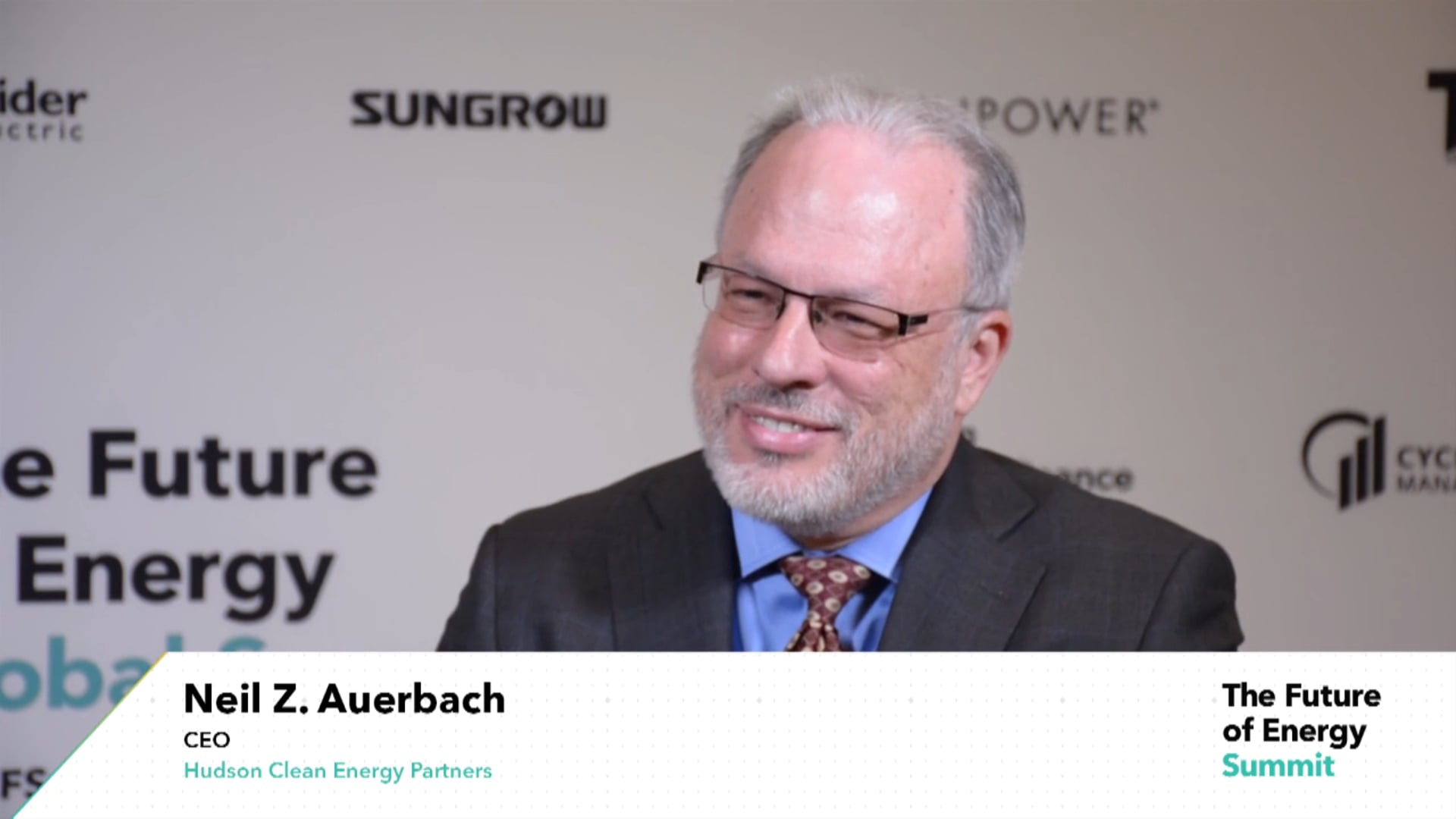
Interview image: BloombergNEF, Global Summit 2017.