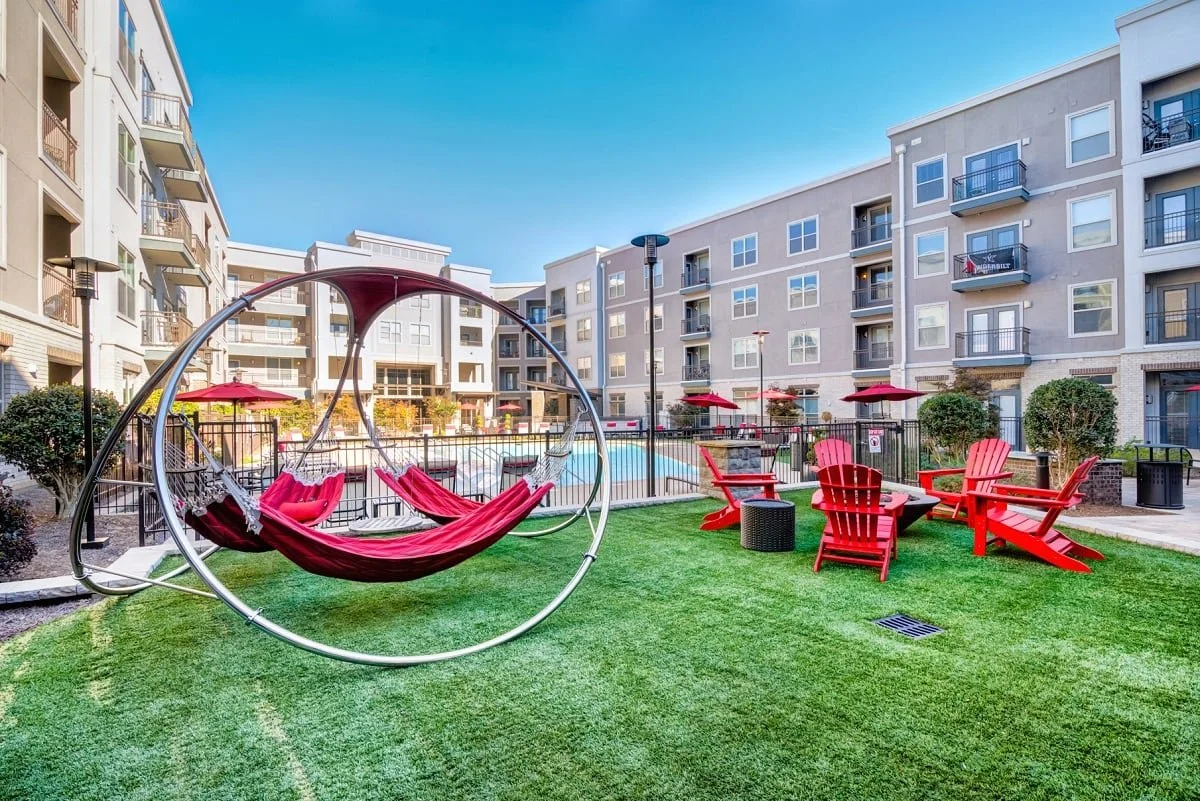
The parking spaces were empty. The dogs, apparently, were everywhere. At the Carillon, an apartment property in Nashville’s Germantown neighborhood, Danny Fishman and his team noticed a mismatch that no handsome leasing brochure could resolve. Residents preferred the covered parking below. The exposed roof above had little to do. So GAIA Real Estate turned it into a dog park.
The same building offered another small comedy of modern living: an unused gaming room, while people working from home competed for conference-room space. GAIA added coworking facilities. In Fishman’s telling, the improvements came from watching residents rather than copying the latest amenity fashion. A room can look excellent on a checklist and spend its entire working life waiting for someone to enter it.
These are modest details for a career involving investment banking, bankruptcy proceedings and thousands of apartments. They are also a useful place to begin. Fishman’s work keeps returning to a question with very little glamour: what is happening here, once the presentation has ended? The answer might concern debt. It might concern the neighborhood. Occasionally, it concerns where to take a dog.
Before the apartments, the state-owned companies
Fishman was born and raised in Jerusalem. His education at the Hebrew University of Jerusalem included economics and an MBA in finance and accounting. He began his working life helping prepare Israeli government-owned companies for privatization, with real estate among his responsibilities. Rental businesses, infrastructure and development were all part of that early education in the machinery behind a property.
The work required getting companies ready for a change of ownership: examining their books, inventorying assets and considering how a sale or flotation should proceed. It was an introduction to buildings as businesses, with decisions and obligations attached. A property’s address could be simple; the arrangements governing it could be anything but.
He subsequently moved into investment banking and private equity, co-founding Tamir Fishman in 1996. The firm became an investment bank and asset management business. By the time the American financial crisis arrived, he had spent years working with capital, institutions and transactions. He was approaching U.S. real estate with the experience of someone who had already built another financial business.
A young firm meets an enormous bankruptcy
Fishman met Ken Woolley, the founder of Extra Space Storage, in Israel. They saw the possibility of buying distressed real estate when an inflated market corrected. In 2009, Fishman moved to the United States and they launched GAIA. New York was their starting point. Early transactions included buying blocks of condominiums for cash from developers facing a suddenly much less cooperative market.
Then came the deal that changed the scale of the company. In 2012, GAIA partnered with Starwood Capital to acquire the PJ Portfolio through bankruptcy court. It comprised 32 properties and about 9,500 apartments across the Sun Belt. Its financial trouble traced back to Lehman Brothers, which had supplied mezzanine financing to the previous owner.
The court process took roughly a year. Winning it brought an immediate operational burden: properties across several states, neglected units, financing to restructure and teams to organize. An auction can end with a winning bid. The plumbing, leasing and repairs have considerably less respect for ceremonial endings.
The partnership invested in rehabilitation and spent its first years increasing occupancy. GAIA and Starwood eventually exited the portfolio in 2022, after nearly a decade. Their announcement reported a return multiple above 15 times. That figure belongs to this particular investment and the partners’ reported results. The underlying story had taken ten years of ownership, capital work and financial decisions to unfold.
Learning a building before buying more of it
New York supplied a different sort of exercise. In December 2013, GAIA bought the entire 50th floor of the Corinthian, the large residential tower in Murray Hill. In 2014, it acquired another 144 condominium units there for $147 million, with plans to renovate, rebrand and sell them. Designer Andres Escobar was engaged for the condominium interiors.
The sequence matters. GAIA had already worked inside the building before taking on a larger purchase. Fishman emphasized its knowledge of both the property and the surrounding area. There is a fairly ordinary advantage hidden inside that statement: familiarity can reveal what a distant valuation leaves vague. The next acquisition begins with lessons from the previous one.
He applied the same curiosity beyond Manhattan. Before GAIA’s approximately $395 million purchase of five Harbor Point apartment buildings in Stamford in 2016, Fishman had visited the development’s apartments and its restaurants, bars, pharmacies and grocery stores. The shopping list was part of the investment work. Residents rent an apartment, but their daily routines extend well beyond its front door.
“We’re always working against the market”
Danny Fishman, on GAIA’s 2022 Texas exit
When the inspection becomes a weekend
Germantown offered Fishman a version of that idea in Nashville. The area’s older buildings, small businesses and walkability appealed to a team accustomed to evaluating apartments in New York. The Carillon was a property they could judge in relation to the places around it, rather than solely by the amenities inside it.
There was an unusually human piece of evidence, too. Fishman recalled staff wanting to stay in the neighborhood after their inspection work was finished. Assignments that ordinarily prompted a quick return flight became trips people wanted. Their own response gave them a way to think about a prospective renter’s choice. Wanting to linger was information.
The rooftop conversion and coworking changes followed that same habit of observation. They also offer a practical test of the word “improvement.” Installing something fashionable is easy to describe. Understanding which existing space residents actually need requires paying attention to use, inconvenience and absence. The quiet room may tell you as much as the busy one.
Fishman has described the property as performing better than expected, while acknowledging the contribution of its location. That qualification is revealing. Good management operates inside a neighborhood, an economy and a financing market. An owner can improve a building without claiming credit for everything happening around it.
Selling Texas, buying a former pencil factory
By 2022, Fishman thought parts of the Sun Belt had become too expensive. GAIA sold five Houston properties totaling 1,376 units, bought in 2015. The sale accompanied its broader regional disposals. Population growth still interested him; the price investors were willing to pay had become the sticking point. A growing city and an attractive purchase are separate calculations.
New York, meanwhile, offered opportunities GAIA chose to pursue. In June 2022, the firm acquired a three-building Lower East Side portfolio with 56 apartments and five retail spaces for $34.75 million. JLL arranged the sale and acquisition financing. These were mixed-use properties, with commercial space and homes sharing the same patch of city.
In August, GAIA bought 55 Hope Street in Williamsburg for $80 million. The six-story building had once been a pencil factory; an earlier owner had converted it into 117 rental apartments. GAIA planned coworking space, and Fishman pointed to the appeal of neighborhoods where residents could live, work and spend their leisure time.
A converted pencil factory is an agreeable setting for an argument about changing habits. Its original business belonged to one era of work. Its apartments and shared workspaces belonged to another. The investment thesis depended on what tenants would want next, and on the amount GAIA would need to spend to provide it.
Miami, with a different kind of inventory
GAIA opened its first Miami office at the beginning of 2025. A headquarters move followed, announced in December that year, while the firm retained a New York office. Fishman’s focus shifted toward South Florida and the Sun Belt. The move was both a business decision and a statement of where he expected to find the next opportunities.
The Miami venture with Doron Broman’s Moderno Development Group introduced a different unit of investment: individual houses and townhouses. The partners launched MILAS, short for Miami land and single-family, with a $150 million first phase and a second phase of the same size planned. Their initial ambition was to acquire about 400 homes near the urban core, renovate or replace them, and offer them for rent.
Those numbers describe the announced plan, rather than a completed collection of homes. The planned rents of $4,000 to $7,000 a month also place the venture in a particular segment of the market. Fishman’s interest in neighborhood change spans different kinds of housing, with different customers and budgets.
Broman has described their shared habit of walking properties. It is an appealing continuity in a career that has crossed countries, institutions and investment cycles. The structures change: state-owned companies, condominiums, apartment portfolios, individual houses. Someone still has to go outside and examine what is there.
- JerusalemEducation, privatization and investment banking
- New YorkGAIA’s 2009 launch and residential acquisitions
- Miami2025 office opening and South Florida expansion
The renter sets the renovation budget
In July 2026, Fishman put another argument into writing: existing apartment buildings could help address the shortage of suitable housing for middle-income renters. He advocated improvements calibrated to what local residents can afford, including updated units, mechanical systems and management. He suggested testing a small group of renovated apartments before committing to a property-wide program.
The order of decisions is central to his proposal. Set a realistic rent for the intended customer, then work backward to a renovation budget. A finish can be lovely and still be the wrong expenditure. His argument gives the resident’s income a direct role in deciding what the owner builds, replaces or leaves alone.
His public comments on New York in April 2026 were equally concerned with the conditions around a building. He argued that predictable tax and rent policies matter to projects that can take five to ten years or more. This is Fishman’s assessment of investment risk; it explains his decisions without turning his view into a universal verdict on a city.
And New York remains in the story. In September 2026, GAIA secured another one-year extension of the $48 million loan on 55 Hope Street, taking its maturity to August 2027. The building had received coworking space and rooftop improvements. Fishman said its net operating income had increased and that its loan-to-value ratio was below 50 percent.
The announcement supplies a useful ending for a profile about patience. Headquarters can move; ownership responsibilities remain attached to an address. Borrowing, repairs and residents continue long after the acquisition photograph. For Fishman, the long walk through a property is only the beginning of the time he expects to spend with it.