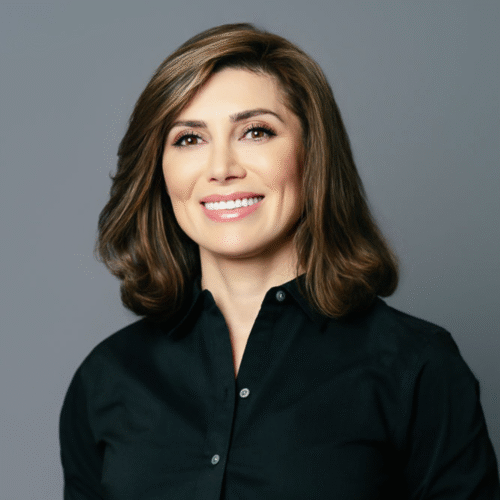
The operator who bet on the device before it had clearance
The year was 2019 and iSono Health hadn't yet received FDA clearance for anything. Neda Razavi wrote a check anyway. She joined the board of advisors, watched the technology take shape, and when the FDA cleared the ATUSA system in May 2022, she already knew exactly what the company needed to do next. Four years after that first bet, she became its CEO.
That sequence matters. Most executives inherit a product. Razavi helped shape one from the outside, then stepped inside to commercialize it. The $2.9 million in revenue generated by a 19-person team in 2024 is the first return on a very long play.
Her entry point into medtech started in Tehran, where she studied microbiology and cellular biology at the University of Azad. The finance MBA from Pepperdine came later - a deliberate pivot toward the commercial machinery that moves drugs and devices from bench to bedside. After Pepperdine, she spent two decades inside the machinery itself: Abbott, Baxter, Medtronic, Kythera, Illumina, Roche, Natera. Six platforms. Sixty-five products. Nine billion dollars in cumulative revenue.
At Natera, she increased customer attachment rates from 40% to 65% and boosted patient engagement by 40%. At Roche Diagnostics, she built the commercialization strategy for oncology and genomic labs. These aren't resume lines - they're the specific operational muscles iSono Health hired when it appointed Razavi CEO in November 2023.
The award authenticates the importance of early detection of cancers using automation, robotics, AI and ultrasound, saving lives as a priority.
- Neda Razavi, on winning the Qatar Foundation WISH 2024 Innovation CompetitionThe product at the center of all this is the ATUSA system - a wearable, hands-free 3D breast ultrasound that captures a complete image in approximately two minutes. Ten to fifteen times faster than manual probing. No trained sonographer required. The AI reads the scan; the cloud stores it. The clinician - an OB/GYN or primary care provider - gets an image without building a radiology department.
The business model is "Ultrasound-as-a-Service" - hardware plus cloud plus consumables - designed to lower the barrier to entry while building recurring revenue. Razavi's read on the market: most women in the United States never see a breast ultrasound because their doctor doesn't have a sonographer. ATUSA changes the denominator. Commercially launched on January 14, 2026, the device is no longer a prototype.
While the product ships, the evidence base is being built. The AUDIBLE study - an NIH-funded, 800-patient pivotal multicenter clinical trial - is running across UC Davis, City of Hope, and Axia Women's Health. The trial compares ATUSA against traditional mammography and MRI and evaluates the AI for lesion detection. Razavi's roadmap for what she calls "machine-as-the-expert" breast imaging depends on this data.
Outside the office, Razavi co-hosts the Precision Medicine Salon with Sarah Eagleman, opening her Menlo Park home to conversations about multiomics, in-home care, chronic disease, and what the next wave of screening actually looks like. She is currently pursuing a certificate in Genomics and Genetics at Stanford. The salon and the Stanford coursework are not separate from the job - they're how she stays current in a field that doesn't wait.
She was recognized by Persian Women in Tech as a "Mom in Tech" - a distinction that says something about the community around her and the fact that she navigated the medtech industry, startup investing, and startup leadership simultaneously. Frost and Sullivan gave iSono Health a 2023 New Product Innovation Award. HLTH named her a 2025 Rising Star in diagnostics. Arab Health's Innov8 competition handed her another win in February 2025.
The pattern is consistent: Razavi picks things early, gets close to the underlying technology, and waits for the moment when commercial execution becomes the bottleneck. That moment for iSono Health arrived in late 2023. She was ready.