The most revealing thing about Navix is that it began as a shopping trip. In 2021, Eric Krueger was working on a request for proposal with a large third-party logistics provider. The assignment sounded ordinary: find software that could automate the back office. Then every bid came back incomplete. Products could digitize a piece of the process, but none could resolve disputes, handle several freight modes and run the whole job without a relay race of human clicks. The RFP had no winner. Krueger and his co-founders, Kevin Ziegler and Jason Mansur, changed the question from “What can we buy?” to “What needs to exist?”
What needed to exist was not another transportation management system. A TMS is good at dispatching a load, tracking its movement and recording the operational facts. The trouble starts after delivery, when bills of lading, rate confirmations, carrier invoices, fuel schedules, reweigh certificates and accessorial charges arrive in different formats. The truck has stopped. The paperwork has begun its own journey.
An exception queue wearing a finance degree
Navix ingests those documents, classifies them and turns their contents into structured data. Its freight-specific engine then checks every invoice line against contracted rates and business rules. Linehaul may match. Fuel may match. A $300 detention charge may collide with a $75 contracted allowance. The software flags the $225 difference, assembles the evidence and drafts the dispute. Clean invoices move to approval. People see the oddities.
That division of labor is the product’s real design. “AI-powered” is on almost every enterprise-software homepage now; a useful system must say what the machine does, what it knows and when it yields. Navix exposes line items, variances and contract references instead of returning a mysterious red light. Configurable rules can auto-approve a trusted carrier, hold a new vendor for three months, demand a delivery document or stop a bill when a charge falls outside a tolerance. The machine does repetition. The operator keeps judgment.
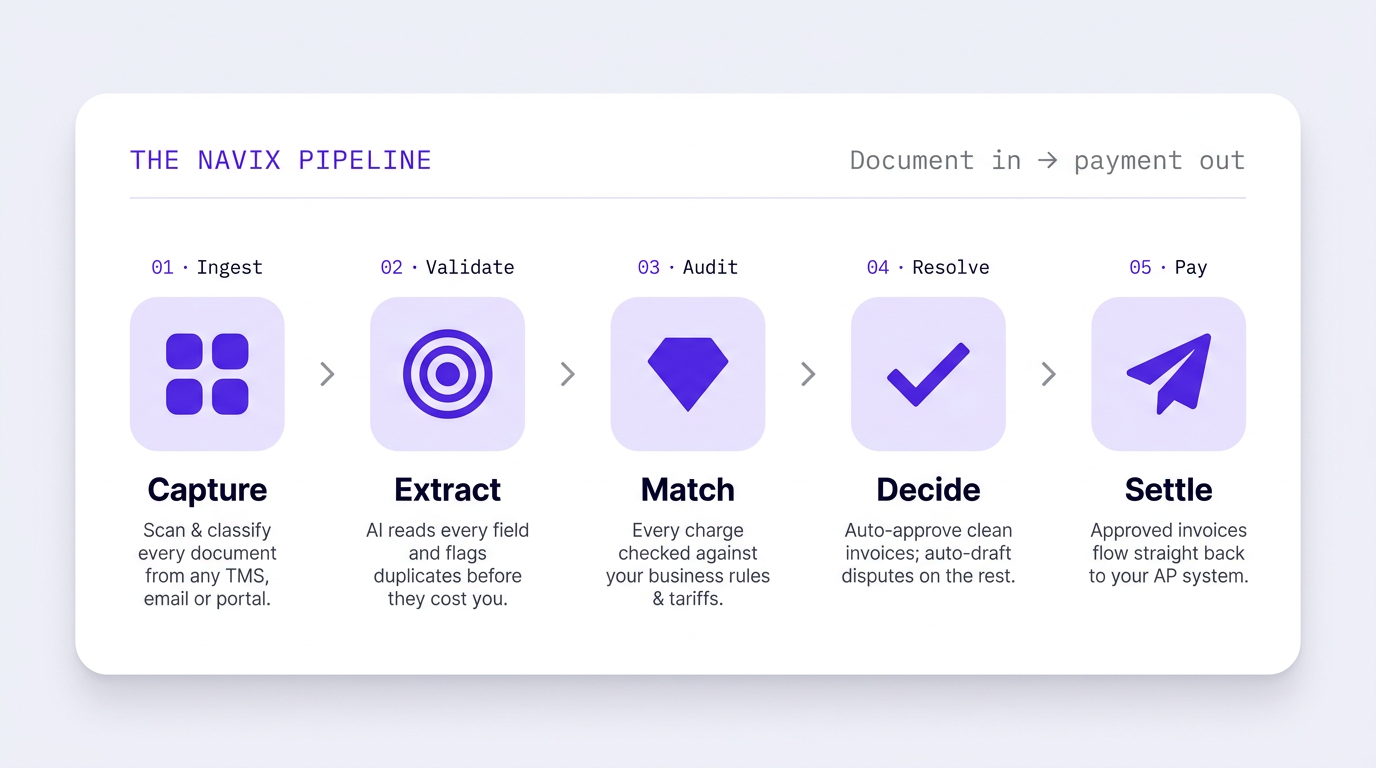
The platform covers full truckload, less-than-truckload and drayage in one workflow, with support extending to warehousing, intermodal and cross-border invoice processing. That range matters. LTL billing can resemble a menu whose prices change by lane, weight, class, tariff and accessorial. A general document reader can recognize a number; freight audit must decide whether that number belongs there.
“Freight execution and financial execution have to move at the same speed.”Eric Krueger, CEO and co-founderThe money
Navix does not sell faster trucks. It sells shorter waiting.
For a broker or 3PL, delay between delivery and billing locks up working capital. Navix’s newer Pre-Bill workflow uses proof-of-delivery data to invoice the customer as soon as a load is delivered, before the carrier bill completes its normal audit. The carrier bill is still reconciled; the customer receivable simply gets a head start. Navix says its customers reduce days sales outstanding by at least three days, with a typical range of three to ten.
One KCH Transportation case study reports days-to-bill falling from eight to four and DSO dropping from 39 days to 28. At Axle Logistics, finance vice president David Jones described moving roughly $4.5 million in freight per day and cutting a 12-to-14-day billing cycle to four or five. He estimated $16 million to $25 million in accelerated cash flow. Those figures are customer reports, not a universal promise, but they explain why a dull-sounding audit tool can earn a meeting with a chief financial officer.
KCH Transportation / reported before and after
Navix’s business model is enterprise subscription software. It does not publish pricing, so buyers have to compare a proposal with their own invoice volume, error rate, labor cost and cost of capital. The company says data can begin flowing in 48 hours and a full rollout can take about six weeks. The important cost is wider than the software bill: integrations must work, rules must be encoded, finance teams must trust the evidence, and carriers must receive sensible disputes. Cheap automation that creates an expensive exception mess is no bargain.
The proofThe first failure became the company’s moat
The original RFP failed because available products were partial. Navix responded by staying narrow in market and broad in workflow. It serves freight finance, yet tries to cover the path from document capture through audit, dispute, approval, payment and analysis. It connects with more than 16 transportation systems, including MercuryGate, Aljex, Tai, McLeod, Revenova and Turvo, plus proprietary systems through APIs. It also interfaces with freight data and rating services such as project44 and SMC3.

The customer list now includes Echo Global Logistics, Armstrong Transport Group, Steam Logistics, Bison Transport, Axle Logistics, Veritas Logistics and Buchanan Hauling & Rigging. Public case studies offer the more interesting evidence. Veritas reported saving 20 to 25 hours of manual work per week, while receivables more than 30 days past due fell 20 percent. Armstrong’s load volume rose sevenfold over 18 months without additional accounts-receivable specialists. Steam Logistics chief executive Jason Provonsha said a group of about 16 people responsible for auditing and approving carrier invoices fell to four, with more than 70 percent of invoices approved hands-free.
Nobody in those stories fired the concept of work. People moved from data entry and routine checking toward exceptions, carrier relationships and other higher-value tasks. That distinction matters both culturally and operationally. A team will teach an automation system where judgment lives only if the system gives them a better job on the other side.
The marketBetween the system of record and the payment rail
Navix occupies connective tissue. Traditional freight-audit-and-payment providers can take the process away after the fact. TMS and ERP vendors retain the core records. Payment networks move money. Navix wants to validate the transaction before bad data reaches the ledger and before an error delays the customer bill. Its own material treats TriumphPay, a freight payment platform, as complementary for many accounts. Alternatives also include established audit companies such as Trax, Cass Information Systems and nVision Global, or the oldest competitor of all: a billing specialist toggling between a spreadsheet, an inbox and a TMS.
The difference is easiest to see in timing. Post-payment recovery finds an overcharge after cash has left. Pre-payment audit stops it. Traditional batch review waits for a pile. Continuous validation reacts as documents arrive. Sampling checks a fraction. Navix says it audits every line. The company also advertises SOC 2 Type II controls, single sign-on and role-based permissions, table stakes for software sitting close to payment and customer data.
The playbook worth stealing
- Run the ugly workflow end to end before building. The missing handoff is often more valuable than another feature.
- Integrate with the system of record instead of demanding a rip-and-replace sale.
- Automate the normal cases and make exceptions legible, evidenced and easy to resolve.
- Measure the outcome in cash, cycle time and headcount avoided, not documents “touched by AI.”
Where the playbook stops working
This model improves with volume and repeated rules. A small operator processing a few clean invoices may never recover the integration cost. A company whose contracts are inconsistent, undocumented or constantly overridden must first decide what its rules actually are. Poor source documents can be read with confidence scores, but confidence is not truth. Someone still owns the exception. And Pre-Bill is most attractive when proof of delivery is timely and the commercial agreement allows a reliable customer invoice before every carrier charge settles.
Automation’s quiet prerequisite
A workflow cannot become dependable software until the buyer can define “correct.” If two senior operators resolve the same invoice differently, the first project is policy, not AI.
Navix’s culture suggests it understands the danger. The company says product decisions follow customer feedback, and its team deliberately mixes logistics veterans with newcomers who will question inherited habits. It also emphasizes partnerships rather than a walled garden. Those beliefs sound like company-wall language until they appear in the architecture: connect to the incumbent systems, encode the customer’s rules and explain each finding.
The company has raised a reported $9.73 million across a $5 million seed round in 2023 and a $4.73 million Series A in 2024. Early backers included freight figures Tommy Barnes and Rob Estes, a useful signal in a market where obscure billing details determine whether software is brilliant or merely confident. Navix now has roughly 21 employees and a larger stated ambition: become the “financial execution layer” for transportation networks.
That phrase risks sounding grander than the work. The work saves it. A bill arrives. The line items are checked. The strange charge carries a receipt. The clean invoice leaves sooner. Cash comes back days earlier. Freight will always generate paper, even when the paper is a PDF. Navix’s wager is that it no longer needs to generate waiting.