The most important character in enterprise AI is not the chatbot. It is the crumpled invoice attached to an email from a supplier whose name is misspelled, whose tax number moved, and whose purchase order lives in another system. Before software can reason about that invoice, somebody - or something - must read it, classify it, check it, route it and remember every decision. Tungsten Automation has been doing versions of that job since 1985.
For most of that time it was called Kofax. Engineers David Silver and Dean Hough left document-imaging pioneer FileNet and started Kofax Image Products in Southern California. Their early wares were not AI agents. They were circuit boards and software that turned personal computers into image-processing machines. The form has changed; the job has barely moved. Take information trapped in a document and make it usable by a business.
Today, Tungsten sells a broad stack for that journey: optical character recognition, intelligent document processing, low-code workflow orchestration, robotic process automation, invoice matching, e-invoicing, print management, PDF editing, e-signatures and, increasingly, knowledge bases and AI agents. The company says more than 25,000 organizations use its software, supported by 850-plus partners and roughly 2,200 employees across 32 countries. It names banks, insurers, hospitals, logistics operators and public agencies among its customers - precisely the places where “close enough” data can become an expensive problem.
01 / The renamingKofax bought Tungsten. Then it kept the name.
The corporate history reads like a folder passed among desks. Kofax went public in 1997, joined DICOM Group in 1999, became Kofax plc, and was acquired by Lexmark in 2015. Thoma Bravo bought Lexmark’s enterprise software business in 2017 and rebuilt Kofax as an independent company alongside ReadSoft. Then came a run of acquisitions: Nuance’s imaging division, Top Image Systems, PSIGEN, cloud-print company Printix and intelligent-document processor Ephesoft.
The cheekiest deal arrived in 2022. Kofax paid about £53.7 million for Tungsten Corporation, whose Tungsten Network connected businesses for electronic invoicing. In January 2024, Kofax renamed the entire company Tungsten Automation while retaining Tungsten Network as a product. The acquired brand ate the acquirer’s name.
The move also revealed the strategy. “Kofax” was closely associated with capture software. “Tungsten Automation” could plausibly hold the whole chain - an invoice arrives, AI reads it, rules validate it, people resolve exceptions, an ERP records it and a network handles compliant exchange. The new name did not erase the legacy products. It gave the portfolio a larger box.
“The AI stack has a paperwork problem. Tungsten’s 40-year head start is knowing all the ways paperwork lies.”
02 / What customers buyA platform wide enough to swallow the inbox
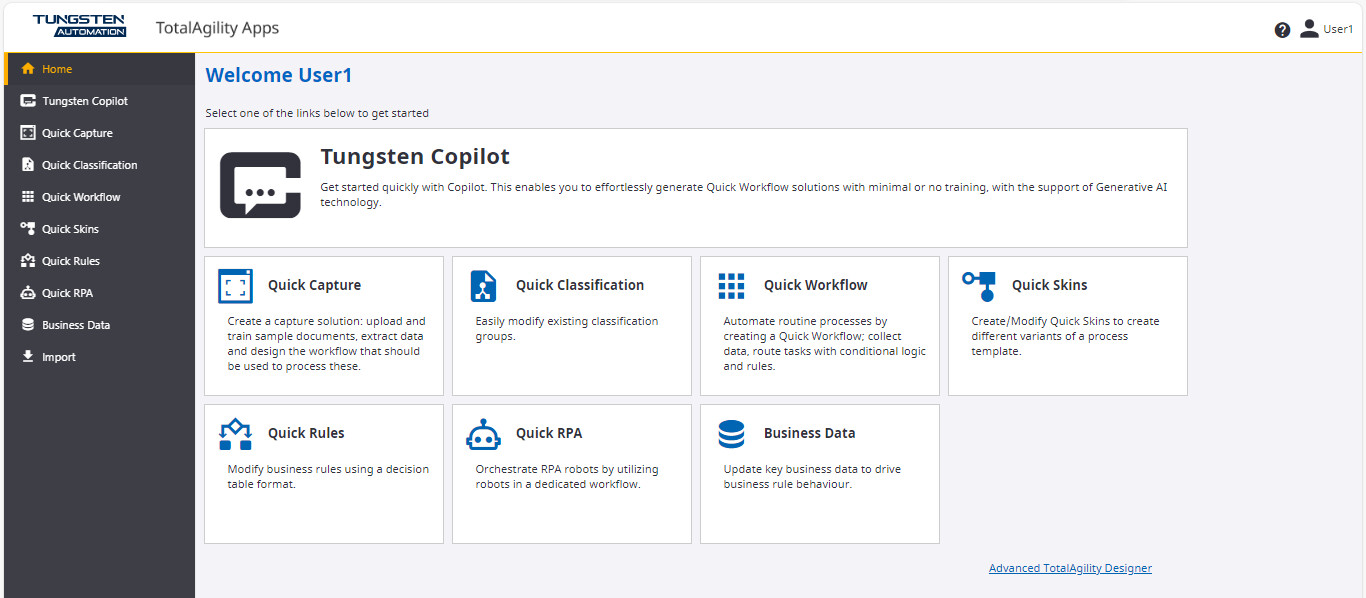
The flagship TotalAgility product combines document intelligence with process and case management. A company can ingest a scan, PDF, email or image; classify the file; extract fields; apply business rules; call other systems; and hand uncertain cases to a person. Newer releases add pretrained document models, generative-AI assistance, knowledge discovery, model choice and multi-agent orchestration. The emphasis on confidence scores, source traceability and audit logs is telling. Tungsten is selling autonomy with paperwork attached.
Finance teams get a more opinionated package. AP Essentials and InvoiceAgility capture invoices, match them to purchase orders and receipts, run approvals and connect to systems including SAP, Oracle, NetSuite, Coupa and Microsoft Dynamics. Process Director works deeply with SAP. The e-Invoice Network handles supplier exchange and compliance. A 2025 partnership with tax-software company Sovos joined invoice automation to real-time tax determination and regulatory reporting.
There are adjacent businesses too: Power PDF and eSignature for document creation and signing; ControlSuite and Printix for secure print; OmniPage SDK for developers embedding OCR; and a marketplace of connectors, templates, robots and partner-built solutions. Tungsten can run in public cloud, private cloud or on-premises configurations depending on product. That choice matters to buyers who cannot move a sensitive workflow just because a vendor’s slide deck says “cloud-first.”
03 / What broke firstThe best automation stories begin with an operational bruise
Tungsten’s customer cases are most useful when they describe the mess before the software. At healthcare staffing company AMN, the timecard system was prone to human error and occasional crashes. Roughly 200 timecards went missing in a year, creating payment and legal risk. Automation covered high-volume steps and the company reported 5,400 hours saved. At Henkel, the trigger was 1.25 million paper invoices a year despite an existing self-billing setup. E-invoicing became the complement the old process lacked.
Mohawk Industries faced a different prod: its CEO challenged accounts payable to cut costs while Sarbanes-Oxley raised the compliance stakes. Paper and exceptions were the expensive part. After moving suppliers to the Tungsten Network, Mohawk said it reduced AP staffing from 54 to 21 through attrition and reassignment, receiving 650,000 electronic invoices annually and saving about $3 million a year.
These teams did not change their minds because “digital transformation” sounded exciting. They changed when the old workflow produced visible loss: crashes, missing timecards, piles of paper, late payments, labor costs or audit risk. That distinction is worth copying. A specific failure earns budget. A general desire to innovate earns a workshop.
“We found quick wins with Tungsten RPA by automating high volume process steps.”Jeff Stratton, AMN Healthcare
04 / The economicsThe price tag is private. The before-and-after is not.
Tungsten’s enterprise platform pricing is quote-based. Cost changes with document volume, modules, deployment, integrations and implementation help, so there is no honest universal sticker price. The better public evidence comes from customers. Capita reported that automating invoice processing cut its cost per invoice from £8 to just over £2, saving about £1 million per year while handling 400,000 invoices a month. University Hospitals reported more than $10 million in operational impact, 217,000 hours of added capacity, 75 automated processes and more than 12 million transactions.
The math works when repetitive volume is high and exceptions are costly. A North American logistics customer said Tungsten RPA handled 500,000 invoices a month and avoided new headcount. Dachser reported a 60 percent reduction in invoice cycle time. Emaar cut document-validation turnaround from 48 hours to under three while processing more than five million pages a year. These are vendor-published case studies, not controlled experiments, but they show what buyers measure: unit cost, cycle time, accuracy, capacity and risk.
05 / The competitive wedgeNot the smartest bot. The most complete paper trail.
Tungsten sits in several crowded markets. ABBYY and Hyperscience compete in intelligent document processing. UiPath, Automation Anywhere and SS&C Blue Prism sell robotic automation. Microsoft Power Automate, Appian, Pega and ServiceNow orchestrate workflows. Basware, Coupa and SAP tackle finance automation; Adobe and Foxit own mindshare in PDF tools.
Tungsten’s argument is breadth with a document-native center. It can read the file, manage the case, call the ERP, preserve the evidence and run in deployment models that suit regulated customers. The company says it serves eight of the ten largest global banks and seven of the ten largest global insurers. Its 2025 Gartner Leader placement in intelligent document processing supports the capture side; FedRAMP High, GovRAMP and Australian IRAP milestones in 2026 strengthen the government-and-governance pitch.
Breadth has a cost. A large platform can demand integration work, process design, training and partner support. It may be the right answer when one workflow crosses ten systems; it can be absurd when a five-person team wants to extract three fields from 200 clean PDFs. The rival is not always another suite. Sometimes it is a focused API, an ERP feature or the decision to leave a small process alone.
Copy this playbook
- Start with one painful, high-volume workflow.
- Measure unit cost and exception rate before launch.
- Keep humans on ambiguous cases.
- Integrate with the system of record.
- Expand only after the first numbers hold.
Skip it when
- Volume is low and documents are already structured.
- No one owns the process end to end.
- Exceptions are undefined or constantly changing.
- A point tool solves the whole job.
- There is no baseline against which to prove value.
06 / The AI turnAgents, but with receipts
In 2025 Tungsten gathered its products beneath the Tungsten Automation Platform, or TAP, and divided TotalAgility into modular tiers. Knowledge Discovery lets users query unstructured content with source-backed answers. Newer releases promote pretrained extraction models, confidence scoring, AI-assisted classification, multi-agent orchestration and controls over which tools and models agents may call. In early 2026, the company hired a chief product officer, a chief AI officer and a new head of research and development. The message was not subtle.
Yet its most credible AI claim is conservative: use the right model for the right task, keep the source, score confidence and escalate uncertainty. In AP Essentials, its Copilot translates natural-language questions into internal queries rather than sending document data to the external AI service. The documentation warns that Copilot can make mistakes and that important information should be verified. That sentence is more persuasive than a dozen promises of autonomy.
That balance is the company’s opportunity and its constraint. Tungsten can make AI useful where documents are abundant, mistakes are measurable and workflows cross old systems. It will struggle where the process itself is incoherent, where volumes cannot justify integration, or where buyers expect software to resolve policy disputes disguised as data problems.
Forty years ago, Kofax taught a PC to see a page. Tungsten’s current ambition is to help an enterprise understand the page, decide what comes next and prove why. The technology sounds futuristic. The payoff remains wonderfully mundane: fewer missing invoices, shorter queues, lower processing costs and a clean trail when the auditor asks.