The most revealing thing about Rossum is that it never required the world to become tidier first. Suppliers could keep emailing PDFs. Freight agents could keep scanning certificates. A purchase order could arrive in one layout today and another tomorrow. Rossum would sit in the middle, turn the mess into structured data, test that data against business rules and send the clean result onward. It is less a robot clerk than a customs desk between the document world and the database world.
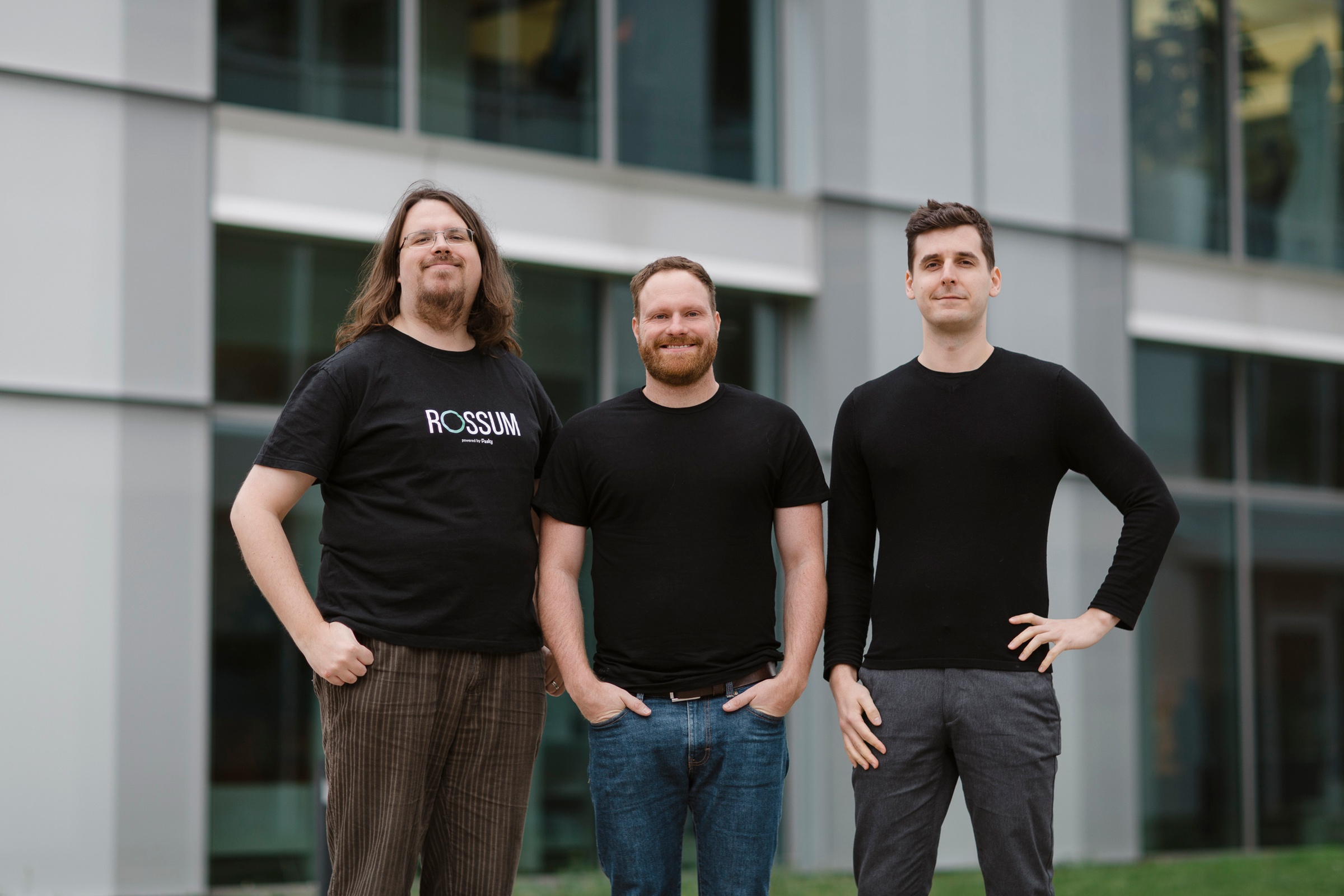
That compromise created a serious enterprise software company. Founded in Prague in 2017 by AI doctoral researchers Tomáš Gogár, Petr Baudiš and Tomáš Tunys, Rossum raised $100 million in 2021 and says it now serves more than 450 customers. In May 2026, Coupa acquired it for an undisclosed sum. The buyer had already spent two years as a partner, watching the software do the grim work that comes before spend management: opening the attachment, identifying the invoice, checking the totals, finding the purchase order and deciding whether a person needs to intervene.
The template cracked first
Old document capture depended on templates: tell the software that the invoice number lives near the top right, the total sits near the bottom and the supplier has promised not to redesign anything. Then reality arrives wearing a new letterhead. At A-Scan, a document-processing customer, 30 to 50 percent of invoices could fail to match a manually configured legacy template, depending on the client. The company still captured half its invoice data by hand.
Rossum’s answer was to treat layout as something a model could understand, not a coordinate somebody had to preserve. A reviewer corrects uncertain fields in a validation screen; those interactions improve future predictions. A-Scan says Rossum replaced more than 1,000 templates and became the capture system for 91 percent of its volume. That is the first copyable lesson: attack the maintenance loop, not merely the keystroke. An extraction demo can look magical while its template library quietly becomes a second job.
This is also where Rossum differs from a raw OCR API. OCR recognizes characters. Rossum wraps recognition in a transaction: it can detect duplicates, compare supplier details with master data, enforce VAT or purchase-order rules, draft an exception email, preserve an audit trail and export the approved record into Coupa, SAP, Oracle, Workday or another system. Competitors range from ABBYY, Hyperscience and UiPath Document Understanding to cloud services from Microsoft, Google and Amazon. Rossum’s pitch is narrower and more operational: one cloud platform for the whole document journey, centered on transactional paperwork.
A language model on a short leash
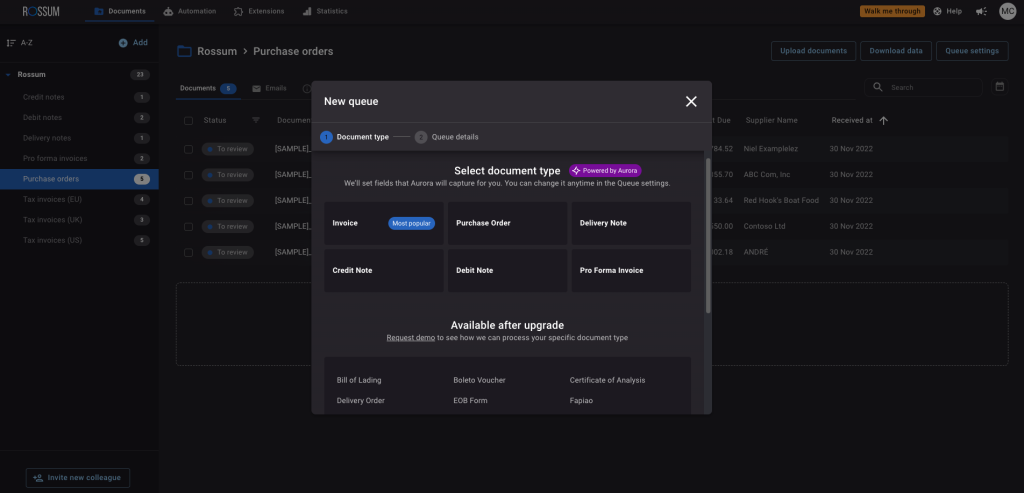
In 2024 Rossum launched Aurora, built on what it calls a Transactional Large Language Model. The name is intentionally less chatty than the consumer-AI boom around it. An invoice system cannot invent a plausible total or daydream a bank account. Aurora is designed to pull values from the supplied document, attach confidence scores and flag uncertainty. Rossum reported a 37.6 percent average reduction in errors among early adopters, with no hallucinated values in those tests. Those are company measurements, not a blanket guarantee, but they describe the right product constraint.
The machine’s most valuable answer is sometimes: I am not sure.Why confidence routing matters in financial automation
Aurora 1.5 extended instant learning to 276 languages and handwriting recognition to 30. Rossum also said it made documents longer than 100 pages process four times faster and reduced the time needed to configure formula fields by 66 percent through a natural-language Copilot. The useful detail is not the number of languages on a feature sheet. It is that a shared-services team can keep one exception workflow while invoices arrive from dozens of countries.
The customer buys throughput
Rossum’s customers are finance, procurement, order-management, logistics and shared-service teams with enough documents to make small frictions expensive. The public logo wall includes Siemens, Bosch, Panasonic, Adyen, Wolt, Kingfisher, Octopus Energy, Veolia and Fugro. The case studies are more useful than the roll call because they show where the time goes.
Deliveroo rolled Rossum and Coupa across 11 countries in April 2025 after months of integration testing. Six weeks after launch, it reported that a user moved from two invoice transactions per hour to 45, while handling time for one complex class of invoice fell from 15 minutes to 45 seconds. The extraction accuracy was 97.6 percent, but average automation for those invoices was still 35 percent. That gap is honest and instructive. Accuracy at the field level is not the same thing as a touchless business process.
Eurowag offers the next chapter. By January 2026, it had put 60 entities on one Rossum-Coupa flow, reporting 70 percent automation, a fall in end-to-end processing from nine days to four and on-time payments rising from 60 percent to more than 90 percent. MKS Atotech used Rossum on the sales side, routing emailed purchase orders into an e-commerce operation. It cut order handling from as much as 15 minutes to under 90 seconds, while keeping human review in place as it worked toward more straight-through automation.
What it costs, and what buyers must bring
Rossum publishes a useful price floor. Starter begins at $18,000 a year with unlimited seats, ingestion by email or API, Aurora extraction, a validation interface, a 12-month archive and API access. Business, Enterprise and Ultimate tiers are quoted. The contract minimum is one year, and the bill varies with page or document volume and workflow complexity. Rossum’s billing guide makes the meter concrete: pages processed by the extraction engine count, and a duplicate can count too if the engine processes it.
So the economic case is not “AI is clever.” It is volume multiplied by labor, delay and error. A buyer needs to inventory document types, measure exception rates, price the current manual minutes and decide where verified data must land. The organization also needs owners for master data and business rules. Rossum can learn where the total sits; it cannot settle an internal argument about which supplier record is authoritative.
The practical copybook
- Start with one ugly, costly queue. Baseline handling time, corrections and touchless rate before the pilot.
- Prove the full trip. Extraction without validation and ERP posting just moves the typing elsewhere.
- Keep confidence visible. Route uncertain fields to people and feed their corrections back into the system.
- Fix master data early. Automation exposes duplicate suppliers, broken purchase orders and inconsistent rules.
- Expand after stability. Reuse the pattern across regions or document types only when exceptions have an owner.
The model is less compelling when volumes are small, layouts are perfectly stable or structured data already travels through a reliable API or EDI connection. It also struggles as a business case when every exception requires ambiguous judgment and nobody is empowered to encode a rule. In those conditions, a simpler capture tool, direct integration or even careful manual work may cost less than an enterprise platform.
The partner became the buyer
Rossum’s route into Coupa is unusually legible. The product earned Coupa certification in 2024. Consulting partners such as KPMG Netherlands helped design and implement cross-country workflows. Customers including Deliveroo, Eurowag, Maximus and NFI used the two products together in production. Coupa then acquired Rossum in May 2026, saying it would apply the document technology beyond accounts payable and across its source-to-pay portfolio.
The purchase price remains private. The strategic logic does not. Spend platforms are only as good as the data entering them, and much of that data still arrives attached to an email. Coupa owns a large network of buyers, suppliers and spend records. Rossum brings a specialist model trained on transactional documents plus the plumbing that turns those documents into governed events. The partnership gave both sides evidence before the deal - a far sturdier reason to buy than a slide about theoretical synergy.
Rossum’s ambition remains cheerfully excessive: enable one person to process one million transactions in a year. At roughly 4,000 transactions each working day, that person is obviously not reading every invoice. The job becomes designing rules, watching controls, resolving rare cases and improving the system. That is the company’s real proposition. It did not kill the paperwork. It changed the human’s relationship with it.
Keep reading and watching