A mechanic’s invoice is quite happy being an invoice. It names the work, lists the parts and announces the sum owed. To a person, its purpose is obvious. To a database, it is a small act of insubordination. The information is there; it has simply declined to occupy the proper fields.
This is BEM’s patch of the software business: the distance between a document somebody understands and a record a computer can use. The company turns files into structured data, then supplies the machinery for getting that data through a workflow. Its market includes the people building insurance, finance, healthcare and logistics software. Their inputs arrive wearing very little respect for a schema.
- BEM converts messy inputs into records shaped for business software.
- Its pitch includes validation, routing, review and an audit trail.
- Fleetio’s case study reports service-entry time falling from 6.5 minutes to 2.
- Paid usage starts at nine cents per function call; several steps mean several calls.
01 The paper rival
Fleetio makes fleet-management software. In BEM’s account of the relationship, the stubborn competitor was paper. Customers were accustomed to it, and entering a service record meant copying details from a mechanic’s invoice. An earlier AI provider could not extract the line items Fleetio needed. That is a wonderfully unglamorous reason for a technology choice: the individual parts on the bill.
“Paper is one of our biggest competitors beyond any other software competitors.”Chuck Drews, Group Product Manager, Fleetio
BEM’s integration let customers photograph their paperwork and carry its contents into the digital record. The published case study reports processing time dropping from 6.5 minutes to 2, and 100% accuracy on totals in the reported customer experience. Treat the latter as a result for that use case, rather than a promise about every document. The interesting product decision was to preserve the familiar input while reducing the labor that followed it.
There is a lesson here for anyone selling software to a reluctant user. Making the user behave differently can be harder than making the software understand what the user already does. A file-upload button can be a more persuasive ambassador than a beautifully designed form.
02 A small company selling the surrounding work
Antonio Bustamante and Upal Saha, BEM’s CEO and CTO, announced a $3.7 million seed round in June 2024. Uncork Capital led it; participants included Kevin Mahaffey, Roar Ventures and Garry Tan. Their starting complaint was the recurring engineering burden of integrations: taking invoices, spreadsheets, emails and other awkward inputs and reshaping them for an application.
The early proposition was an API that accepted input and returned the requested data shape. It was particularly relevant to software serving complex supply chains and other sectors where information travels through documents. An engineer could spend less time maintaining another parser and more time building the feature the customer had actually bought.

Today, the platform describes a collection of reusable processing functions. A developer can classify an input, extract fields, split a bundle, join records, enrich the result and shape a payload for the receiving system. BEM fits between incoming material and the application that must act on it. Buying it is partly a decision about which infrastructure the customer wants to own.
Its stated working principles suit that proposition: debate with evidence, commit after a decision, and act when something looks wrong. Those are company declarations, rather than an independent account of office life. Still, fixing a small defect before it spreads is an apt ambition for a business whose output may become someone else’s financial record.
03 The number needs an address
Consider an extracted total. It has the right type. It fits the schema. It even looks plausible. None of those properties establishes that it came from the correct place. A tidy mistake remains a mistake, only better dressed.
BEM’s validation write-up describes three layers: statistical confidence for individual fields, a separate evaluation model checking the extraction, and deterministic checks on structure and constraints. Operators can review uncertain values and submit corrections. The distinction matters: a field passing a type check has satisfied a formatting rule, while a field matching its source has satisfied a different test.
- 01Raw filePDF, image, email
- 02ExtractFields + confidence
- 03ValidateSchema + evaluation
- 04DeliverApplication record
Uncertain fields → human review → corrections
The May 2026 Bounding Boxes release makes inspection more literal. Extracted fields can carry coordinates identifying their location on the original page. A reviewer can go back to the evidence instead of hunting through a PDF. This does not make a value correct by decree. It makes the value easier to challenge, which is often the more useful feature.
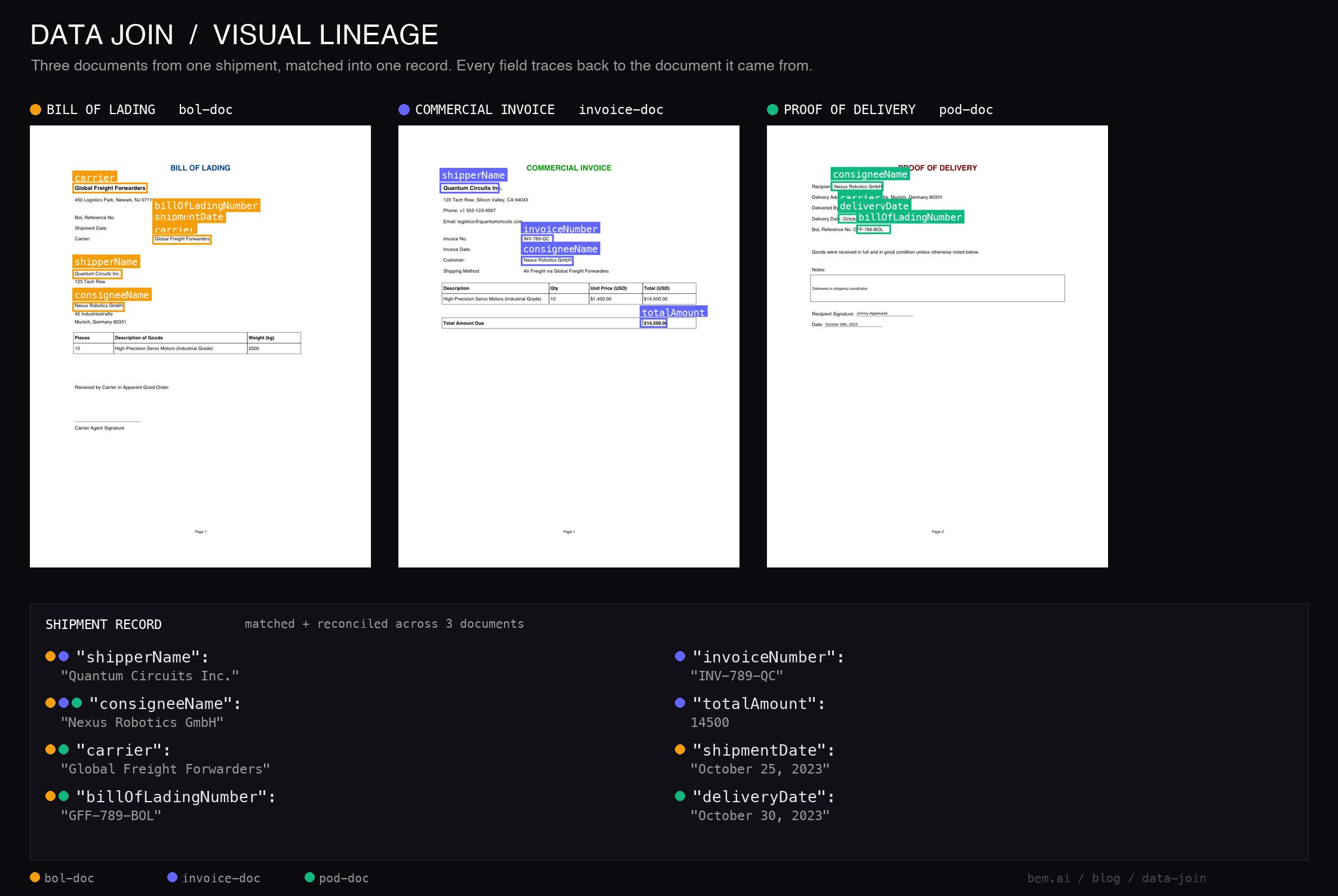
Data Join, released in June, extends that idea across several documents. A bill of lading, an invoice and a proof of delivery can contribute to one shipment record, with provenance attached to the fields. The practical benefit is reconciliation: when sources disagree, the operator needs to see which document supplied which answer.
04 Nine cents, multiplied by the workflow
BEM publishes usage pricing by function call. The first 100 calls each month are free; paid rates start at $0.09 and decline through graduated volume bands. The unit deserves attention. Extracting from 100 files uses 100 calls. Classifying and then extracting those same files uses 200. The document has not doubled, but the work has.
100 paid extraction calls / 200 paid classify-and-extract calls
Illustrative arithmetic at $0.09 per call, before free allowance, volume discounts or add-ons. Pricing checked October 1, 2026.That model rewards paying attention to workflow design. A buyer should count processing steps alongside document volume, then compare the total with manual handling and internal maintenance. An impressive per-call price can only answer the per-call question. It cannot decide whether the complete operation is economical.
For a software company, the alternative may be assembling an extraction stack internally. BEM’s SaaS offering puts document intake inside the customer’s own product and includes operator review, audit trails and developer access. The company sells relief from the accompanying engineering work as much as the initial extraction.
05 The useful work happens after extraction
Ply, which builds inventory and purchasing software for trade businesses, is another instructive customer. Its supplier RFQ workflow involved manually entering individual lines. BEM’s case study describes an embedded drag-and-drop process that maps the uploaded information to Ply’s schema and displays it in the product. The reported integration took days. A purchasing user experiences that infrastructure as fewer things to type.
PromptWell’s problem had a different costume. The healthcare analytics company was handling inconsistent client data, including CSV files, and spending engineering time on mapping, formatting and validation. BEM’s published story reports an 80%+ reduction in engineering overhead. The case illustrates why being a spreadsheet does not automatically make information consistent enough for another system.
The 2026 releases follow the surrounding work. Forge, launched in February, builds and tests a workflow from a description of the operation and sample documents, then exposes an endpoint. V3 followed in April with a redesigned API and developer tools, including SDKs, a Terraform provider, an MCP server and a command-line interface. May brought connectors for services including Google Drive, Dropbox, SharePoint, Box and S3. Intake, deployment and inspection all belong to the same journey.
06 Try the ugly files first
The copyable habit is to begin with the documents that make your team sigh. Evaluate a mixed batch, decide which fields matter, and measure errors at that level. Keep examples with unfamiliar layouts and missing values. Choose who reviews exceptions before sending outputs into a live business system. This is an editorial recommendation drawn from the workflow BEM describes, rather than a guarantee of its performance.
Its retry documentation offers an equally practical detail: use a stable reference ID for a call. Repeating a request with a fresh random ID defeats deduplication and can produce duplicate work downstream. Document AI still has to behave like ordinary production software when the network misbehaves.
The buying logic weakens when an existing reliable integration already supplies clean records, when volume does not justify the setup, or when nobody can define a usable output schema and review mistakes. Those are conditions to assess, not flaws a model upgrade automatically repairs. A confidence score also needs to be tested against actual outcomes.
BEM’s useful wager is that customers will pay for this whole passage: a messy input, a usable record, and a way to question the result. The mechanic can keep the invoice. The software ought to stop treating it as an invitation to hire another typist.
Follow the paperwork
Explore BEM, its developer documentation, pricing and engineering log. Find the team on LinkedIn, X and GitHub.
Watch Hard Software with Fleetio CTO Jorge Valdivia, or browse BEM’s interviews and videos.