A pet insurance claim is a modest piece of drama. Someone sends a form, perhaps a bill, perhaps a photograph. Somewhere else, a worker reads the bundle and enters its contents into a system. At Markerstudy, Automation Hero says that one division handled about 450 such claim forms a day. Each took roughly eight and a half minutes. The cost was not hidden in a futuristic model of work; it was sitting in the queue before lunch.
- Automation Hero turns emails, PDFs, scans and forms into data that can move through a business workflow.
- It began in sales automation, then focused on document-heavy work, especially insurance.
- Its public cases include Markerstudy, Kin and Baloise; the strongest numbers are tied to particular processes, not whole companies.
- The practical test is simple: measure time per document, exception rates and the work left for a person.
Robin meets the filing cabinet
Stefan Groschupf founded the company in 2017 after building Datameer, a big-data analytics business. The new venture was called SalesHero. Its assistant, Robin, was meant to save salespeople from the small administrative chores that crowd out actual selling: updating a CRM, filing an expense report, moving information from one place to another. The name invoked Batman’s partner. The work, alas, was less glamorous.
In 2019 the company changed its name to Automation Hero and announced a $14.5 million Series A led by Atomico, with Baidu Ventures and Cherry Ventures participating. It had previously raised $4.5 million in seed funding. The wider name made sense: a salesperson’s data-entry problem was merely one specimen of a much larger species. In finance and insurance, documents arrive in many formats and make simple click automation stumble.

A claim is not a spreadsheet
Traditional robotic process automation is good at repeating predictable steps on a screen. An incoming claim is less obedient. One email contains a typed form; another has a scan, a receipt and a handwritten note. Even the important number may move from page to page. The software has to decide what arrived, read it, extract the right fields, pass them to an existing system and let a person inspect the uncertain cases. Automation Hero calls this intelligent document processing, or IDP, inside its broader Hero Platform.
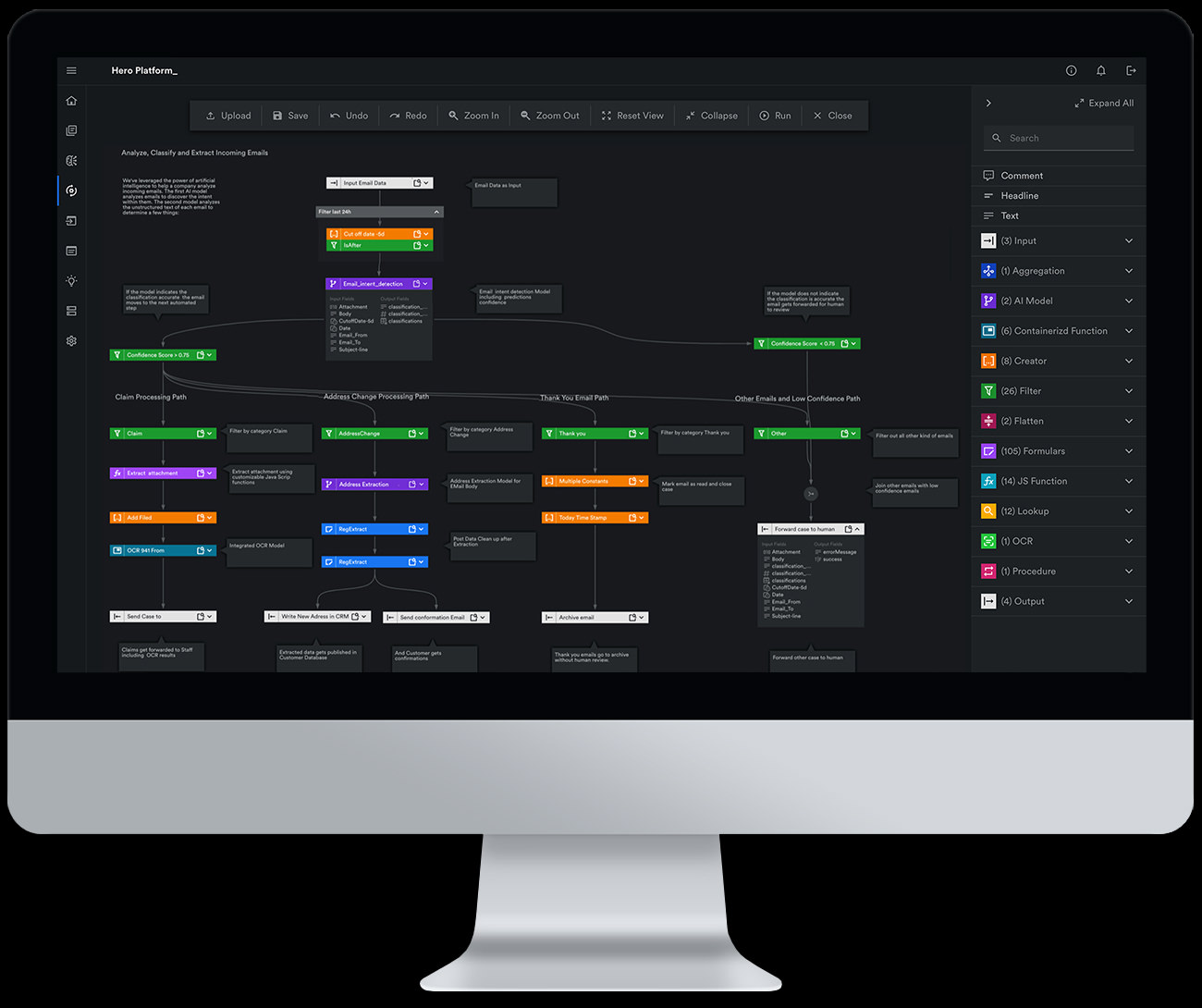
The platform offers no-code workflow building, optical character recognition, classification, extraction and connections to business systems. Its visual flow can route a low-confidence result to a human reviewer. That last step is no embarrassment. In regulated work, the question is often whether a questionable document reaches the right person quickly, with enough context to make a decision.
A screen from the company’s product page makes the mechanics plain. It shows branching paths for incoming email, including a claim path, an address change and a route for low-confidence cases. That is a more useful picture of enterprise AI than a chatbot floating above an empty desk.
The numbers have addresses
The company’s best evidence is local and specific. Markerstudy had already tried automation, but wanted a way to handle claims without constant help from data scientists. Its case study reports that the pet insurance team employed roughly 18 to 20 people to process about 450 forms daily. Automation Hero’s site describes a reduction of more than 40 percent in dedicated hours. That is a company-reported result for a particular operation, not a guarantee for every insurer.
Kin offers another revealing document: a wind mitigation form used in home insurance. It combines checkboxes, handwriting and signatures. Kin told Automation Hero that sales representatives could spend up to 45 minutes entering one form, and that about 15,000 arrived each year. Its case study says processing fell to under 30 minutes. That improvement may seem small beside grand claims about AI. Multiply it across a year and it becomes a reason to buy software.
Baloise, the Swiss insurer, came through a 2019 Plug and Play ideation workshop. Automation Hero says it helped the asset-management team streamline gathering and entering data, saving around 700 hours annually. Different insurers, different processes, same recurring nuisance: information exists, but someone must first rescue it from a document.
“We wanted something more accessible that would still leverage the human aspects of a process.”Eoin Grace, deputy head of IT at Markerstudy
The business of reading
Automation Hero sells to organizations with enough document volume to make small delays expensive. Its public customer stories concentrate on insurance, while its site also targets finance, banking, manufacturing, healthcare and other operations teams. It has described consumption-based pricing and invites buyers to request a demonstration. The product has been offered in the cloud and on premises; in June 2023 it became available through AWS Marketplace.
Its competitors come from two directions. RPA platforms such as UiPath and Automation Anywhere automate actions across applications. Document specialists such as ABBYY focus on reading and extracting information. Automation Hero’s argument is that the buyer needs the whole route: document recognition, workflow logic, system integration and human review. That is an attractive claim when documents vary and a mistake has a real cost. It also sets a demanding standard for proof.
The company’s 2022 version 6 release put more emphasis on its document engine, including handwriting and context-aware OCR. Its marketing quotes impressive accuracy comparisons. Those are best treated as claims to test on a buyer’s own forms. An invoice from one supplier, a cursive note from another and a bad scan from Tuesday will expose different weaknesses. A fair pilot measures extraction accuracy alongside the time spent correcting errors.
A useful lesson for the next queue
The most portable idea in this story is not the superhero name. Find a process with high volume, variable inputs and a measurable manual step. Count the documents, minutes and corrections before buying anything. Start with one document family. Keep the person who understands the work close to the design of the workflow. Then count again, including exceptions. That is how the company’s case studies become useful to someone outside insurance.
There are limits. A team with a few predictable forms may be well served by simpler software. A company without clean access to its downstream systems can read documents brilliantly and still strand the data. If a process has too few repetitions or too many judgment calls, the review queue can swallow the savings. Automation Hero’s own shift from Robin to document processing makes the point: the prize was never automation in the abstract. It was the particular pile of paperwork that someone had to finish today.