Ten thousand short videos sound manageable until each one needs to speak eleven languages. Then a library becomes a production schedule: captions to generate, phrases to translate, timing to preserve, files to approve. A tiny mistake, repeated often enough, acquires a department of its own.
- The job: coordinate multilingual text, video, audio, and review in one platform.
- The approach: AI for production speed, people for judgment, workflows for delivery.
- The evidence: named customer cases, a $1.5 million seed round, and an Indonesian dubbing acquisition.
Ten thousand videos, eleven sets of consequences
That was the assignment described in Ollang’s case study of Shorten, a mobile video streaming platform. The clips were one to two minutes long. The target was more than 10,000 videos, localized into eleven languages within three months. Ollang says it met the schedule using agents assigned to particular tasks, including video understanding, cultural adaptation, and correction.
The revealing detail is the scale of repetition. An isolated subtitle error is an editing task. The same uncertainty across a catalog is a workflow problem. Who sees it? Which version gets fixed? Does the correction reach the delivered file? Ollang’s proposition is to put those questions inside the same system.
Ollang’s reported Shorten deployment. These describe a particular project, not a guaranteed capacity or turnaround.
The company sells localization software and services to organizations with a recurring supply of content: media distributors, broadcasters, educators, and enterprise teams. Its attraction grows when language work has enough moving parts to become a management occupation. A perfectly translated sentence still needs somewhere to go.
The interpreter and the engineer
Ebru Yıldırım Gul had already run Parlonist, a localization and interpretation firm. Her experience included serving Fortune 500 companies; her training was in translation and interpreting. Co-founder Muhammed Aziz Ulak brought computer engineering, a previous fintech venture, and experience leading Facebook Developer Circles in Istanbul. One understood the work. The other understood how to make a system carry it.
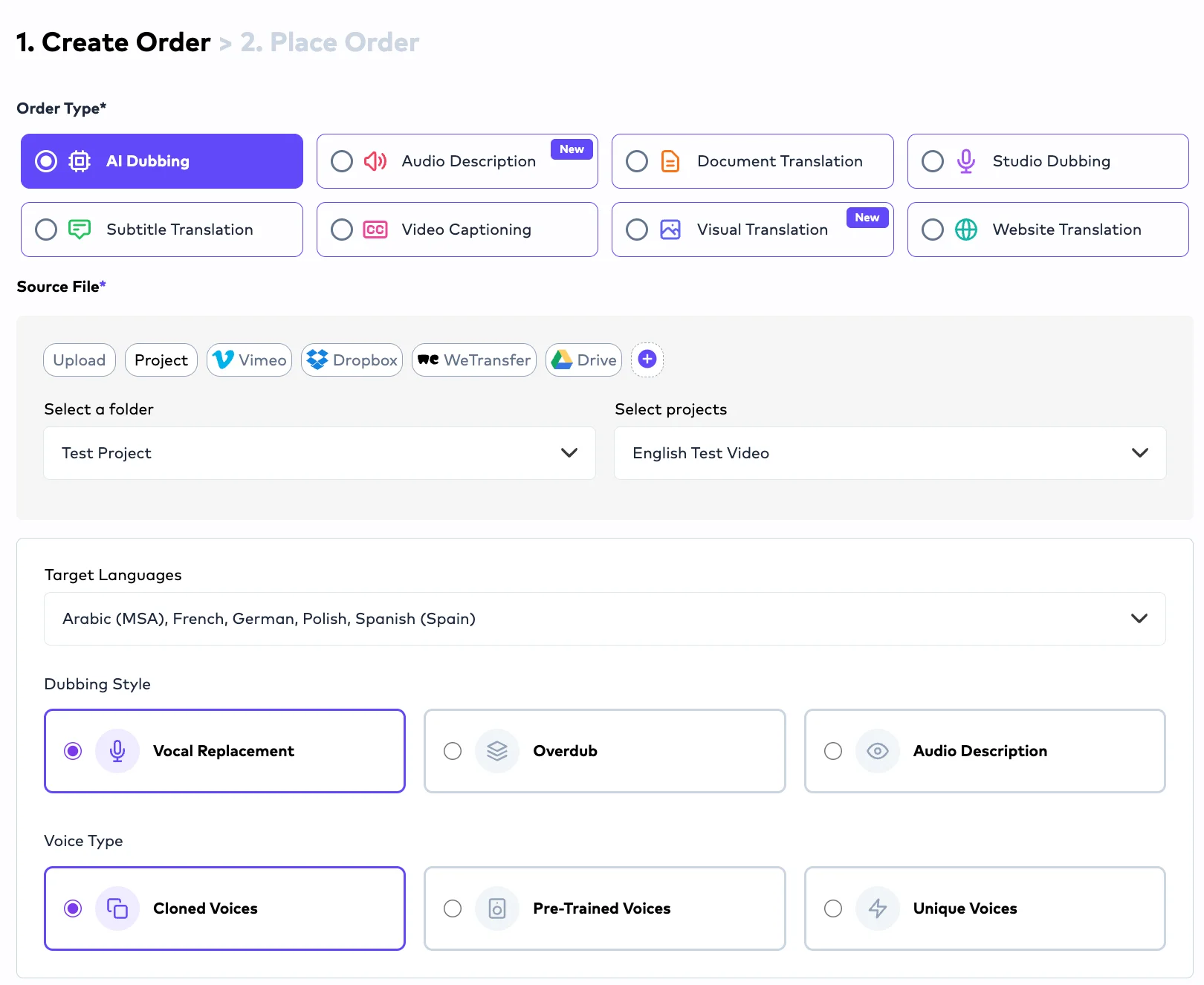
Founded in 2019, Ollang built OLabs as a place to order and manage subtitling, closed captions, AI dubbing, and studio dubbing. The initial difficulty described in its founding account was familiar to anyone who has chased a file across vendors: switching tools, uneven quality, and handoffs that consumed time. The product follows that diagnosis.
In March 2023, Ollang closed a $1.5 million seed round. Revo Capital, JIMCO, and Dubai Angel Investors were among the investors. The money was intended for international expansion and continued development of OLabs. Six months later, Ollang announced the acquisition of TUJJU Media, an Indonesian dubbing company, establishing a Jakarta office and making TUJJU’s chief executive its Southeast Asia general manager.
There is something pleasingly practical about an AI business buying a dubbing operation. Local production knowledge, voice talent, and relationships remain useful when software accelerates the first draft. The acquisition suggests a company expanding its ability to execute work in a market, alongside its ability to generate language.
A dub is a chain of decisions
Ollang’s current positioning is broader than video translation. The platform advertises support for 240-plus languages and dialects, and coordinates text, audio, video, and visual content. Its tools include a subtitle studio, AI voice refinement, workflow automation, and the OLabs dashboard. The language total is a platform claim; individual services have their own coverage.
For a dubbing job, the sequence begins with source media and supporting material: a script, timing information, terminology, perhaps a character list. Speech is transcribed, dialogue translated, and voices generated. Then comes the inconvenient discovery that an elegant sentence can be too long for the space allocated to it. Segment editing, timing correction, and resynthesis matter precisely here.
- 01SourceMedia + context
- 02GenerateText + voices
- 03ReviewMeaning + timing
- 04ApproveAccountable sign-off
- 05DeliverUsable files
Human review is configurable. Ollang describes confidence scoring, specialist linguists, project-specific review thresholds, and an audit trail. A team can review every segment or concentrate attention on selected passages. For professional studio work, it also offers native voice actors, script adaptation, directors, recording, and mixing. These are different kinds of judgment, with different costs.
“end-to-end globalization product”Ebru Yıldırım describing OLabs, 2023
Developers get another entrance: a REST API, SDKs, an MCP server, and agent skills. Public documentation covers orders, review gates, quality annotations, and export formats. That makes the offer relevant to a content operation whose work starts in another system and must return there after approval.
France was only the beginning
W4tch TV supplies a different test. In Ollang’s account, the distributor selected French documentaries for English and Spanish dubbing after examining audiences, demand, and profit and loss. It chose AI-generated dubbing with speech-to-text validation, voice selection, and human supervision, then used YouTube’s multilingual audio tracks to distribute the work.
Ollang reports that 71 translated videos accumulated more than 80 million views within a year. It also reports average revenue 69% higher for those dubbed videos than for untranslated videos. That comparison is encouraging, but it does not isolate dubbing from title selection, audience demand, or distribution. It is a customer case, not a controlled experiment.
The useful lesson is the decision sequence. Choose content that travels, identify an audience, examine the economics, and select a production method. Translating a library before deciding who will watch it is a magnificent way to manufacture inventory.
The bill follows the work
Ollang operates at the intersection of software and managed language production. Its provider-supplied G2 pricing listing documents custom enterprise consumption pricing per minute or word. For buyers, the relevant unit depends on the asset: words for text, minutes for audiovisual work, multiplied by languages and shaped by review requirements.
Its own multimodal guide gives rough benchmarks of $5-$20 per minute for synthetic AI dubbing and $50-$150 for human voice talent. Those are planning ranges, not an Ollang price quote. As an illustration, a ten-minute video in three target languages represents thirty localized minutes: $150-$600 at the first range, or $1,500-$4,500 at the second, before scope-specific adjustments.
10 minutes × 3 languages
= 30 localized minutes
Based on ranges in Ollang’s multimodal guide. Language, revisions, review, mixing, and delivery scope can change the bill.
Competition overlaps the offer. ElevenLabs provides automated dubbing and human-edited production services; translation management platforms coordinate language work; agencies and studios supply people and production. Ollang’s distinguishing pitch is the combination of modalities, model routing, review, and delivery. A human in the process, by itself, is hardly a private invention.
Even the filename has a job
The September 4, 2026 changelog contains a wonderfully unromantic failure. An upload without a usable filename could be stored with a .blob extension. The document pipeline failed, yet a project remained. Attempts to create an order returned an error, and retries could leave more orphan projects. Ollang changed validation to reject the upload before creating the project and updated SDK filename handling.
This is a small engineering detail with a large explanatory value. A localization system must understand language and survive ordinary software behavior. The same changelog added guideline uploads at folder level. In August, it introduced delivery-history events showing when AI output, translator work, approval, and final delivery occurred. Those are the receipts for the journey.
Borrow the pilot, then earn the scale
A sensible evaluation starts with one representative, awkward asset. Supply the actual glossary, speakers, timing files, and delivery specifications. Measure reviewer changes and the time required to correct a segment. Open the exported subtitles in the destination tool. Listen to the final mix. The attractive demo clip has a habit of answering only the attractive questions.
The approach fits repeated content with defined destinations and clear review ownership. It needs more human attention when performance carries the value, terminology is unforgiving, or the target language has weaker model support. A promotional joke, an emotionally delicate scene, and a specialist document should not inherit the same approval rule simply because all three contain words.
Ollang AI’s 2024 Webby People’s Voice award offers a neat five-word acceptance speech: “You Can Speak Every Language.” The working proposition is more demanding. Someone must decide whether the words are right, whether the voice fits, and whether the file is ready. Ollang’s business lives in the distance between speaking and being understood.
Follow the work
Explore the platform, interactive dubbing demonstration, and developer documentation. Read the Shorten and W4tch TV cases, or browse the news and blog.