At an energy conference in Las Vegas, Natasha Kalergis Healey found time to feed the sheep. She had also moderated a panel on community engagement and partnerships at RE+ 2025. Her colleague Jonathan Drobis recorded both activities in his account of the trip. The sheep were part of an American Solar Grazing Association demonstration, which makes this a business anecdote with unusually agreeable supporting characters.
It is a useful place to begin with Healey. Her work concerns the encounter between a proposed energy project and the people around it. Agrivoltaics makes that encounter wonderfully literal: electricity generation and grazing animals occupying the same ground. In her public affairs business, the question is how developers and communities can find enough common ground to move forward.
The audience gets a say
Before energy conferences, there were consumer campaigns. Healey worked at Olson in Minneapolis on brands including McDonald’s, Supercuts, and Bissell. One assignment involved celebrities’ pets’ Instagram accounts and vacuum cleaners. There are less entertaining ways to demonstrate the problem of pet hair.
She had started at Charlottesville agency Payne, Ross and Associates in 2011, progressing from intern to communications director. Side clients eventually gave her a route into working for herself. She returned to Charlottesville and founded Bantam in 2015. Her background included photography and journalism at Virginia Commonwealth University.
That early career supplies a helpful connection to the work she does today. Both involve thinking carefully about who will carry a message and why anyone else should care. The subject has changed considerably. An energy development asks people to consider a proposal that may become part of their surroundings for years. Attention opens the conversation; the conversation has much further to go.
Today, Bantam Communications works on American energy infrastructure through public affairs. Its stated purpose brings developers, communities, and policymakers into the same picture. Healey leads a business whose subject can be measured in physical projects, but whose daily work includes the less easily measured business of public trust.
A communications career that began with consumer brands now reaches into the local decisions behind energy infrastructure.
A seat beside the people building it
By May 2023, Healey was moderating a CLEANPOWER discussion called “The Evolving Role of Community Relations in Clean Energy Development.” The panel brought together practitioners from EDF Renewables, Vesper Energy, Clearway Energy Group, Apex Clean Energy, and Vestas-Steelhead. The subject was how to make community outreach a deliberate part of project development, particularly through permitting.
The lineup matters. These were people working inside organizations that develop or support energy projects. Community relations was being discussed alongside the work of getting those projects through the decisions that precede construction. For Healey, the moderator’s seat placed her among the people trying to make that relationship function.
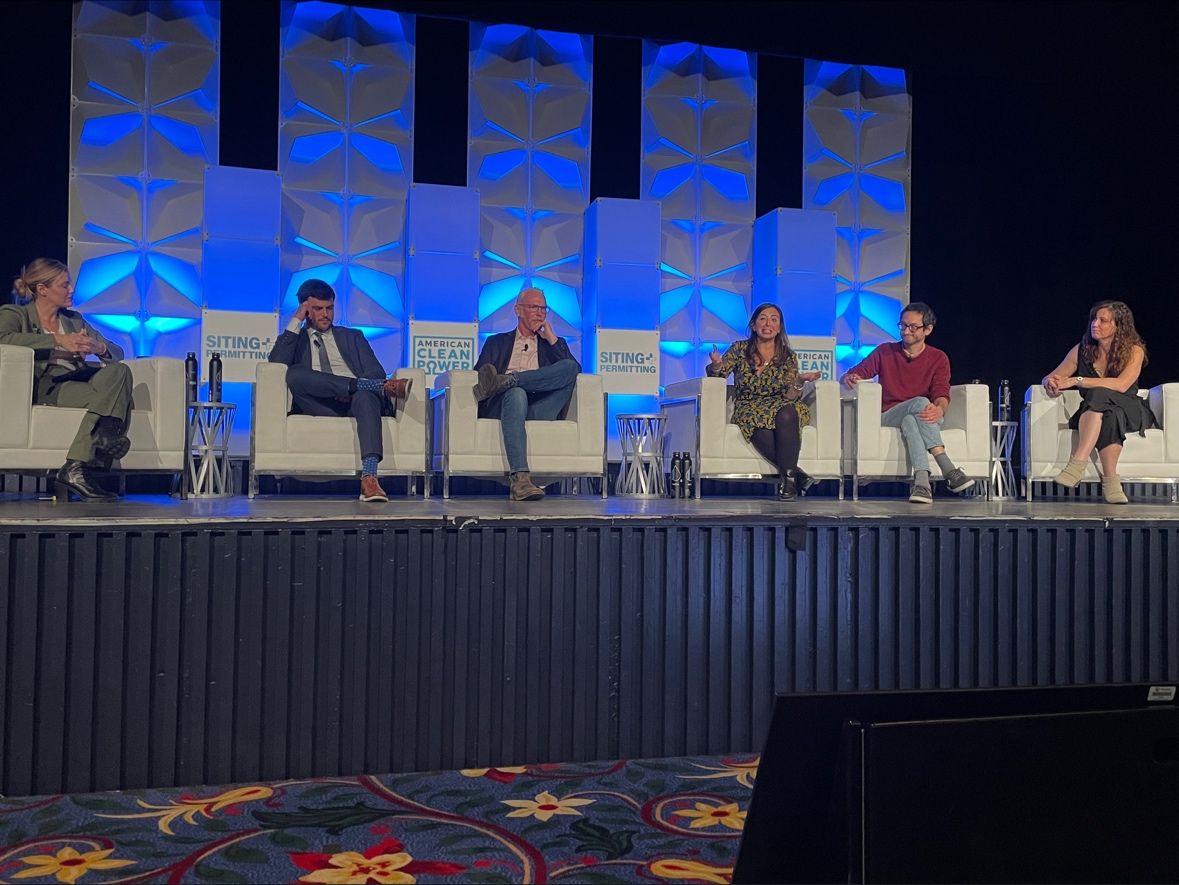
At ACP’s Siting & Permitting Conference in 2024, she moderated another panel. This one included Dahvi Wilson of Siting Clean Collaborative, Jackson Keith of Steelhead Americas, Benjamin Kelahan of RenUSA, Jessy Tolkan of Drive Agency, and Matthew Traldi of Greenlight America. Her reflection afterward put community engagement at the center of how renewable energy could be deployed.
Across these appearances, there is a recurring professional role: bringing several kinds of experience into a discussion that no single discipline can settle. A developer knows the project. An organizer knows how participation happens. A local institution knows its own community. The moderator’s job is to make the exchange worth everyone’s time.
Her own account of a Bantam storytelling project in Benton County, Indiana, makes her preference for local voices more explicit. She praised Vestas and Steelhead Americas for giving residents a platform, and credited her team for bringing their stories to life. The residents she named were Marci, Allen, and Bryan. The names keep the subject at a human scale.
“First-hand stories of rural resilience are the bridge-builders”
Natasha Kalergis Healey, on Bantam’s Benton County storytelling work
The video she shared was about local impact. Her emphasis was on people describing their own experience. For a communications executive, that is a consequential editorial choice: the company’s explanation makes room for the community’s account.
A town is more than a target audience
The business Healey leads has developed practical ways to act on that preference. In Decatur County, Indiana, Bantam describes working with a respected local figure who could serve as a public-facing ambassador. The person brought civic experience and credibility across partisan lines, helped the developer understand local decision-making, and connected the project with community activities and institutions.
Read as a method, the example turns on an ordinary fact about social life: people have relationships before a project arrives. The visiting organization enters a conversation already in progress. A local participant can help it understand which questions matter, which introductions are useful, and which assumptions are likely to travel badly.
Another Bantam account, from Noble County in early 2025, describes a campaign against a proposed solar moratorium. The firm says its work combined education, mobilization, and disciplined messaging. Supporters wrote letters, signed petitions, and attended the deciding meeting. The moratorium was defeated by a 2-1 vote; Bantam reports that supporters outnumbered opponents two to one.
at the meeting
the solar moratorium
Bantam’s account of the campaign outcome.
These are examples of the firm’s work under her leadership. The distinction is useful: a founder creates an organization that can do work through many people. The modern Bantam team includes campaign, research, technology, communications, and operations roles. Its structure reflects the number of tasks hidden inside the simple instruction to engage a community.
Research can also unsettle the starting assumption. Bantam describes one county where an existing perception survey showed stronger support for renewable energy than the developer expected. In another example, mapping county board members’ relationships helped identify connections with local trades that produced support letters and hearing testimony.
The practical lesson is modest and demanding. An organization needs to find out what people think before deciding how to speak to them. Otherwise, even a careful message may be answering a question the audience never asked. For Healey’s business, learning the place is part of deciding what work needs doing.
The promise has to go somewhere
There is a material side to this work, too. In a Southeast Kansas wind-project example, Bantam describes a community-benefits process involving a weighted scorecard and a committee of local leaders. Listening sessions identified education and childcare as priorities. The developer committed $25,000 annually to a rural revitalization nonprofit focused on education and workforce development.
The commitment belongs to the developer. It shows the kind of question Bantam helps address: what form should a project’s local contribution take? A process that allows community priorities to influence the answer gives the conversation a specific destination. It can end with something people can identify and discuss.
- 01Understand the placeResearch, institutions, local priorities
- 02Build the conversationTrusted messengers, meetings, participation
- 03Coordinate the follow-throughProject information, tasks, shared records
Behind those encounters sits a coordination problem. BantamOne, the firm’s campaign command center, centralizes project information for research, strategy, and public affairs. Its purpose is to give teams visibility across a development pipeline. A useful system lets different people work from a common understanding of the project rather than a collection of separate recollections.
Friendly Studio’s account of its design work on BantamOne adds another dimension to Healey’s role. The studio describes building a research platform, organizing data into dashboards, and creating adaptable modules and widgets. Healey supplied a testimonial praising the work. The founder with a creative background was also a client for a product-design exercise in making complicated information usable.
There is something appealingly unglamorous about this part of the story. A public affairs business can be photographed on a stage. Much of its usefulness depends on what the team can find afterward: the record, the task, the project information that prevents the next conversation from starting over.
The next conversation
Healey’s public professional profile extends beyond running Bantam. She lists advisory work with Greenlight America beginning in December 2023 and a Virginia National Bank Advisory Board role beginning in June 2018. In June 2026, she added mentorship at the University of Virginia’s Batten Institute i.Lab Incubator, supporting early-stage founders with business models, opportunities, and leadership.
That mentoring role brings a founder back to questions that precede an established business: what should this become, and how will it work? Her own career has moved across disciplines while keeping communication close to the center. The next founder she advises may be working on a different problem entirely. The obligation to understand the people involved will be familiar.
At RE+ in Las Vegas, Drobis’s account returned to sustained community engagement and the resources it requires. Healey’s panel and the grazing demonstration belonged to the same trip. Between the stage and the sheep lay the business she now leads: helping organizations think about what happens when an energy proposal meets a place with a life of its own.