A dictionary is an unlikely place to look for the next chapter of a materials executive’s career. Yet before Nakyang Seong was dealing with tire reinforcements and international production plans, he was running a publisher that found a paying audience for a dictionary on a phone. The object was familiar. The route to the customer had changed. For a career that has crossed chemicals, consulting, internet portals and educational publishing, it is an unusually useful little episode.
Today, Seong is co-CEO of HS Hyosung Advanced Materials. His professional itinerary puts Yahoo Korea and tire cords on the same résumé, with Doosan Dong-A in between. Read as a list of industries, it looks restless. Read as a succession of questions about what an established business can do next, it begins to make sense. The interesting part is what happens between the job titles: the decisions about products, customers and where a company’s existing knowledge might travel.
In September 2026, that question took him to Mexico City. He appeared at a signing ceremony for an investment memorandum with the government of San Luis Potosí. The plan called for phased investment from 2027. Once, his business involved getting people to a website. Now it involves getting materials closer to the markets that use them. Geography has become rather more literal.
The portal had to earn its visitors
Seong’s arrival at Yahoo Korea came during a competitive period for the country’s portals. By June 2005, Yahoo’s local standing had slipped behind Korean rivals. The company possessed an international brand; its users had plenty of local alternatives. That combination gave its management a problem that a famous name could not settle on its own.
In an interview that month, Seong addressed complaints about slow decisions and weak communication with headquarters. He described more frequent contact with the global business and greater delegation over matters including budgets. His response treated speed as a management question: an organization needed to recognize an opportunity, make a decision and get something useful to its customers.
By 2006, he was talking about personalized homepages, new search services and sports content. His World Cup reasoning was pleasingly practical. Matches in Germany would take place in the small hours in Korea; he emphasized activities around the matches and player content as ways to engage supporters. A global sporting event still had to fit the local clock. Even the internet, it turned out, could have an inconvenient bedtime.
He also described a Korean-developed mini-dictionary service receiving a favorable response from Jerry Yang and being selected for use elsewhere in Yahoo. It is a small detail beside the larger portal contest, but one that makes his subsequent move into publishing seem less abrupt.
- 1990Chemical trading
Samsung Corporation - 1996Strategy consulting
McKinsey, then Accenture - 2004Internet portals
Yahoo Korea - 2007Educational publishing
Doosan - 2018Management innovation
Hyosung
A publisher with something in its pocket
At Doosan, the question of reaching customers acquired a different shape. Seong entered the publishing business in 2007 and became CEO of Doosan Dong-A in October 2008. The company had textbooks, dictionaries and the accumulated work of editors and authors. A phone offered another way to put that work into somebody’s hands.
In a 2009 interview about textbooks, he emphasized the publisher’s long history and the responsibility of educating young people. He discussed the work of professors, teachers and editorial staff behind the books. This was a business whose finished products could look ordinary precisely because so much preparation had gone into making them usable.
The dictionary app provides a concrete result. Launched in May 2010, Doosan Dong-A’s Prime English-Korean and Korean-English dictionary had passed one million cumulative downloads by the end of 2011. In July 2012, the company reported cumulative sales above ₩20 billion. The paid app carried a price of $13.99. Seong had established a dedicated digital-content team after taking office.
There is something quietly comic about the dictionary’s second career. A book associated with desks and diligent study had found a home on the same device as games and messages. Its contents still mattered; so did the convenience of carrying them. The commercial achievement belonged to a publishing organization and its development team. Seong’s contribution included creating a team to work on that new route to readers.
Education also brought him onto a public stage. At the 2012 Global HR Forum, he was a discussant in a session on innovation through smart education. The subject fitted the work taking place at his company: established educational content meeting new technology. His career at that point occupied both worlds, with the publisher’s catalogue on one side and the possibilities of digital delivery on the other.
The chemical business came first
The career had started much closer to his present industry. Seong worked in Samsung Corporation’s chemical business from 1990 to 1993. After an MBA at the University of California, Berkeley, completed in 1996, he joined McKinsey in Seoul. Accenture followed in 1999, where he became a global partner. Yahoo Korea came in 2004.
Those changes gave him experience on several sides of the corporate table: trading products, advising businesses and then running them. They also make it difficult to reduce his career to the familiar story of an internet executive discovering factories late in life. Materials had appeared near the beginning. The years in between supplied different commercial problems.
His later appointments included leadership of Doosan Glonet alongside his publishing responsibilities, followed by a period as CEO of SCEABIQ. In 2018, he joined Hyosung as head of its management innovation office. Six years later, the advanced-materials business became his next chief executive assignment.
Inside the tire, beyond the label
In September 2024, the company changed its name to HS Hyosung Advanced Materials as part of the wider group reorganization. Shareholders elected Seong as an internal director on September 6; the board approved his appointment as a representative director the following day. His remit included tire reinforcements and future strategy.
The pairing is revealing. Tire reinforcements are part of an existing industrial business, while future strategy asks where the next business will come from. Putting both within his responsibilities joined present operations to the search for new applications. It gave the executive who had worked on digital delivery a much more physical set of products.
The company’s portfolio includes tire cords, technical yarns, airbag fabrics, aramid and carbon fiber. Much of that work sits inside something else. A driver chooses a car and sees its badge; the reinforcement materials have already done their work before anyone thinks to ask who supplied them. For Seong, the customer relationship now extends through manufacturers to the people using the finished product.
He shares the chief executive role with Jindal Lim. In March 2026, Seong’s internal-director term was renewed through the regular shareholders’ meeting in 2028. The arrangement places his cross-industry background within a leadership team managing a manufacturing business with international customers.
A dictionary, a search page, a tire cord: the useful work often happens before anyone notices.
The thread through the career
A handshake with a competitor
One of his public appearances in 2026 involved a rival rather than a new product. On February 13, Seong and Kolon Industries CEO Heo Sung attended the signing of an agreement ending their companies’ patent dispute. The two businesses agreed to withdraw ongoing patent-related lawsuits in South Korea and the United States.
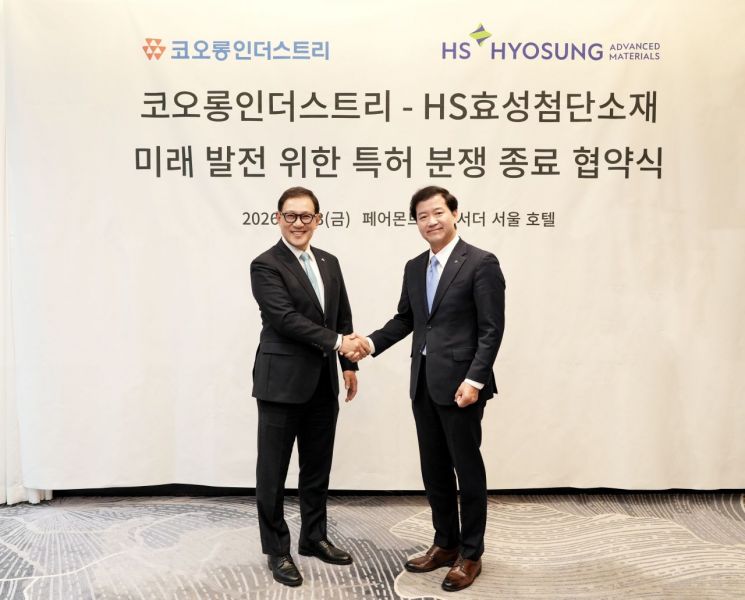
The agreement established a basis for cooperation within the necessary scope while respecting each company’s technology and intellectual property. Seong’s accompanying remarks emphasized future materials, core businesses and joint research with global tire manufacturers. It was a statement about where he wanted the business to direct its effort.
The photograph captures the ceremonial version of that decision: two executives, one handshake, a backdrop explaining the occasion. The practical meaning lies in the agreement to bring litigation to an end and concentrate on development. Competition would continue, with a different set of tasks occupying the companies’ attention.
The next address is Mexico
Seven months later, Seong was photographed holding an agreement in Mexico City. At the Korea-Mexico Business Forum on September 25, HS Hyosung signed an investment memorandum with San Luis Potosí’s government. The proposed advanced-materials production base would extend the group’s supply network toward North American and global markets.
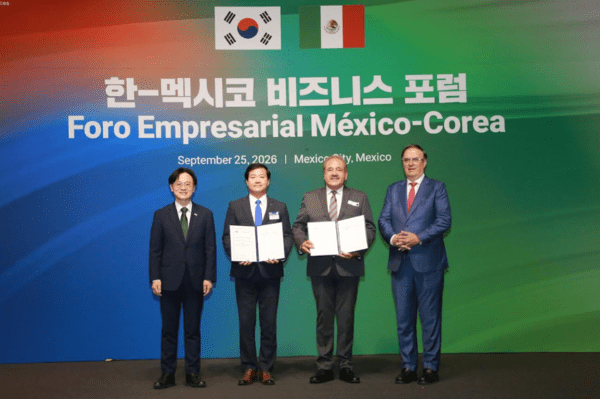
His stated ambition included local economic participation. “We will also contribute to strengthening local supply chains,” he said, alongside a commitment to job creation. Those intentions belong to an announced investment plan. The signing marks a step toward a production base; the phased investment is planned to begin in 2027.
The move adds another dimension to a career repeatedly concerned with access. In publishing, customers gained another way to reach a body of knowledge. In Mexico, a manufacturing group intends to expand the physical network through which it serves customers. The products and decisions differ substantially. The recurring commercial question is how to bring an existing capability into another useful setting.
Seong’s present ambitions also include developing new materials. In their joint brand-book message, he and Lim connect the quality of established automotive products with the development of carbon fiber and aramid, environmental work and applications in aerospace and defense. For an executive whose career has crossed several industries, the next chapter again involves finding places where a company’s knowledge can travel.
The dictionary is worth remembering. It offers a compact, tangible example from the middle of his career: editorial work carried into a new format, with a team organized to make it happen. Tire cords are a long way from a pocket reference book. Seong’s route between them has been longer still, and it has brought him back to materials with several other businesses behind him.