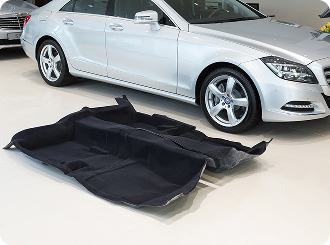
One hundred million square meters is an awkward quantity to picture. It becomes easier when you put it under someone’s shoes. By June 2026, HS Hyosung USA had passed that cumulative sales mark for automotive carpet. At five square meters per vehicle, the company’s comparison works out to enough for about 20 million cars. That is a lot of floor covering for a business whose name rarely enters the conversation at a dealership.
- Its U.S. operation makes tire cord and automotive carpet, and sells a broader range of industrial fibers.
- The customers build tires, vehicles and other engineered products. They buy materials to put inside something else.
- A planned steel-cord sale at its parent stopped in 2026. Stable supply had become part of the argument for keeping it.
The carpet is a useful introduction. Car buyers can see it, but its job extends beyond looking presentable. The parent’s interior-materials business describes cushioning, sound absorption and vibration reduction among its functions. The quiet cabin has an industrial backstory. Someone has to make the fiber, turn it into carpet and deliver a product an automaker can use repeatedly.
A hundred million square meters underfoot
HS Hyosung USA occupies a particular place in that chain. Its Charlotte office connects customers to a materials portfolio; its listed Decatur, Alabama, plant produces tire cord and automotive carpet. Behind it stands South Korea’s HS Hyosung Advanced Materials. Keeping those identities straight matters. The American operation has a local manufacturing story. The parent supplies the wider research, product range and international production network.
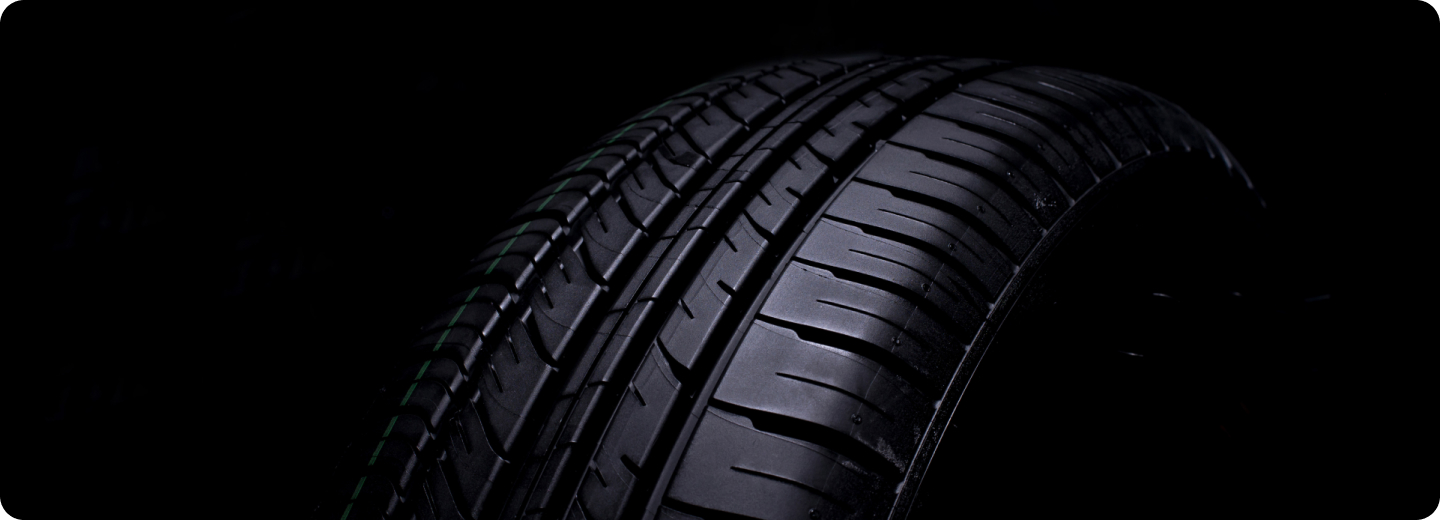
Consider a tire. Rubber is the obvious ingredient. Inside, textile cords help form its structure and contain inflation pressure. PET cord provides dimensional stability; nylon finds uses where heat resistance and adhesion matter. Hybrid cords combine materials to meet particular performance requirements. A buyer is choosing a behavior under load, heat and repeated use. The spool is merely the delivery format.
This is a business of selling into other people’s factories. July reporting named Hyundai Motor in the United States, GM and Tesla among the U.S. carpet operation’s customers. Tire makers represent another customer group. Kordsa offers competing textile reinforcement; Bekaert supplies steel cord. Hyosung’s breadth across textile and steel reinforcement gives customers several material routes within one group.
A second thread runs through the organization: patient improvement. The parent’s published recruitment values pair innovation with responsibility, trust and partnership. Those are declarations, rather than a measurement of working life. Its research history is more tangible: projects address abrasion, heat treatment, surface coatings and the behavior of yarn in production. The appeal for a customer is practical. A material that behaves predictably can make the next manufacturing step easier to control.
The $50 million shortcut
One historical transaction makes the model concrete. In July 2011, Goodyear sold its steel tire-cord business to Hyosung for $50 million. Its filing identifies inventories, manufacturing equipment and a license to patents and know-how. The businesses were in North Carolina and Luxembourg. Goodyear also entered a separate agreement to buy finished wire from Hyosung.
+ inventory+Licensed
know-how→A continuing
customer
The interesting purchase was a position in a production system. Equipment came with technical knowledge, while the supply agreement preserved a customer relationship. For another industrial supplier, the transferable idea is straightforward: evaluate the future orders alongside the assets. A cheap factory without dependable demand can become a very expensive building.
A spool with a different job
The newer materials carry the same question into different markets. What does the customer need the finished object to survive? TANSOME carbon fiber, commercialized by the parent in 2013, comes in several grades. Its applications include pressure vessels, cable cores, aerospace and sporting equipment. Toray is an established alternative in carbon fiber. Product selection requires more precision than picking a brand name.
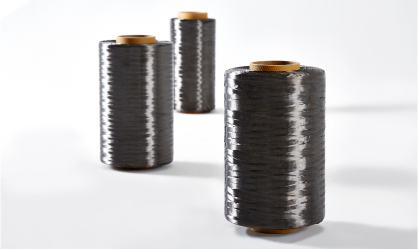
ALKEX, the parent’s para-aramid brand launched in 2009, serves another set of requirements. Uses include protective equipment and reinforcement for optical cables, ropes and rubber goods. The company’s research record also tracks seatbelt yarn, recycled automotive PET yarn and steel-wire processing. Much of the expertise lies in improving a familiar material’s strength, consistency or processability. Small changes can matter when the customer repeats a manufacturing operation thousands of times.
The deal that stopped
Then came a revealing interruption. The parent had considered selling its steel-cord business and selected Bain Capital as preferred bidder in 2025. In April 2026, it withdrew. The company cited global uncertainty, customer requests for stable supply and opportunities within the existing business. A supplier relationship had become a reason to hold an asset.
A cheap factory without dependable demand can become a very expensive building.THE INDUSTRIAL LESSON
That was a reversal in the sale process, rather than evidence of a failed fiber. It also puts a limit on the acquisition lesson. The approach depends on qualified products, workable production economics and customers willing to keep ordering. Ownership alone cannot establish those conditions. Nor should a buyer assume that performance in one application transfers automatically to another.
An old product gets new ingredients
The next investment returns us to carpet. In September 2026, the parent announced a $100 million Vietnamese plant, scheduled for completion in 2029. The plan connects yarn production, processing, tufting, backing and laminating. Its expanding carpet range includes recycled PET from bottles, recycled nylon from fishing nets and a PET option containing 30 percent bio-based material. That last percentage deserves to travel with the claim.
“Discover New Safety & New Comfort through Future Materials”THE PARENT COMPANY’S STATED MISSION
Recycled content answers one question about raw materials. A purchasing team still needs to assess durability, processing requirements and the relevant environmental evidence. Changing the ingredient does not remove the work of qualifying the product.
For a prospective customer, the useful starting point is a specification: required strength, abrasion performance, processing method and material content. HS Hyosung USA publishes product-specific sales contacts to begin that conversation. Ask for the evidence relevant to the finished product. Somewhere between that conversation and a factory floor, an ordinary-looking thread acquires a remarkably demanding job.