At a paint counter, the customer sees a color. The person operating the tinting machine inherits a small maintenance problem. Liquid colorants can thicken, dry or develop mold, especially when a particular shade moves slowly. In an interview about Pearls, Vibrantz researcher Peter Thommassen identified those recurring problems as the starting point. The interesting question was whether the colorant needed to remain liquid at all.
- Vibrantz supplies the ingredients behind paints, plastics, glass, electronics and more.
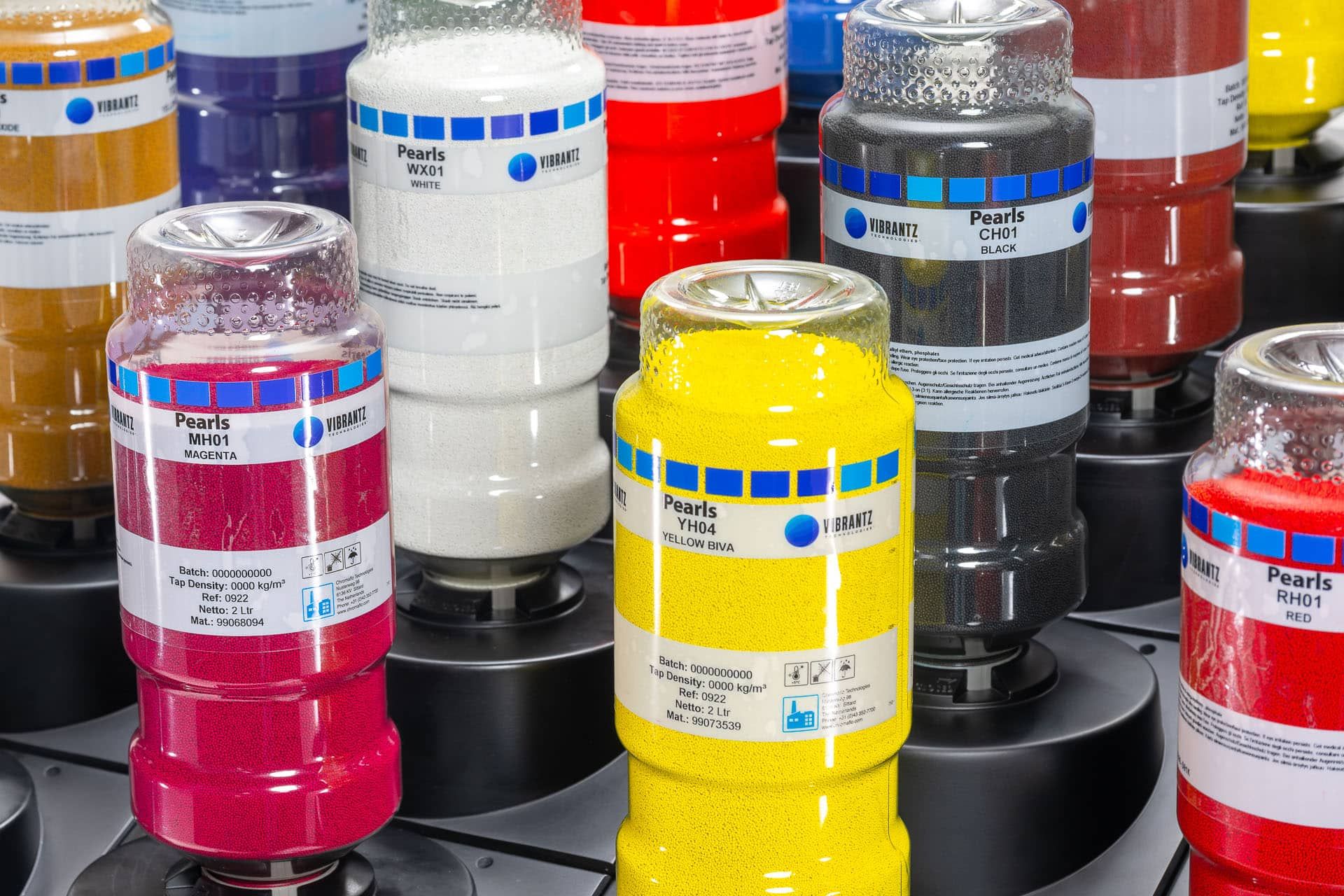
- Pearls replaces liquid tinting colorants with solids in a dedicated dispensing system.
- The commercial argument includes less cleanup and waste; buyers still need to qualify their paints and formulas.
01 The trouble in the can
Pearls begins with pigment dispersions that are freeze-dried into porous solids. The resulting colorants can be dispensed by volume and mixed into waterborne architectural and industrial paints. Think less about a new shade of blue and more about changing the machinery behind every shade. Removing the liquid carrier changes storage, dosing and the daily business of keeping a dispenser working.
Vibrantz describes the colorants as free of biocides and volatile organic compounds, with recyclable packaging. Those claims concern the colorant system; they do not establish that every finished paint has those properties. The distinction matters. A useful ingredient must still behave properly inside somebody else’s formulation.
02 Three companies, one missing piece
The company behind this experiment arrived through a different kind of mixing. In April 2022, Prince International completed its acquisition of Ferro and combined with Chromaflo under the Vibrantz name. The Ferro transaction alone was valued at approximately $2.1 billion. Houston became the headquarters of a specialty materials business with roughly $2 billion in sales at formation.
There had been an earlier false start. In a 2024 interview, American Securities managing director Scott Wolff recalled making an unsuccessful offer for Ferro in 2016. The investor subsequently bought Chromaflo, then Prince. It held off combining those two businesses because their overlap was insufficient.
What changed? Wolff said Ferro sold a non-core business, renewing acquisition discussions. Ferro’s remaining activities connected the capabilities of the other two companies. The lesson for anyone contemplating a merger is fairly sharp: shared ownership alone does not make a coherent business. The missing piece must do actual work.
“We buy basic raw materials”D. Michael Wilson, then CEO, describing the business in 2024
03 Small ingredients, several businesses
Vibrantz turns those raw materials into specialized ingredients that customers add to their own products. Color Solutions supplies pigments, dispersions and colorants. Advanced Materials provides mineral and chemical additives for applications including batteries, electronics and construction. Performance Coatings supplies glass coatings and porcelain enamels. A paint company, an appliance manufacturer and an electronics producer can therefore encounter different parts of the same supplier.
The current company overview reports more than 13,000 customers and over 500 patents. The common expertise is particle engineering, color technology, and glass and ceramic science. That combination helps explain the portfolio better than the loose word “chemicals.” Vibrantz sells control over properties that a finished-product manufacturer needs to reproduce.
Particle size. Color. Surface performance.
04 Count the cleaning hours
For Pearls, the customer buys into a system. Vibrantz sells the dispensers, although it says it does not manufacture them, and supplies its Innovatint software. Formulas and calibrated canisters turn a color request into a repeatable dose. Its webinar guidance places much of the potential saving in reduced waste, maintenance and lost time.
That gives a prospective buyer a practical exercise: measure those costs before comparing systems. Test the actual base paints and shade range. Check the local service arrangements. A conventional liquid system may remain a sensible choice where existing equipment and validated formulations already work well. Penn Color’s ASTRAD dispersions illustrate the continuing alternatives available to coatings formulators.
The economic argument depends on use. A retailer with slow-moving shades may value storage stability differently from a busy industrial operation. Neither should substitute a headline carbon percentage for a trial with its own products. The published Sphera comparison covers a defined set of stages, from raw materials through point-of-sale distribution, and reports an average per square meter of coated surface. It is a starting point for questions about the buyer’s system, rather than a promise about every can.
Vibrantz’s named Pearls references include Meffert, Copagro and San Marco. In November 2025, it announced the first African implementation with Namibia’s Peralin Paints. These are more useful adoption signals than an expansive claim about changing an entire industry.
Lower average carbon footprint for Pearls in the published tinting-system comparison.
Indexed illustration. Per m² of coated surface; Sphera assessment, A1-A5 boundary. An average comparison, not a forecast for every formulation.05 The factory and the financing
In June 2023, Vibrantz announced almost $20 million to expand Pearls production in Sittard, Netherlands, targeting approximately 1.2 million liters annually. The original release anticipated operation in 2025. Later materials moved that expectation to 2026. A factory target deserves a different verb from a factory achievement.
The balance sheet also belongs in the picture. In February 2026, Vibrantz announced an agreement with more than 90% of its first-lien loan and unsecured bond holders covering new debt financing, extended maturities and liquidity enhancements. Mike King, who became CEO in November 2025, faces the work of turning technical promise into dependable commercial execution.

06 Keep the terracotta
Another project captures the attraction of this business. In June 2026, Barcelona, Vibrantz and Pinturas Montó began testing infrared-reflective coatings matched to the city’s terracotta roofs. The experiment includes a school roof and a comparison between two sheds. The question is whether a familiar color can absorb less heat.
By August, Vibrantz reported encouraging interim shed measurements; the final results were still ahead of this profile’s October research date. The experiment offers a useful method to copy: preserve the feature people value, change the material underneath, and measure both versions under comparable conditions. Sometimes the product looks almost exactly the same. The work it does changes.
Go a little deeper
Explore the products, people and demonstrations.