The lunch rush tells you something about a restaurant. Dong-ho Kim is interested in what happens afterward. In the stretch between three and four in the afternoon, when the obvious reasons to fill a dining room have disappeared, sales may reveal a different kind of strength. He has offered that quiet hour as one example of evidence a lender could use to understand a business. A credit score attached to the owner cannot tell the whole story of the shop.
It is a fitting detail for Kim, also known as Kelvin Kim, the co-founder and chief executive of Korea Credit Data. He works with numbers, but his subject is the person trying to make a living behind them. A returning customer, a card payment and an expected deposit all contain information. His career has become an effort to put that information to work for the owner.
The researcher who changed the question
Kim’s original plan was a life in research, following his father, a professor. He attended the first cohort of the Korea Science Academy of KAIST and studied information and industrial engineering at Yonsei University. Exposure to Silicon Valley during an exchange in San Jose helped turn his attention toward entrepreneurship. Here was another way to test an idea: build something and let people decide whether it helped.
The timing mattered. As smartphones spread, they changed where information could be collected and how quickly an answer could arrive. Kim began to see consumer research as a business that would move onto the device people carried everywhere. The opportunity was practical. Companies wanted to ask questions; traditional research could demand more time and money than they had.
In 2011, he and two friends started the business that became Opensurvey. He later recalled watching the rise of young founders around him, particularly Ticket Monster’s Shin Hyun-sung, and realizing that starting a company was within reach. The example made entrepreneurship seem less remote. He credits the moment at which they entered the mobile market as an important part of the outcome.
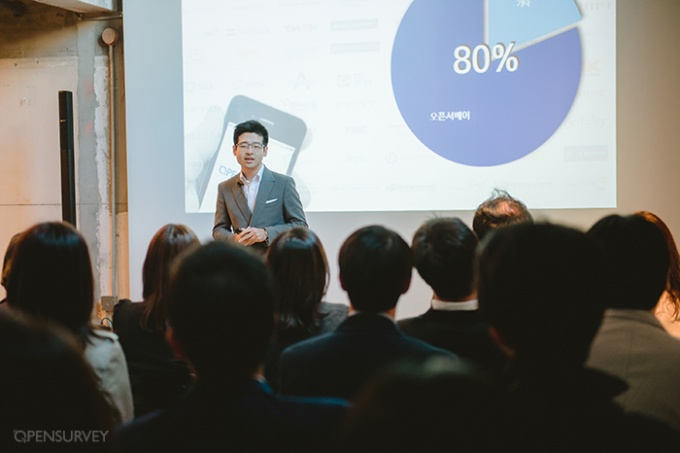
He spent five years as Opensurvey’s CEO before stepping down in 2016. The next company would also concern data, although its customers had very different questions. Consumer surveys helped companies understand a market. Kim now wanted to understand why a working neighborhood business could remain so difficult for financial institutions to assess.
A message worth opening
For his second venture, Kim met small-business owners and encountered a stubborn problem: getting a loan could be difficult even when there was a real business to examine. Reliable financial information was missing from the relationship. He reasoned that a useful sales management service could help owners assemble a clearer picture and, eventually, help connect that picture to finance.
Korea Credit Data was founded in April 2016. Cashnote followed in April 2017. Its early proposition answered a question with very little room for poetry: how much money would come into the account today? Card sales and the money arriving in a bank account were things an owner had reason to check repeatedly. A daily answer offered a daily reason to return.
Even the description needed work. An early emphasis on easy accounting drew a muted response. Sales and cash flow made the value clearer. Kim’s team also used KakaoTalk to deliver the service, avoiding the immediate need to build separate mobile apps and persuade busy people to install them. The familiar chat window was a useful place to meet a customer who already had quite enough to learn.
The choice reveals something about his approach. The owner had a shop to run. Making that person become enthusiastic about software was an unnecessary additional assignment. Cashnote could earn attention by helping with a task already on the day’s list. Early adoption exceeded the team’s expectations: more than 10,000 businesses joined within three months of launch.
A sale is only the beginning.
The customer a credit score overlooks
A regular customer is reassuring to a shopkeeper. To make that reassurance useful to a lender requires evidence. Kim has argued that repeat visits and the pattern of sales can help explain a business’s capacity to repay. The distinction is between examining the owner’s existing personal credit history and also examining the enterprise the owner is operating.
In June 2025, he described small businesses as a divided population. Some were struggling; others had room to grow. Designing policy for an imaginary average owner would miss that difference. His argument was that public support and private finance should respond to different circumstances, including the prospects of businesses capable of becoming larger firms.
The same reasoning gives meaning to that restaurant’s afternoon sales. They are a proposed clue about competitiveness, rather than a promise that a quiet-hour customer automatically earns anyone a loan. Kim’s ambition depends on translating operating information into assessment. The numbers need interpretation before they can support a lending decision.
KCD’s services have expanded through businesses handling payments, point-of-sale systems and credit evaluation. Korea Credit Service received its sole-proprietor credit bureau authorization in July 2022. The group also includes Korea Payment Networks and POS company IMU. These names describe the machinery behind the ambition: collecting useful records, connecting them and making them available for decisions.
Kim has also defended KCD’s independence. In early 2023, he said a sale was not under consideration because the company needed to remain independent over the long term to make better offers to owners. That stance gives the expansion a particular test. More services should make the customer’s working day easier, a standard considerably more demanding than adding another company to a group chart.
A bank is harder to launch than a chatbot
The banking project brought that ambition into a different arena. KCD led the Korea Soho Bank consortium in seeking authorization for a new internet bank focused on small businesses. Having merchant relationships and data was part of the case. Securing approval required satisfying a regulator about the institution that would be built around them.
The first application did not succeed. In 2025, the consortium failed to obtain preliminary authorization, with evaluators identifying shortcomings in the major shareholder’s capital strength, operating sustainability and stability. Kim continued to argue for the project and said he intended to persuade the authorities with a more developed business structure at the next opportunity.
There is a useful interruption here to the familiar upward curve of a founder biography. Customer adoption cannot substitute for every other qualification. A service can prove useful long before its operator has established everything required to sponsor a bank. Kim’s response has been to keep pursuing the ambition while working on the business supporting it.
Opensurvey begins
KCD is founded
Cashnote launches
First monthly operating profit, in December
In January 2026, KCD announced its first month of operating profit, recorded the previous December. It had taken nine years and eight months from incorporation. The company attributed progress partly to AI features and a broader range of subscription options. A profitable month was a milestone; the announcement’s expectation of annual profitability in 2026 remained a forecast.
A fondness for the supporting cast
Kim’s interests provide some relief from the paperwork. In a 2022 interview, he described Saturday-morning badminton with friends and a fondness for late-night cinema. An unpredictable finishing time at work had made films a convenient solitary pastime. He liked Youth, and thought supporting actors helped distinguish a very good film. There is an agreeable lack of founder grandeur in choosing a hobby that comes with a scheduled screening.
He also reads. Before an opportunity to present to SoftBank’s Masayoshi Son in 2013, he sought out books about Son, including titles that were out of print. Preparation meant studying the person in front of whom he would stand. His curiosity about other entrepreneurs extends to Dongwon founder Kim Jae-chul, whom he has cited for recognizing the industrial needs of his time.
“Without hurrying, but without resting.”
Kim’s stated motto, translated from Korean
The motto has appeared in his public reflections. It suits the long interval between a useful daily message and a business able to announce a profitable month. In 2025, the World Economic Forum selected him as a Young Global Leader. Recognition arrived while the financial project was still unfinished.
Ten years, then another morning
For KCD’s tenth anniversary, Kim returned to its first room: a small officetel near Sinnonhyeon Station, where the company began without a sign. His April 2026 message to colleagues described a group of roughly 500 people and infrastructure serving 3.5 million establishments. He admitted he had not imagined that scale at the start. The recollection contains both pride and surprise.
His updated biography puts Cashnote at 2.3 million establishments in August 2026 and group-wide service reach at about 3.6 million. The figures measure different things. One counts adoption of the merchant service; the other includes the wider infrastructure businesses. Behind both is the continuing task of being useful to individual owners.
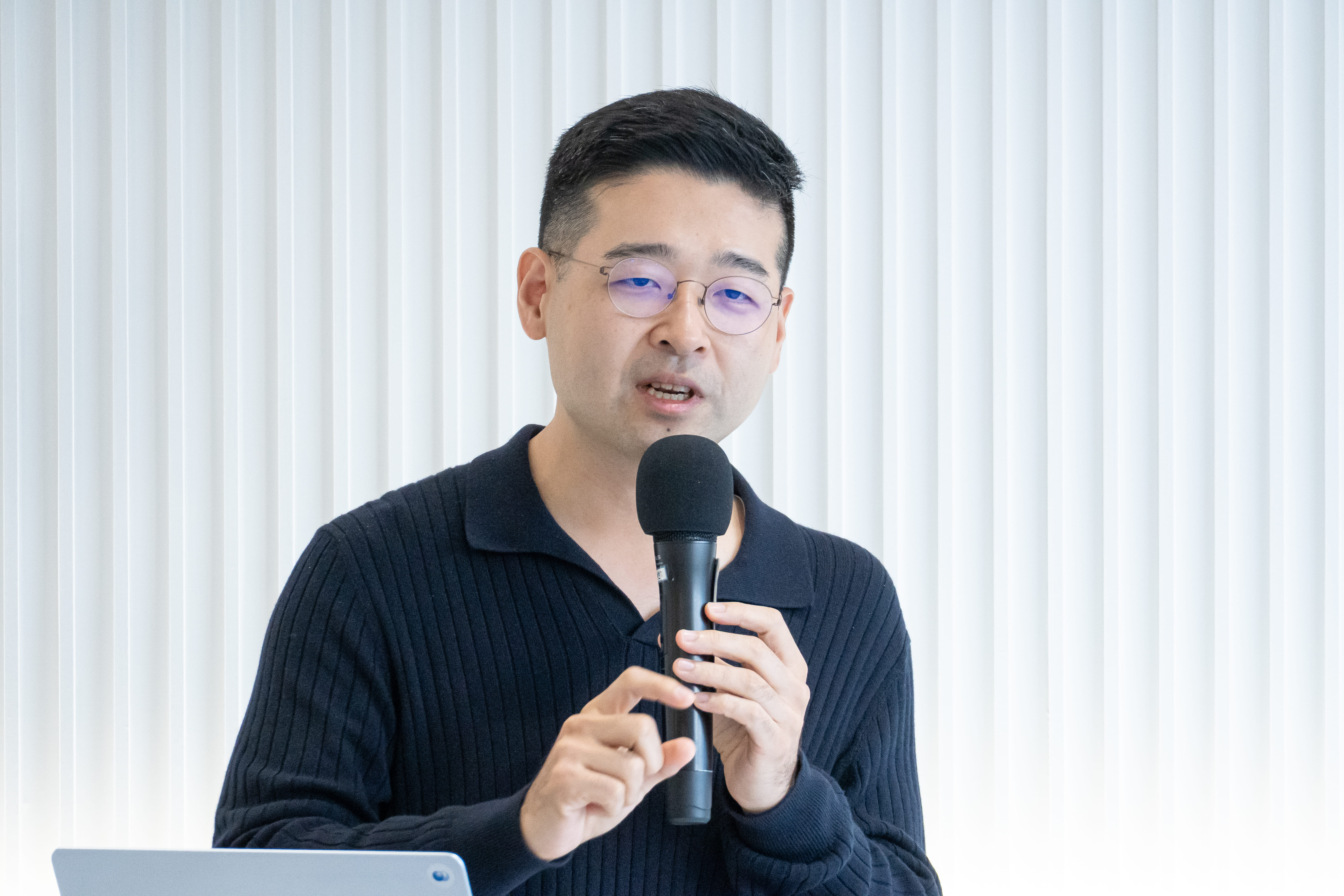
At an October 12, 2026 gathering of startup people, Kim returned to the time required to earn trust. AI could speed up technical work, he argued, while other parts of company building still took patience. Useful data needed a purpose. Customers needed a reason to consent to sharing it. He urged attention to what changed for the customer after a service was built.
His anniversary message allowed a longer horizon, including the possibility of eventually serving small businesses beyond Korea. For now, the ambition remains anchored in an ordinary working day: the owner checking receipts, expecting a deposit, wondering what comes next. Kim has kept finding larger questions inside those small transactions. The next answer still has to be useful when the shop opens.