A shop can be busy and still look empty to a bank. Its customers arrive, its parcels leave, its product pages accumulate reviews. Yet the documents that traditionally make a business legible to a lender may say very little. Lee Kyung-ho built ConnexioH around that awkward discrepancy: the distance between running a business and being able to prove that you run one.
He arrived at the problem through information security. Before the company, there were corporate networks, security responsibilities at NHN, and a university laboratory concerned with risk. His subject changed from protecting information to making overlooked information useful. The underlying question remained familiar: what evidence deserves to be trusted?
For an online merchant, that question has consequences beyond an interesting seminar. Stock needs buying before the next sale. A growing business needs money while it is growing. Lee’s proposition is to give its everyday activity a form that financial institutions can understand. The humble product listing, usually busy trying to sell a pair of shoes, acquires a second job.
The engineer before the credit model
Lee began his professional career through Samsung’s graduate recruitment system. As a Samsung SDS network engineer working at Samsung SDI, he dealt with large networks, overseas factories and network management systems. He later worked in the group’s security organization. These were environments where the movement of information could carry substantial operational consequences.
He went on to establish a company, work as a consultant after a merger with STG Security, and serve as NHN’s chief information security officer. By 2012, he had also moved into a full faculty position at Korea University after years of teaching there as an adjunct.
He stressed the support he had received from senior management at NHN. Technical competence mattered, but so did getting an organization to support the work. He wanted to organize practical experience into knowledge that other people could use, and to educate people who could help Korea’s security industry grow.
The progression gives his later company a particular texture. Lee had already experienced the distances between an engineer’s findings, an executive’s decision and a student’s understanding. Making information useful to another person had been part of the job for years.
A laboratory discovers an absent shop
His academic training spans mathematics, communications and information protection. He earned his mathematics bachelor’s degree at Sogang University, followed by a master’s in information and communications engineering there. His doctorate at Korea University focused on information protection, including information security policy.
His research includes risk assessment, financial security, abnormal transaction detection and information protection governance. A financial anomaly detection technology was transferred to ConnexioH in 2020. This is a founder whose commercial work has a visible connection to the questions being pursued in the university.
ConnexioH was established on March 25, 2020. Lee founded it with master’s and doctoral researchers from Korea University’s Graduate School of Information Security. A corporate credit evaluation project had exposed a missing layer of data, particularly around online businesses.
The difficulty was remarkably mundane. Transactions passing through payment intermediaries did not necessarily give financial institutions a clear view of the underlying merchant. A seller could leave abundant traces across an online marketplace and remain difficult to assess through conventional financial records. Lee’s team began with those traces.
The product listing gets a hearing
ConnexioH’s approach looks at activity that a conventional balance sheet does not describe in detail. Product information, customer interest, delivery and changes in sales can help build a picture of how an online business operates. Lee’s argument is that this activity deserves to be considered when evaluating a merchant’s capabilities.
The company’s alternative credit work and its seller tools approach the same business from different directions. Financial institutions need evidence they can use in an assessment. Merchants need information that helps them improve the business being assessed. In Lee’s company, those audiences meet around the shop’s daily work.
A simplified view of ConnexioH’s services, not a lending decision or a credit score.
That distinction matters. A dashboard can help someone see a business more clearly; a lender still has a decision to make. Lee’s work occupies the space between a merchant’s activity and the institutions trying to interpret it. The useful output is evidence that another organization can actually work with.
It is an unusually practical ambition for a business built around data. The customer does not need to admire the machinery. The customer needs a clearer view of the shop.
Forty-three thousand shopkeepers
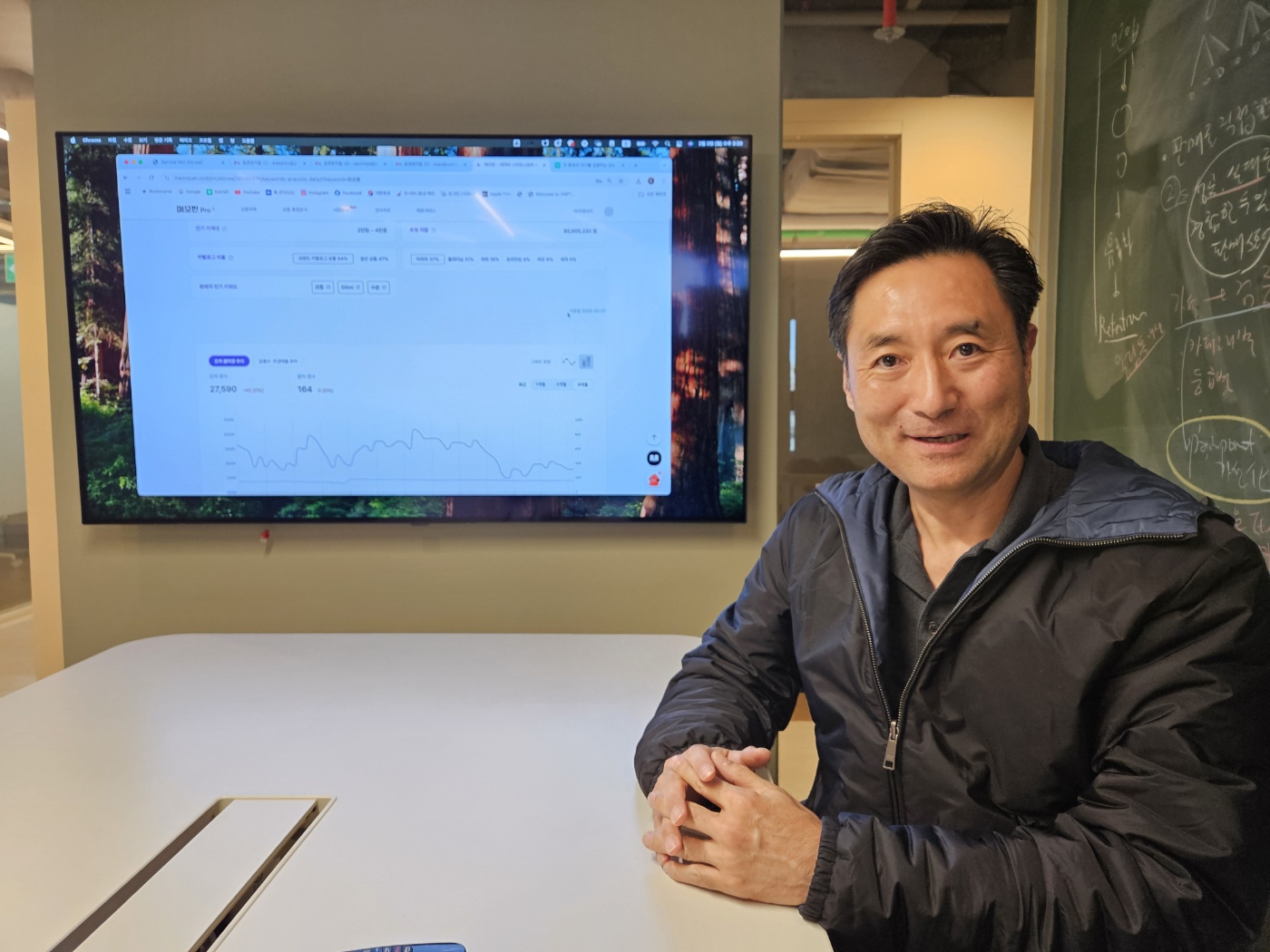
Maemopan, the company’s analysis service for Naver Smart Store sellers, makes that ambition tangible. Its tools include tracking product rankings, analyzing keywords and managing registration information. These are the chores of being discoverable in an online marketplace, where a useful product still has to appear in front of a potential buyer.
By August 2024, Maemopan had passed 43,000 registered business members. Lee said he intended to give businesses starting without substantial capital or a physical store access to IT services comparable to those available to large companies.
The aspiration has a welcome lack of glamour. Ranking checks and product information are hardly red-carpet material. They are, however, things a merchant has to deal with between orders. A tool that helps with these tasks has a direct way of demonstrating whether it belongs in the working day.
Lee also described the economics of this problem in 2024. Small merchants could struggle to justify expensive IT systems. He wanted to bring useful analysis within their reach. The attraction of the software lay in making an existing job easier to do, at a price an individual business could contemplate.
His example of seasonal swimwear businesses made the financing side equally concrete. He saw activity data as a possible basis for financial products suited to changing demand. A swimming costume has a season. The business selling it has bills throughout the year. The timing is rather less forgiving than the photograph on the product page.
The unglamorous ninety percent
By October 2025, Lee was describing the labor behind these services with a memorable estimate: collecting and refining information in the field could account for 90 percent of the work. A research setting supplies cleaner material. A commercial system has to contend with the information it actually encounters.
At that point, ConnexioH was supplying more than 110 data items monthly to NICE Information Service. Its bank-facing Oncell dashboard was undergoing testing with BNK Busan Bank. Lee also described an ambition to pursue an IPO by 2029. That was a goal he set, rather than an outcome already achieved.
The figures give the business an institutional setting. A merchant-facing tool has to be usable by someone trying to sell a product. Data supplied to a financial institution has another demanding audience. Both require the collection and refinement that Lee emphasized. The attractive dashboard sits at the end of a considerably less photogenic process.
“I want to expand the credit market through data and help more people get opportunities.”
Lee Kyung-ho · February 2025 interview
A Google engineer stops by
At CES 2024, Lee recalled a Google engineer approaching him and asking to be contacted if he could obtain Amazon data. The encounter surfaced during discussion of startups at the DINO Lab Gyeongnam center. It is a small anecdote, with a very specific object of interest: access to useful commerce information.
There is something fitting about that request. A company explaining its work on a global exhibition floor might hope for applause. Here, the conversation came down to whether it could get the data. For a founder working on collection and interpretation, that was a question very close to the business itself.
Overseas ambitions were already part of ConnexioH’s plans in early 2024, including work on commerce data and service prototypes for Singapore, Vietnam and Indonesia. Lee was seeking a wider application for an approach developed around Korean marketplaces. The ambition travelled; the work of understanding each marketplace would still have to follow.
The next question is still about meaning
ConnexioH’s current website extends the product vocabulary into pricing tools and connections for AI agents. NexPrice tracks prices across selling channels and adjusts them within configured limits. NexMCP packages external APIs as tools agents can call. The company also describes an ontology-based knowledge graph for connecting commerce information.
Those products belong to a different moment from the early credit project, but the practical question is recognizable. What does this piece of information mean to the person or system receiving it? A seller considering a price change and a bank considering a business need different views of the same commercial world.
Lee’s career has repeatedly put him beside that question. The network engineer, security executive, professor and founder have had different immediate responsibilities. Each job has required a way to turn complicated information into something people can act on.
For the online merchant, the test remains wonderfully ordinary. Does the work of running the shop become easier to understand? Can the business make a fuller case for itself? Lee has built his company around the possibility that the answers are already present in the day’s activity, waiting to be collected carefully enough to count.