In August 2020, a derecho tore through the Midwest. For an electrical contractor, this is where the organization chart becomes a practical question. Who has the crews? Who has the equipment? Who can get them moving? In Iowa, four MYR Group subsidiaries answered together, rebuilding transmission lines and clearing access for ITC Midwest. The holding company became visible through the work of its parts.
- The work: power lines, substations, building electrical systems, solar and storage.
- The edge: established local contractors drawing on shared labor, equipment and financial resources.
- The catch: a busy order book can still contain expensive mistakes.
That is a useful way into MYR. Electricity attracts grand language: transformation, modernization, the future. Construction makes those ambitions specific. A connection needs a crew, a schedule and a price that survives contact with the job site. MYR occupies that demanding middle ground between deciding to build and switching something on.
The customer knows the local name
Start with the names on the trucks. L.E. Myers. Sturgeon Electric. Harlan Electric. These are operating businesses with histories of their own. MYR combines them with other specialists across the United States and Canada, retaining local management while making equipment and labor available across the network. The proposition is straightforward: keep the relationships close to the customer; give those relationships more resources.
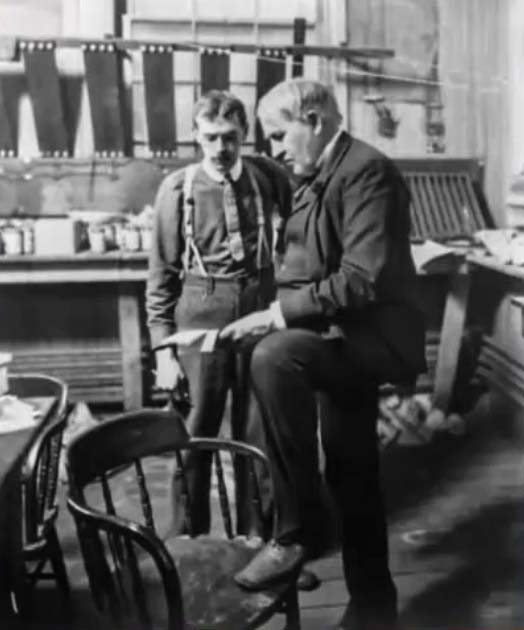
The dates require a little care. Lewis Edward Myers, once a salesman for Thomas Edison, founded L.E. Myers in 1891. The corporate entity was organized in 1982. The MYR holding company identity arrived in 1995, bringing together L.E. Myers, Sturgeon and Harlan. Treating all three dates as interchangeable loses the interesting part: the business grew by assembling experience that already existed.
That operating heritage reaches management, too. Rick Swartz became president and chief executive in January 2017 after beginning in field operations at Sturgeon Electric. His route included operating and management roles. For customers entrusting a contractor with a complicated installation, familiarity with what happens below the executive floor has an obvious appeal.
MYR sells to organizations: utilities, developers, general contractors, industrial owners and public agencies. Its two reporting segments follow the work. Transmission and Distribution handles the network delivering power. Commercial and Industrial handles electrical systems in places such as hospitals, airports and data centers. A customer buys a completed scope, maintenance capacity or emergency response.
Against smaller regional firms, shared financial capacity and specialized equipment can make larger assignments feasible. Against other national contractors, the contest still comes down to price, relationships, safety and execution. MYR competes in a market where a familiar name may get a conversation started, but a competitive bid must follow.
A solar farm is a coordination problem
Consider Battle Mountain, Nevada. Completed in June 2021 for Consolidated Edison, the project paired a 132-megawatt DC solar plant with 100 megawatt-hours of battery storage, rated to deliver power over four hours. MYR Energy Services was the prime engineering, procurement and construction contractor. The batteries are a reminder that producing electricity and having it available when needed are separate jobs.

MYR’s scope included buying trackers, inverters and the storage system; installing piles, cables and modules; then commissioning and testing. That list explains what the company actually supplies. Hardware must become a functioning system, with different trades and suppliers working in sequence. The service is the organization of all those dependencies, backed by people capable of doing the installation.
There is a similar logic in restoration. MYR advertises round-the-clock mobilization and repair work extending from damaged substations to transmission lines. During its response to Hurricanes Helene and Milton in 2024, staffing reached 373 at the Milton peak. Moving people and machinery across regions is part of the product, even though it rarely appears in a photograph of finished infrastructure.
The price of getting the estimate wrong
Here is the complication. MYR gets paid under several arrangements, including fixed prices, unit prices and time-based contracts. In a fixed-price job, a contractor promises a defined result for an agreed amount. Costs can keep changing. Weather, labor productivity, equipment availability and revised site requirements all have a vote.
A connection needs a crew, a schedule and a price that survives contact with the job site.THE ECONOMICS OF GETTING IT BUILT
In 2024, trouble on certain clean energy projects and a commercial and industrial project weighed on margins. Annual net income fell to $30.3 million, against $91.0 million in 2023. The weakness showed up in project execution and expected profitability while bidding opportunities remained active. Demand for the industry’s output did not protect the contractor’s earnings.
The contract mix subsequently shifted. Fixed-price work represented 43.9 percent of Transmission and Distribution revenue in 2024 and 34.3 percent in 2025. That change reduced the segment’s exposure to one form of estimating risk; it does not establish that every underlying problem disappeared. Companywide, 57 percent of 2025 revenue still came from fixed-price work.
Profit recovered to $118.4 million in 2025, on $3.66 billion of revenue. MYR attributed improved margins partly to the comparison with troubled 2024 projects, alongside stronger productivity, favorable change orders and job closeouts. That distinction matters. A recovery can reflect both better current execution and the passing of unusually difficult work.
Safety also belongs in that calculation. Multiple MYR districts have earned OSHA’s VPP STAR designation, which requires continuing evaluation. Training and worker involvement matter commercially as well as personally: a construction business needs people who can recognize trouble early and act on it. A centralized balance sheet cannot make that judgment for them.
The useful thing to copy
By June 2026, backlog had reached $3.16 billion. Second-quarter revenue was $1.08 billion. In July, MYR added Valley Electric and Comet Electric, extending its commercial and industrial reach. The company continued building the same kind of organization: more regional capability beneath a common financial roof.
For a buyer, the practical lesson is to examine the delivery system. Ask which operating company will execute, how equipment will be supplied and who bears the cost of changes. For an operator, MYR offers a structure worth studying: share scarce resources while preserving local accountability. It depends on capable supervisors, available workers and contracts that price uncertainty sensibly. Without those conditions, greater scale can simply spread the consequences of a bad estimate.
The appeal of MYR is that its business makes an abstract electricity story concrete. Somewhere between a forecast and a functioning grid, people must arrive with tools. Then they have to finish.