An electric grid is a curious place to look for a personal story. Most of the people who depend on it would prefer never to think about it. Christopher Vincze has spent much of his working life in the opposite position: thinking about the engineering, permissions, risks and organizations that let infrastructure do its job. His career follows the work that has to be finished before everyone else can take a service for granted.
In February 2026, WSP completed its acquisition of TRC Companies for a total cash purchase price of $3.3 billion. Vincze was TRC’s chairman and CEO; the firm brought approximately 8,000 professionals into the combination. It was a large transaction at the end of a long stretch of company building. To understand his part in it, the more revealing starting point is twenty-one years earlier, when the assignment was to help rebuild.
The rebuild came first
Vincze’s route to TRC ran through environmental consulting and risk services. He had served as president and chief operating officer at ATC Group Services, an engineering and environmental consultancy in Woburn, Massachusetts. At Marsh, he became a managing director and led the Corporate Environmental Practice, working alongside construction, transportation and real estate practices. His work also included corporate integration and growth programs.
Those businesses sit close to an awkward truth about development: owning a site, financing a project and making it usable are different undertakings. Environmental questions can travel across all three. Vincze’s experience placed him where technical advice meets the commercial consequences of getting something wrong. Read in that light, his move into running a broader engineering business has a recognizable logic.
He had completed a bachelor’s degree at Connecticut College in 1984 and a master’s degree at Boston University in 1985. By the time TRC hired him, his qualifications included experience leading an established consulting business. The appointment announcement described ATC as a company with 1,700 employees and $155 million in business. He came with practice in the scale of organization he would be asked to manage, as well as the industries it served.
TRC announced his appointment in March 2005, with a May 2 start as chief operating officer reporting to CEO Richard Ellison. He became CEO in January 2006 and chairman in November. The sequence matters. He entered through operations before taking responsibility for the whole enterprise. TRC describes his initial remit as turnaround, integration and rebuilding: three words that make a respectable amount of work sound almost manageable.
By 2010, the company’s board was describing him as a leader who had guided a difficult turnaround. The later transactions can make his tenure look like a continuous acquisition story. Its beginning was more demanding and less celebratory. An organization had to be put in a position to grow before the growth could become the headline.
A wager on the wires
TRC had roots in air quality and a substantial environmental business. Under Vincze, power and energy became a central direction for expansion. In a 2013 interview, he described the U.S. energy transformation as a driver of the company’s strategy. He was looking at the delivery side: the engineering required to get electricity onto the grid, including feasibility work and project execution.
“We view this transformation as inevitable,” he said. The remark is interesting because of its date. His argument already treated changes in energy production and use as an enduring source of work, even amid uncertainty over policy. The practical opportunity lay in the infrastructure required to accommodate that change.
That gives his career a particular shape. He was taking a position on a market while building an organization capable of serving it. The two activities had to advance together. Buying a capability without customers would leave one problem; finding customers without the necessary specialists would leave another. Power delivery gave the expansion a direction that could connect several kinds of technical work.
A signature before a celebration
A year later, Vincze offered a wonderfully unromantic test of business momentum. For TRC to count a project in backlog, he explained, “it has to be funded and signed,” with work moving forward. A possible future project did not qualify merely because somebody was pleased to discuss it. The distinction is small enough to fit in a sentence and large enough to affect how a company plans.
He also described bringing acquisitions into TRC’s financial reporting, systems and culture within a year. Together, these details suggest an operating preference for things that can be made concrete. Both methods tie growth to the practical capacity to deliver. The work was to secure the assignment and then make the organization able to carry it out.
“it has to be funded and signed”
Christopher Vincze, on what qualifies as backlog, 2014
The discipline gives the growth story some friction. Expansion produces additional people, offices and reporting obligations as well as revenue. Integration is where the attractive diagram encounters everyday working habits. For a chief executive who began his TRC career in operations, that part of the assignment kept returning.
Two investors, one continuing assignment
In March 2017, TRC agreed to be acquired by affiliates of New Mountain Capital for $17.55 per share in cash. The announcement described a business with more than 4,100 staff and more than 120 offices in the United States and United Kingdom. New Mountain planned to keep the management team in place and operate TRC as a standalone business.
For Vincze, the stated attraction was the ability to continue pursuing long-term growth. That is a consequential distinction within his career: ownership changed while management’s assignment continued. The investment firm’s subsequent account dates its entry to June 2017 and says it had first met TRC more than five years earlier. The relationship had a longer preparation than the announcement suggested.
Warburg Pincus announced its growth investment in October 2021. By then, TRC described a workforce of just under 6,000 and emphasized its position in power and utilities. The stated plan included expanding engineering and consulting services connected to decarbonization. Vincze credited New Mountain’s support during the preceding four and a half years and welcomed the next investor.
The vocabulary was changing alongside the services. Grid design remained part of the business, while renewable energy, efficiency and digital capabilities featured in the explanation of where it was going. His continuing task was to make those additions useful to customers already relying on the company.
More specialists, more coordination
A seat beyond the company
A photograph from July 2019 catches Vincze in a different professional setting. Standing opposite David Bohigian, then acting president and CEO of the Overseas Private Investment Corporation, he raises his right hand to take the oath as a board member. The pinstripe suit is familiar executive equipment; the flags announce a different responsibility.
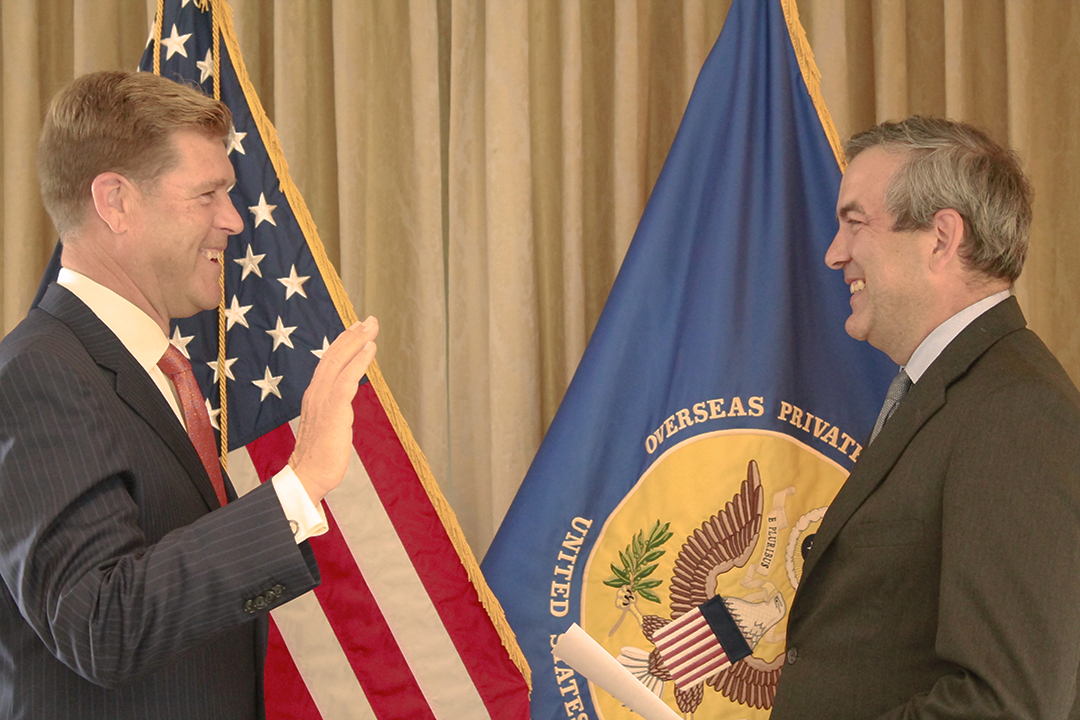
His public record also includes board service at the U.S. International Development Finance Corporation. It places another strand beside the operating career: participation in institutions concerned with investment beyond a single company. Infrastructure involves capital and public decisions as well as technical work. His career has repeatedly brought him into contact with those adjoining worlds.
Adding the missing skills
Two later acquisitions make the connecting logic of TRC’s expansion easier to see. In June 2023, the company announced the addition of Gladstein, Neandross & Associates, known as GNA. Its specialty was low- and zero-emission transportation, supporting technologies, infrastructure and fuels. The firm also helped clients pursue public incentives for commercial vehicles and infrastructure.
Vincze linked that expertise to TRC’s work on energy supply and delivery. A fleet transition creates connected questions about vehicles, infrastructure, energy and funding. Bringing the advisers closer together offered a way to address more of that assignment. In March 2024, TRC received an Environmental Business Journal M&A award for the GNA acquisition.
In January 2024 came Locana, a geospatial technology business with a presence in the United States, Canada and the United Kingdom. It added location intelligence, mapping capabilities and software, including the Lemur mobile product. Vincze described the acquisition in terms of extending services from advice through design and asset management.
Maps might seem a modest addition to an infrastructure story until someone has to locate the asset. The acquisition also supported TRC’s technology expansion in Europe. It is another example of a familiar management problem in his tenure: choosing an adjacent capability, then making it part of a service customers can use.
& permitting
& engineering
& assets
The next rebuild is integration
WSP announced its agreement to acquire TRC in December 2025. Vincze’s explanation joined the firm’s environmental origins to its technology-oriented power business. He pointed toward rising power needs associated with electrification, domestic manufacturing and infrastructure. The themes had acquired a different scale, but the interest in the work surrounding electricity was recognizable from his earlier interviews.
The deal closed on February 24, 2026. Vincze welcomed the chance to expand opportunities for employees and capabilities for clients, and committed to a smooth, thoughtful integration. The language returns his story to its opening assignment. After years spent incorporating expertise into TRC, he was discussing how TRC would join a larger organization.
The transaction gives his tenure a striking number. The more personal thread is the persistence of the work: rebuilding, choosing where to concentrate, bringing specialists together, and doing it again when ownership changes. A career spent behind infrastructure has arrived at another integration. Somewhere within it, a project still needs a signature, an engineer and a place on the calendar.