Kelly Tomblin wanted to be Barbara Walters. Growing up in a West Virginia coal town, the daughter of a miner imagined a future asking questions for a living. She became the first in her family to attend college, earned a journalism degree, and eventually found herself responsible for something rather harder to switch off than a television interview: an electric utility.
It is a useful beginning for understanding her. The public knows a power company through its bills, its poles and the inconvenient moment when the lights disappear. Tomblin has spent much of her career considering the people on either side of that relationship. Her route has taken her through law, international energy businesses, Jamaica, an Illinois infrastructure contractor and, since 2020, El Paso Electric.
Now that last assignment has a closing date. On October 9, 2026, El Paso Electric announced that Eli Viamontes would succeed her on November 9. She will remain an adviser through the end of the year. The approaching handover offers a chance to look at a career in which changing a company's equipment and changing its habits have repeatedly belonged to the same job.
A reporter's education, an operator's career
Her formal education makes an unusual collection for a utility executive: journalism and law at West Virginia University, followed by an MBA at New York University's Stern School of Business. There is a logic to the combination. Reporting requires attention to an audience. Law requires an argument capable of surviving somebody else's argument. Business adds the numbers and the machinery of an organization.
Tomblin has described her early newspaper and radio work as training in speaking to people whose concerns differed. Environmental and mergers-and-acquisitions legal work then exposed her to competing interests inside the energy business. Comparing companies gave her a way to examine why some organizations functioned better than others. Her eventual move into management carried that interest into the places where decisions became daily work.
Before Jamaica, she was president of Pennsylvania Electric Company and a vice president at GDF SUEZ/International Power. Her experience extended across the United States, Britain, Latin America and the Caribbean. These were businesses with different markets and rules, but the recurring practical question was familiar: how do you get a group of people to carry out a difficult change together?
Jamaica had questions of its own
When she took charge of Jamaica Public Service in 2012, the company faced high electricity prices, unhappy customers and stagnant growth. An overseas executive arriving at an unpopular utility cannot expect much credit for the contents of her résumé. The electricity still has to arrive. The bill still has to be paid. A customer's irritation can survive a very impressive introduction.
One early response was organizational and distinctly local. JPS appointed 15 parish managers and three regional directors. Decisions about customers in the parishes were to move closer to those customers, instead of travelling automatically to headquarters. The design gave her talk about personal connection an address and a person responsible for answering.
That mattered because a utility's reputation is built in repeated encounters. A grand strategy can look satisfactory in a conference room while a customer waits for someone to resolve a small problem. Giving local managers more responsibility was a concrete attempt to shorten that distance. It also made customer service part of how the business was organized, with authority attached.
“My heart was broken open in Jamaica.”
Kelly Tomblin, reflecting on her years at JPS
The engineering changed, too. Her tenure included the introduction of liquefied natural gas into Jamaica's energy mix, smart-grid technology and prepaid metering. JPS added more ways for customers to contact the company and established its philanthropic foundation. Each change touched a different part of the relationship: fuel, information, payment, access and community life.
In December 2016, the Platts Global Energy Awards named her CEO of the Year. She was the only woman among 12 finalists from six countries. The judges singled out the speed of the turnaround in a difficult setting. An award cannot stand in for every customer's experience, but this one recorded how far the assignment had moved from its unpromising starting point.
The departure with a box of cookies
Tomblin left Jamaica in July 2017 after five years. She had promised her sons that the family would return to the United States as they reached new stages in their schooling. She also believed her management team had grown strong enough for the next stage of the company's work to belong to someone else.
Her next employer, INTREN, sent a small introduction to its culture: cookies made by people whom the company supported. The gesture appealed to her sense of stewardship. For a leader considering the distance between a company's stated values and its actual behavior, the contents of a welcome package can be surprisingly informative.
She became CEO of the Illinois-based utility infrastructure contractor on July 10, succeeding founder Loretta Rosenmayer, who moved to chair the board. It was another vantage point on the energy system, through the business of building and maintaining the infrastructure utilities need. INTREN's female leadership also gave her an immediate setting for a longstanding interest in women's careers.
A leadership book that went home first
In 2018, Tomblin returned to Jamaica to launch a book with Kathleen Sullivan, a leadership and culture strategist. 100 Days of Doing Power Differently was dedicated to the people of Jamaica and the JPS family. Launching it at the Jamaica Pegasus Hotel put the work back among the people whose experience had helped inspire it.
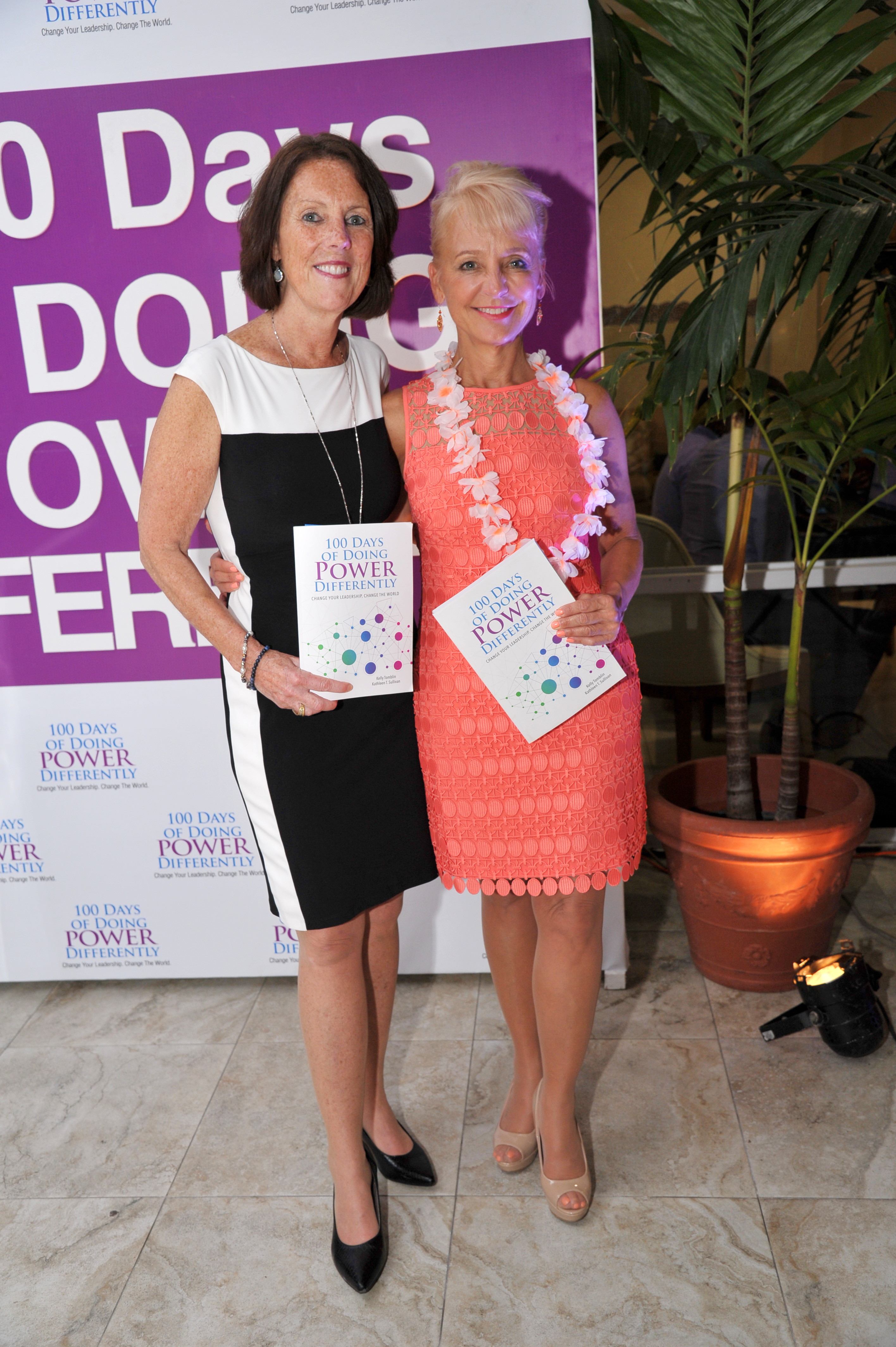
The book uses a 100-day structure to turn reflection into practice. That choice fits the awkward problem of leadership advice: agreeing with a principle is easy; remembering it when someone annoys you before lunch is less convenient. A guide spread across days asks the reader to return, rather than congratulate herself for having understood the introduction.
The ThinkLove framework Tomblin and Sullivan describe includes trust, listening, knowledge, purpose and navigation. Its account of trust brings together character, caring and competence. It explicitly includes conflict and accountability. That combination gives the word “love,” which can sound rather decorative in a business setting, a demanding list of obligations.
There is also a practical insistence on making room for other people. Tomblin founded Jamaica's Women in Energy and has spoken about leadership and gender equality internationally. Her work with the JPS Foundation and Junior Achievement extended that interest beyond executive appointments to younger people and communities. The concern is consistent across these activities: who gets the chance to participate?

El Paso, and the work behind the promises
Her appointment at El Paso Electric was announced when Infrastructure Investments Fund completed its acquisition in July 2020. The transaction came with commitments to local leadership, workforce development, customer bill credits and community investment. Tomblin arrived with experience across generation, transmission and distribution, as well as the less easily diagrammed work of rebuilding public confidence.
That context matters. New ownership is an event on a company's calendar; for customers, the relationship continues the following morning. Promises about investment have to become equipment, service and decisions people can recognize. The incoming executive's job included carrying the commitments of a financial transaction into a business rooted in a particular place.
At El Paso Electric, her initiatives included a new strategic plan, smart metering, automated systems and electric-vehicle infrastructure. The renewable portfolio expanded during her tenure. Her civic roles reached into WestStar Bank, the El Paso Chamber, the Downtown Management District and the Borderplex Alliance. For someone running a regional utility, those connections put the grid alongside the businesses and neighborhoods that depend on it.
A useful example of what expansion meant sits in San Elizario. In March 2025, the company announced its new 10-megawatt community solar facility was online. Built with EDF Renewables on 70 acres, it contained 18,930 panels and added room for 5,000 more customers to subscribe. Homeowners, renters and businesses could participate without installing rooftop panels.
A place for renters, too.
The expansion also reduced subscribers' monthly capacity charge by approximately 15%, with a further discount for income-qualified residential customers.
The distinction between buying solar equipment and subscribing to a shared facility is consequential. A renter can want renewable energy as sincerely as a homeowner with a suitable roof. Changing the route into the program changes who can join. It is a modest, specific illustration of the participation question that has followed Tomblin through her career.
Leaving the chair, keeping the connection
There are lighter clues to the person behind the appointments. During her Jamaica years, Tomblin spoke warmly about Bob Marley and Chronixx, declared her enthusiasm for ackee and admitted that Jamaican fruit had made fruit elsewhere a difficult proposition. A utility boss can have quite definite opinions about dinner. These details also suggest how much the place had entered her everyday life.
Her November 2026 handover will return her to a question she faced when leaving Jamaica: when should the next person take over? Viamontes arrives from Entergy Texas, while Tomblin remains available to advise through December. The timetable makes room for both departure and continuity. After six years at El Paso Electric, she will leave the chief executive's office without immediately severing the working relationship.
The journalist she once hoped to become might have enjoyed this ending: an executive whose career keeps returning to the people outside the executive's office. Customers, local managers, young women considering an energy career, a renter looking at solar. The questions have changed since West Virginia. Her work has repeatedly brought her back to the business of listening for the answer.
Keep the conversation going
Interviews, leadership writing and the next chapter.