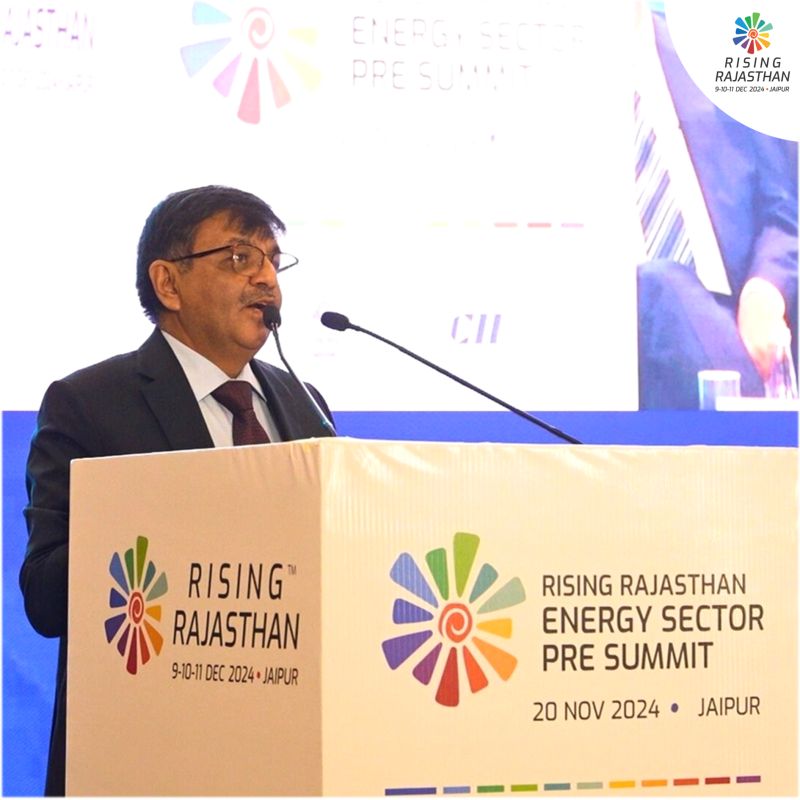
On 20 November 2024, Sandeep Zanzaria stood behind a lectern in Jaipur and described a future in which Rajasthan could sell surplus electricity to other states and regions. The occasion was an energy investment gathering. The opportunity, as he described it, lay in transmission and storage. A state’s ability to produce power was only the beginning of the proposition.
It was an apt subject for the managing director and chief executive of GE Vernova T&D India. Zanzaria works in the stretch between an energy ambition and a usable supply of electricity. That stretch contains transformers, converter stations, switchgear, contracts, engineering teams and quite a lot of waiting for things to be ready. A solar panel photographs beautifully. The equipment that helps its output travel has a less accommodating publicist.
His career offers a way into this less photographed part of the energy transition. It began with electrical engineering, continued through commissioning and project management, and eventually acquired the vocabulary of commercial strategy. By April 2023, he was running GE T&D India. The company later took the GE Vernova name. The underlying business remained concerned with a stubbornly physical question: how does power get from where it is generated to where it is needed?
Fourteen years before the corner office
Zanzaria graduated in electrical engineering in 1989 from Maulana Azad College of Technology in Bhopal, now Maulana Azad National Institute of Technology. In 1990, he joined Bharat Heavy Electricals Limited as a graduate engineer trainee. His first employer occupied fourteen years of his working life. His assignments included engineering, commissioning and project management.
Those are useful distinctions. Engineering determines what a system should do. Commissioning tests whether the installed equipment can actually do it. Project management has to bring equipment, people and schedules into agreement. His early career placed him across all three activities, well before his responsibilities expanded to regional commercial leadership.
He joined Alstom T&D in 2004 and held commercial roles as well as the position of unit managing director for the projects business. In 2015, he moved to Schneider Electric India as vice president of projects for South Asia. Two years later, he joined GE’s Grid Solutions business, leading commercial strategy and order intake in South Asia.
The geography widened further with responsibility for strategy and growth across Asia Pacific. Along the way, he attended senior leadership programmes at the Indian School of Business in Hyderabad and GE’s management development programme in Crotonville in the United States. The sequence is unusually consistent: different employers, broader responsibilities, the same transmission and distribution terrain.
- 1990BHEL
Graduate engineer trainee - 2004Alstom T&D
Commercial and project leadership - 2015Schneider Electric
South Asia projects - 2017GE
South Asia commercial strategy - 2023GE T&D India
MD and CEO
The optimism comes with a list
On 17 April 2023, Zanzaria became managing director and chief executive of GE T&D India. He arrived at the role with experience of both the equipment business and the commercial work of securing projects. His public comments from that period paired confidence about demand with a fairly unromantic account of the obstacles.
He pointed to land issues that delayed transmission projects, financing that had to close on time, and dependence on imported raw materials. More renewable generation would also make grid operations more complex. These are awkward companions to a sunny growth forecast, which is precisely why they matter. They describe the work that must happen between a target and a commissioned asset.
In a 2024 interview, he also described a change in the order of operations: transmission corridors were being planned proactively, giving generation developers more visibility. That helps explain why the timing of network investment occupies so much of his attention. A generator and its route to market have to develop in a workable sequence.
His colleagues’ descriptions add a small personal detail to the business record. On LinkedIn, Rajeev Dhande, who said he knew Zanzaria through their Areva association, described him as humble and candid. It is one colleague’s assessment, rather than a personality test. Alongside his repeated discussion of practical constraints, it gives some texture to an otherwise title-heavy public biography.
A factory answers the forecast
In May 2025, the business announced an order from POWERGRID for more than 70 extra-high-voltage transformers and shunt reactors. The 765 kV equipment was intended for renewable power transmission corridors. Manufacturing was assigned to Vadodara, with deliveries expected to begin in 2026 and continue through 2027.
The scope extended beyond supplying equipment to erection, testing and commissioning. For a former commissioning and project management engineer, the list has a familiar shape. Winning the order begins a sequence of obligations. The announcement covered corridors serving Rajasthan, Gujarat, Karnataka, Tamil Nadu and Andhra Pradesh, turning a national energy ambition into specific equipment for specific networks.
Vadodara also supplied a measure of continuity. The factory had been designing, manufacturing and testing equipment in this voltage class since 2009. By the time of the announcement, it had supplied more than 700 such transformers and reactors. That is a manufacturing history shared by many teams, and a reminder that a chief executive inherits capabilities as well as responsibilities.
Another 2025 announcement put $16 million behind an expansion in Chennai and an engineering and test laboratory in Noida. The Chennai line was planned for converter valves used in HVDC and grid-stability systems. Noida would support engineering, validation and control systems. The announced schedule envisaged the lab by the end of 2025 and the manufacturing line by early 2027.
The distinction between a plan and an operating facility matters here. These were announced investments and schedules. Their purpose was tangible: develop more of the engineering and manufacturing capability close to the market being served. For Zanzaria, growth strategy had acquired a factory line and a test laboratory.
“Through this investment, we are strengthening our ability to deliver technologies”
Sandeep Zanzaria, on the 2025 manufacturing expansion
Two contracts, two ages of the grid
December 2025 produced a useful pairing. GE Vernova announced an HVDC contract for Adani Energy Solutions’ Khavda-South Olpad corridor. The planned transmission capacity was 2.5 gigawatts. Its job was to move renewable electricity from the Khavda zone in Gujarat into the wider network. This was new infrastructure for an expanding energy geography.
In February 2026, Zanzaria described the project’s scope: system design, converter equipment and erection, testing and commissioning, excluding associated civil works. He said India-based teams would perform most of the execution, with completion targeted for 2030. The time horizon is revealing. An order announced in one year becomes an engineering and delivery commitment across several more.
The other December announcement concerned an existing asset. POWERGRID had awarded GE Vernova a contract to refurbish the 1,000 MW Chandrapur back-to-back HVDC link. Originally commissioned in the late 1990s, it had already spent decades helping power move between regions. Its next chapter involved replacement converter valves and modernised control and protection systems.
For the business Zanzaria leads, the two contracts illustrate different kinds of demand. New renewable generation calls for additional routes and equipment. Existing networks require renewal. A growing grid has to accommodate both. There is an appealing absence of glamour in the second task: sometimes the next energy project is a better version of something that has been working for years.
The contrast also brings his career into focus. He entered the industry in 1990. The Chandrapur asset dates from later in that same decade. Now his company is participating in its refurbishment while preparing technology for a corridor intended to serve a different generation mix. Industrial careers and industrial equipment both accumulate history.
The distance is only half the problem
Zanzaria’s discussion of technology tends to return to the different jobs a grid has to perform. In his February 2026 interview, he explained why two forms of HVDC, line-commutated converters and voltage-source converters, would both have roles. Bulk transfer over long distances and flexible control around renewable generation create different requirements.
His comments resist the temptation to treat every new technology as the winner of a single contest. The same reasoning applies to storage and transmission: a battery can shift energy across time, while a transmission link moves it across geography. Decisions about one have to take account of the other, and of where generation and demand actually sit.
In October 2025, he had highlighted another difficulty for equipment companies: tenders arriving in bunches, followed by quieter periods. The annual total tells only part of that story. A manufacturer must also decide when to buy materials, allocate engineering hours and prepare capacity. The calendar can be as consequential as the order book.
This is where the engineering graduate and the commercial executive meet. His public agenda brings together local manufacturing, technical capability, project visibility and customers willing to coordinate over long delivery periods. The ambition is expressed through the means of getting work done, with fewer dependencies and a clearer path from order to execution.
An industry career, still adding connections
His involvement extends beyond a single employer. Zanzaria has served as a national executive member of the Indian Electrical and Electronics Manufacturers’ Association since August 2021. His earlier involvement in its projects division stretched back more than a decade by 2023. He is also listed on the strategic advisory committee for Bharat Electricity Summit 2026.
Those affiliations suit a business whose outcomes depend on coordination among utilities, manufacturers, developers and policymakers. No chief executive can settle all the questions along a transmission route. Even the equipment with the most imposing dimensions depends on agreements, approvals and other people’s schedules.
The Jaipur appearance offers a fitting final image. Zanzaria was speaking about the commercial possibilities of surplus power, but the investment he identified concerned the connections that would make those possibilities useful. After a career through engineering, projects and commercial leadership, he was still working on the journey between generation and consumption. Electricity may travel quickly. Building its passage is the patient part.
Keep following the connections
- Sandeep Zanzaria on LinkedIn
- GE Vernova
- Career profile and industry outlook, April 2023
- Interview: transmission economics and technology, October 2024
- Interview: the transmission outlook, October 2025
- Interview: HVDC projects and local manufacturing, February 2026
- The Jaipur energy pre-summit appearance
- Chennai and Noida investment announcement
- POWERGRID transformer and reactor order
- Chandrapur refurbishment announcement