Before Puneet Gupta started selling conversations about the future, he had trouble deciding what to do with his own. In his account of Astrotalk’s beginnings, he describes a resignation letter, an anxious pause and a colleague who practised astrology. She encouraged him to send it. Later, when a business partnership unravelled, he remembered her prediction.
- Astrotalk puts astrologers on call and chat, with a price attached to each minute.
- Its FY25 operating revenue reached ₹1,176 crore; growth required substantial spending.
- A spiritual goods store extends the relationship from a conversation to a purchase.
The skeptic with a resignation letter
Gupta’s version is unusually candid about the detours. He left a banking technology job, exhausted savings and returned to employment. In 2015, he started CodeYeti, an IT services business. Then came two product experiments. Six months went into them, capital was wasted, and his partner left in March 2017. The service company had customers; the attempted products had failed to find their footing.
Gupta says the colleague’s apparent foresight changed his view of astrology. That is a founder’s account of a conversion, rather than evidence that predictions work. But it explains the question he took seriously next: could people find a practitioner they trusted without relying on a family introduction? Astrotalk launched in 2017. Its practical proposition was access.
A clock, a wallet, a person
Open Astrotalk and the old consultation becomes a sequence of ordinary software decisions. Choose a practitioner. Compare language, experience, ratings and price. Recharge a wallet. Start a chat or call. The clock runs, and the fee accumulates. The company shares consultation revenue with the practitioner. Economic Times reported prices of ₹10-₹200 a minute in June 2024; today’s listings and promotions vary.

The customer can arrive with an embarrassingly ordinary concern: marriage, a relationship, a job. In June 2024, the company was handling roughly three million sessions a month, with marriage questions leading employment enquiries. The useful change is convenience. Chat allows a private question without an overheard conversation, and leaves a written record. Availability and choice become part of the service.
Free horoscopes, kundli creation, compatibility tools and live sessions give visitors something to try before paying. The current chat page advertises a free first chat and per-minute billing afterward. Vedic astrology sits alongside tarot, numerology and Vastu. These are different traditions gathered behind one purchasing process, with a human consultation at the centre.
Free tools02 Choose
Expert + price03 Recharge
Wallet balance04 Consult
Paid minutes
AstroYogi, AstroSage, InstaAstro and local practitioners offer alternatives. Astrotalk’s pitch rests on a managed network, easy access and visible customer feedback. Its screening and ratings can help someone choose a provider; they cannot establish that a forecast will come true. The platform’s expertise combines practitioner recruitment with the less mystical work of making discovery, payments and support function.
Growth has a media bill
The numbers sharpen the story. Operating revenue climbed from ₹283.32 crore in FY23 to ₹651.12 crore in FY24, then ₹1,176 crore in FY25. This was a business collecting payment for a service people already understood. Yet reaching those people was expensive: FY24 advertising and promotion cost ₹162.68 crore, roughly a quarter of operating revenue. The app did not distribute itself.
Expansion brought a bigger expense base. FY25 total expenses reached ₹1,129 crore. The company reported adjusted profit before tax of ₹285 crore, after excluding exceptional employee-related costs and a non-cash adjustment to preference shares. Adjusted pre-tax earnings are a different measure from net profit. That distinction matters when a growth headline makes the business look effortlessly profitable.
Institutional funding arrived in February 2024 with $20 million from Left Lane Capital. A June transaction led by Elev8 Venture Partners added an announced $14 million, including secondary share sales. Anmol Jain, who joined in 2021 and became co-founder in 2023, oversaw product, finance and operations. The founder story now needed an operating organisation.
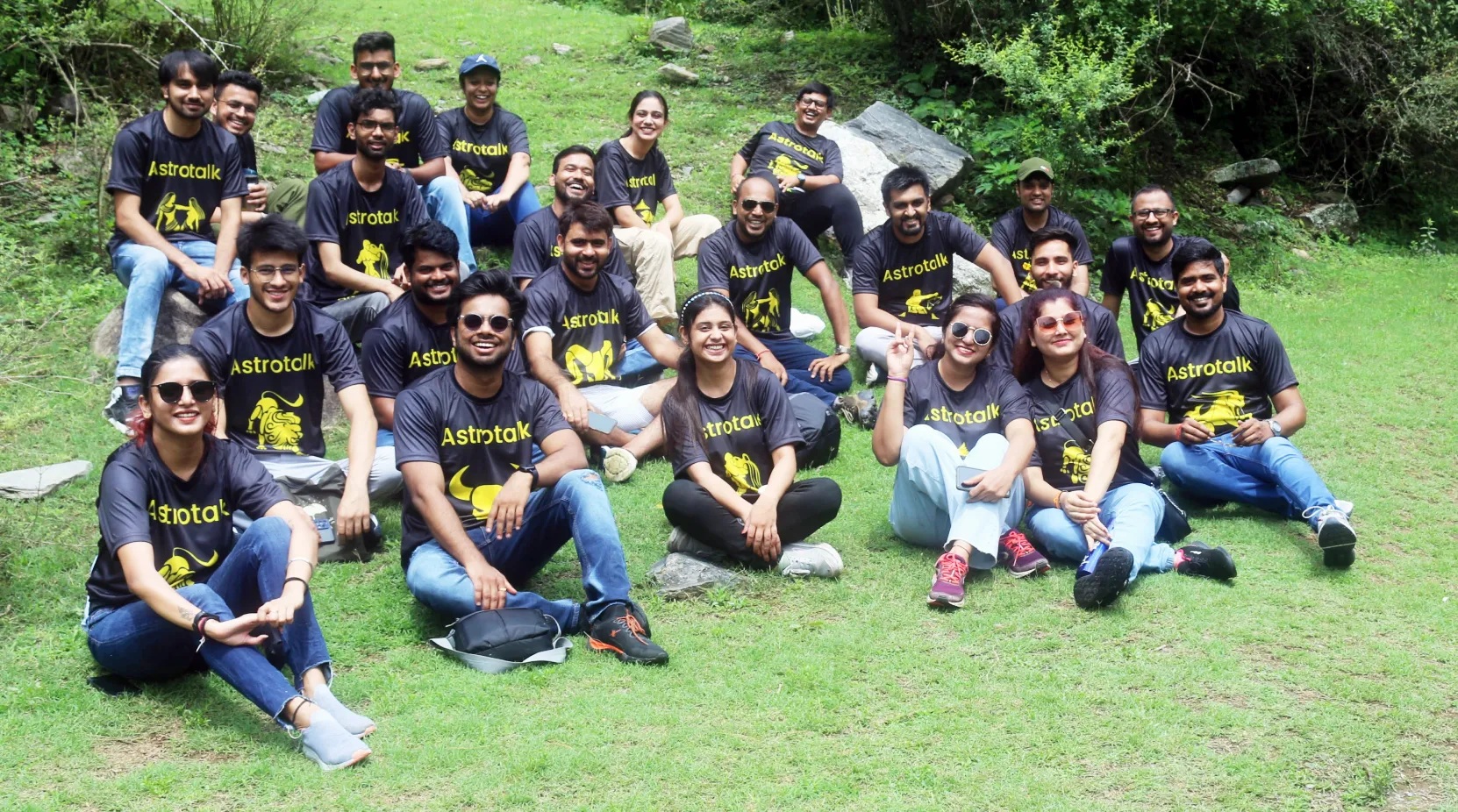
“Our greatest moat is our core team”Puneet Gupta, announcing Jain’s elevation in 2023
Then the advice needed a parcel
Astrotalk Store launched in November 2024 and scaled commercially from January 2025. The hypothesis was straightforward: customers seeking spiritual advice might also buy spiritual goods. A ₹30 lakh pilot tested demand. After early traction, the company committed another ₹40 crore to inventory, supply chains, technology, marketing and categories. Gemstones, rudrakshas, bracelets and ritual essentials turned consultation demand into a physical retail proposition.
The company reported more than 1.6 million store orders in calendar 2025. Its commerce leadership described a browser-led, website-first operation, with systems built separately from the app-led service business. That separation makes sense: connecting two people and delivering a parcel create different problems. Practitioner availability does not solve stock control, authentication or returns.
Borrow the sequence, keep the boundaries
For another entrepreneur, the copyable part is the order of decisions. Find an existing paid behaviour. Remove the effort of locating a provider. Make price and payment understandable. Offer a small first experience. Test the adjacent purchase before making the large investment. This approach needs repeat demand, dependable providers and acquisition costs that the transactions can support. A matching interface alone supplies none of those conditions.
There is also a boundary around the promise. Astrotalk’s terms describe consultations as personal insight and reflection, rather than professional medical, legal or financial advice. The product helps people access spiritual conversations; a rating is no guarantee of an outcome. That limit belongs inside any honest account of what the customer is buying.
In August 2026, Astrotalk announced an employee share buyback at a $1 billion valuation, funded from company profits and involving more than 100 employees. It was a liquidity event, with no new funding round announced. The next minute had become valuable enough to price the company. Whether the stars explain tomorrow remains a separate question from why someone pays to talk about it today.