Puneet Gupta knew how to write a resignation letter. On his second attempt, he remembers, he no longer needed to search Google for a template. Sending it was another matter. The document offered the tidy confidence of a completed task; the decision brought back memories of an earlier business attempt that had consumed his savings. Entrepreneurship had already taught him that a blinking cursor can be more intimidating than a manager.
Years later, the Noida-based founder and CEO of Astrotalk would be running a company whose customers pay to discuss what might happen next. His own career had taken enough turns to make that question personal. Bank software jobs, an IT services venture, an astrology app: the sequence looks orderly when printed on a timeline. Living through it required considerably more improvisation.
A resignation with a backspace key
Gupta studied engineering at Punjab Engineering College in Chandigarh, graduating in 2011. A software development job at Nomura took him to Mumbai. In 2013 he left to pursue entrepreneurship. The attempt did not provide a lasting livelihood, and he eventually returned to the city to find work again.
In his telling, the gap in his employment made technology interviews harder to obtain. An old colleague referred him to BNP Paribas, where he accepted a pay cut. That return matters to the story. It gave him another stretch inside a large organization before he tried to build his own. The path to Astrotalk included going back to a job, a detail that tends to disappear when a founder’s biography is reduced to a brave resignation.
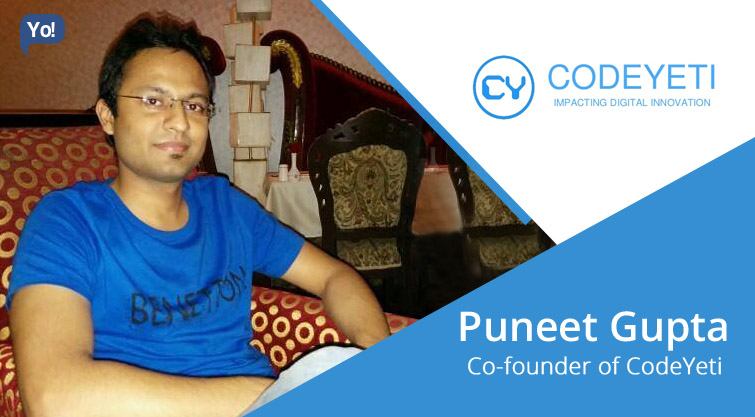
In April 2015, he co-founded CodeYeti in Noida. The company built apps and websites for other businesses. There was a useful apprenticeship here: clients had requests, developers had deadlines, and someone had to make the two agree. By 2017, Gupta was ready to put a different kind of conversation inside an app.
The colleague he underestimated
At BNP Paribas, a colleague named Heena practised astrology. Gupta was skeptical. His later description of their relationship includes a mischievous detail: he had not been impressed by her coding, which hardly disposed him to trust her predictions. Software competence had become his rather unconventional entrance exam for an astrologer.
He says she predicted that he would start an IT company, do well for a period, and then see that venture end. When events appeared to him to match the prediction, he reconsidered his earlier dismissal. He subsequently invited her onto an Astrotalk podcast to discuss both what had been right and what had gone wrong.
The episode belongs to Gupta’s personal account of changing his beliefs. It also supplied a founding narrative with an unusual advantage: he could address someone’s skepticism because he had once shared it. He was entering a field he had mocked, carrying the engineer’s habits with him. The resulting company would need to make an old, personal service available through a modern interface.
Finding astrologer number two
Astrotalk launched on October 18, 2017. Its first astrologer was already part of Gupta’s story. Finding the second, he recalls, proved surprisingly difficult. Some prospective recruits resented being interviewed about their knowledge. Others considered themselves too established to join a small platform.
One candidate eventually cleared the interview, but attached a condition. He wanted his money every evening because he foresaw a financial loss. Gupta negotiated weekly payment. A month later, the astrologer was comfortable with monthly payment, having incurred a loss in another activity. Even a business concerned with planetary movements had to agree on the movement of money.
Gupta tells the anecdote with amusement, but it describes a real marketplace problem. Customers needed reasons to trust the practitioners. Practitioners needed reasons to trust the company collecting the payments. A recruitment process and a payment schedule had to bridge both gaps. His willingness to interview candidates put the founder in the awkward position of assessing people whose service he had only recently begun to believe in.
“Honesty and trust are the keys to surviving in this business.”
Puneet Gupta, 2022
Two weeks to launch, a year to learn
Gupta has described the first Astrotalk app as a hurried effort, developed in two to three weeks. He wanted to get it into the market and observe the response. After earlier product ideas had failed, he placed more value on learning quickly than on polishing an untested proposition.
The following year was slower. He called customers and astrologers for feedback and handled customer support himself. The person selling access to guidance had plenty of listening to do. Those conversations offered information a launch announcement could never provide: where people waited, where a session became awkward, and what they expected the app to make easier.
He identifies August 2018 as the point when the product found its market fit. That date puts ten months between launching the app and seeing the business begin to pick up. A founding insight may arrive in a conversation. A workable service takes revisions, and the first release leaves a founder with an audience capable of disagreeing.
in people’s hands
revise
market fit
The answer that found an audience
Writing became another way to reach people. Gupta says that, when Astrotalk was doing about ₹10,000 in daily revenue, he encountered a question on Quora about whether people believed in astrology. He answered with his own experience. Within seven days, he recalls, daily revenue reached ₹50,000.
The episode is his account of an early burst of growth. Its appeal is easy to understand: a personal answer gives a curious reader a person to consider before a company asks for a transaction. His LinkedIn writing also helped create an early audience. A founder could explain why he had changed his mind in the same places where readers were forming theirs.
As the business grew, marketing became more deliberate. Gupta has described using Quora to answer questions, offering a first consultation free, and displaying practitioner qualifications and reviews. Each choice addresses the hesitation before someone tries the service. Readers arrive with different expectations; the company has to turn that curiosity into an experience they are willing to repeat.
His blog archive also includes a question about why astrologers give different predictions. For a marketplace founder, that is an especially relevant subject. Variation among practitioners follows the customer into the product, however neatly the app arranges the profiles.
Learning to leave the room
In Gupta’s account, Astrotalk’s second year brought faster activity, and the third required a more defined organization. He had to establish departments, policies, and a team structure. He also had to learn to delegate tasks he had previously done himself.
That is a change in the founder’s job description. Calling every customer can teach someone a great deal at the beginning. As demand grows, the same habit can leave the rest of the organization waiting for one person. Delegation requires the founder to turn what he has learned into arrangements other people can use.
He continued to describe direct contact with practitioners. In a 2023 post, he wrote about checking in with astrologers on Fridays to ask how their work was going. Those conversations prompted an announced plan to fund astrology and tarot training for mothers seeking to restart their careers. He presented it as an initiative to build, with assessments and interviews before hiring.
The announcement shows another side of his role: the marketplace’s workforce has its own ambitions. Flexible access matters to the people providing consultations as well as to the people buying them.
A company gets bigger; a person stays particular
Gupta has described himself as an introvert, an interesting admission from someone whose writing became part of his company’s public presence. The distinction is quite plausible. A person can enjoy putting a thought into words without wanting every evening to become a networking event.
He has named writing and cricket among his interests. Asked about money in a 2022 interview, he compared it to a toy that becomes ordinary once a child finally has it. He also described placing greater value on his time and being willing to spend on things that saved it.
Earlier, during the CodeYeti years, he argued for employee empowerment and a more open work culture. He also expressed an ambition to provide accommodation, education, and skills training for people living in poverty. These were stated interests and aspirations. They help place the software founder beside the public company narrative without turning either into a personality test.
He has been clear about one professional distinction: he is not an astrologer himself. His work lies in building the business around practitioners. He brings the app, the recruitment process, the organization, and the audience; someone else conducts the reading.
The future has a balance sheet
Astrotalk’s expansion eventually brought institutional investors. In February 2024 it raised $20 million from Left Lane Capital, followed by another $14 million in June. By January 2026, the company was reporting more than 20,000 active astrologers and users in markets including the United States, United Kingdom, Canada, and Australia.
Its reported operating revenue rose from ₹651 crore in FY24 to ₹1,176 crore in FY25, an increase of about 81%. The figures describe the business at particular dates. They give the founder’s long sequence of experiments a measurable result, while leaving the individual decisions visible beneath it.
In August 2026, Astrotalk announced an employee share buyback involving more than 100 employees at a $1 billion valuation, funded from company profits. The total buyback amount was not disclosed. For employees taking part, the announcement offered a way to turn a stake in the company into cash.
Gupta’s stated direction remains international expansion, investment in technology and talent, and profitable growth. The business that began with his change of mind now asks him to make decisions for a much larger organization.
There is a temptation to let the prediction at the beginning explain everything that followed. Gupta’s own recollections offer a more populated story: a referral, a colleague, difficult recruitment, customer calls, a written answer, and the eventual need to hand work to other people. The future supplied the subject. Building the company kept him occupied in the present.