Josh Wong had already sold a company to GE when friends in the investment world asked a reasonable question. Why build another startup for electric utilities? He knew the customers. He knew the long conversations, the technical demands, the distance between a promising demonstration and something an operator would trust. He was volunteering for another helping.
His explanation was disarmingly personal: “I have unfinished business and I see the need to keep modernizing the grid.”
There are more fashionable objects of affection than electricity infrastructure. It rarely photographs well, and dinner guests seldom ask follow-up questions about distribution planning. Wong has nevertheless built a career around it. His second venture, ThinkLabs AI, applies machine learning to the calculations and decisions behind electric networks. The company is new. The preoccupation has been with him for years.
A career measured in planning horizons
Wong was born in Hong Kong and moved to Toronto as a child. He studied electrical engineering at the University of Toronto, then electric power engineering at the University of Waterloo. His later education included executive programs at MIT Sloan, IMD and Harvard Business School. Engineering supplied a way into the problem; business education accompanied the expanding responsibilities.
At Toronto Hydro, he worked inside the organization responsible for making electricity an everyday convenience. He eventually led its smart-grid work, with responsibilities spanning engineering, policy, regulation, strategy and business development. Among the assignments was a 25-year smart-grid roadmap. A quarter-century plan is a useful introduction to an industry where equipment and institutional decisions can remain consequential long after a launch announcement has disappeared.
His utility work also reached into public policy. At Toronto Hydro, Wong served on a policy and regulatory advisory committee ahead of Ontario’s Green Energy and Green Economy Act in 2009. He consulted on smart-grid policy for the federal government, too. The experience put another part of the job in view: a workable engineering idea has to find its way through rules and decision-making structures. Understanding those structures would become part of the founder’s preparation for dealing with long utility sales cycles.
He also served as director of engineering at energy-storage company eCAMION before founding Opus One. His experience reached from the network itself into the devices changing its behavior. Batteries, solar generation and electric vehicles were giving utilities a growing number of moving parts to accommodate. Wong was learning the problem from several angles before trying to build a business around it.
The consultancy that needed a company
Opus One Solutions began in 2011 as a one-person consulting firm. That origin gives Wong’s story a pleasantly unceremonious beginning. Before there was an organization to sell, there was a person selling his knowledge. The software business grew from work on the practical difficulties utilities were encountering as energy became more decentralized.
By 2017, Opus One was winning million-dollar contracts across North America. Its Toronto office occupied a narrow walk-up on Queen Street West, near the Horseshoe Tavern. The surroundings offered brick walls, hardwood floors and shops selling things considerably easier to explain than distributed-energy software. Inside, employees were working on how new power sources could coexist with older utility systems.
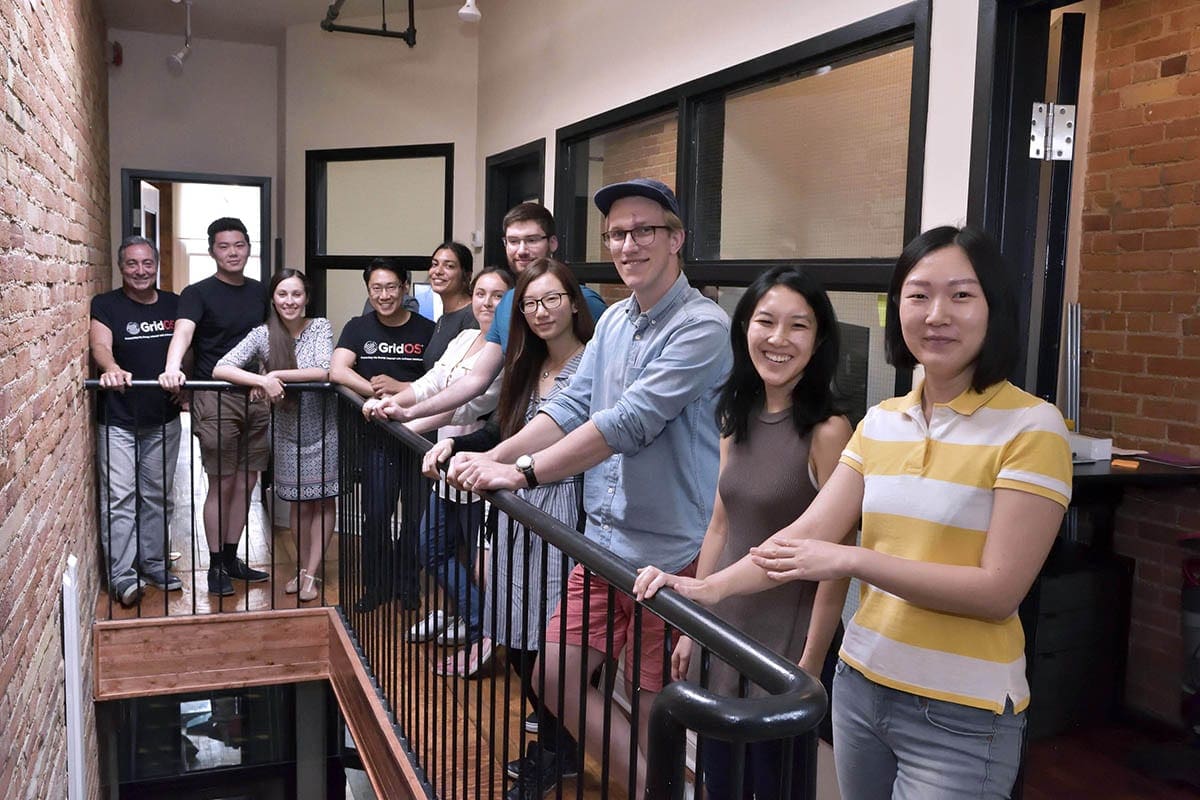
Building the organization required an education beyond electrical engineering. Wong contacted MaRS in 2013 and found other entrepreneurs nearby. Support included a route toward the US market through the Canadian Technology Accelerator program. As the company grew, it also needed help with organizational structure, talent policies and benefits. The technology had to acquire an employer around it.
Wong’s own account allows room for the unpolished version: “I admit that I stumbled into entrepreneurship and didn’t do a lot of research.” He described falling and receiving help from Toronto’s innovation community. It is an unusually useful detail in a founder biography. The finished company can make its beginnings look inevitable. His recollection gives the peers and advisers some of their work back.
An exit with work left over
GE acquired Opus One in 2021. By January 2022, the company had appeared on the Global Cleantech 100 for five consecutive years. Its GridOS software helped utilities model their networks and make decisions about renewable generation and distributed resources. Wong had taken an idea from consultancy to an operating software business inside a much larger industrial organization.
The work could become tangible in small places. In Parry Sound, Ontario, Opus One software supported the SPEEDIER microgrid project with Bracebridge Generation. The system combined local resources and controls to help a distribution feeder operate through an outage. In 2022, GE reported that an unplanned town-wide outage had left 165 participating homes energized through the project.
That is a useful scale for understanding what Wong was building. Grid software eventually has to answer to a household, a street or a community. The abstractions end at ordinary electrical equipment that people expect to work. A working microgrid gives the engineering diagrams a destination.
Wong went on to serve as general manager of grid orchestration at GE Vernova. ThinkLabs grew from an incubation effort in its Electrification Software business. When GE Vernova announced the venture in May 2024, it called ThinkLabs the first startup launched from the company. Wong left to run it. GE Vernova supplied early backing, and a $5 million seed round brought in investors including Powerhouse Ventures and Active Impact Investments.
“I could play a very long game to dedicate this career, this lifetime of work, to clean energy.”
Josh Wong, 2021
Teaching a machine the electrical rules
ThinkLabs brings together three areas that recur throughout Wong’s career: power-system engineering, software and the institutions responsible for electricity. Its approach begins with a model of the utility network. Conventional power-flow calculations generate examples of how that network behaves under different conditions. Machine-learning models train on those examples and are adjusted as requirements and conditions change.
The company calls these physics-informed AI digital twins. The phrase sounds more mysterious than the sequence: describe the network, calculate its behavior, teach a model from those calculations, then use the model to perform analysis quickly. Wong’s insistence on engineering context makes sense for a product intended to recommend actions around real equipment.
- 01 / MapUtility network data
- 02 / SimulatePhysics-based power flow
- 03 / TrainAI learns the scenarios
- 04 / AssistAnalysis and recommendations
A process diagram, not a performance benchmark.
At launch, Wong described ThinkLabs Copilot as a layer of intelligence working alongside existing utility systems. The tasks included estimating network conditions, identifying congestion and voltage problems, and recommending possible responses. Existing platforms would continue handling communications and control. That approach reflects familiarity with customers who already have substantial machinery, software and responsibility in place.
Three minutes, carefully read
In January 2026, ThinkLabs announced results from a Southern California Edison collaboration. Across more than 100 circuits, its system processed a full year of hourly power-flow data in under three minutes. Recommendations for a bridging solution, together with an engineering report, took under 90 seconds.
Reported time to process a year of hourly power-flow data across 100+ circuits in the SCE collaboration announced January 2026.
The surrounding workflow helps explain Wong’s interest. Engineers ordinarily spent an average of six hours preparing project data, running analysis and producing reports. Energization analyses could take 30 to 35 days amid the volume of requests and competing responsibilities. The calculation sat inside a much longer working process. Accelerating it creates room to examine options sooner; a network connection still involves other decisions and physical work.
The reported recommendations included load flexibility, battery storage and changes to network topology. These are different ways of responding to constraints, rather than simply discovering that a constraint exists. For Wong, the analytical model is useful when it helps an engineer consider a practical next step. The impressive stopwatch has an assignment.
The company around the calculation
On March 31, 2026, ThinkLabs announced a $28 million Series A led by Energy Impact Partners. NVentures, NVIDIA’s venture-capital arm, and Edison International, Southern California Edison’s parent, also invested. The financing brought computing expertise and utility relationships into the same company-building exercise. Plans included expanding customer delivery, broadening the product portfolio and scaling deployments with partners.
Wong also has colleagues whose experience crosses the boundaries his product requires. CTO Neal Vali previously led data and machine-learning engineering at GE. George Zheng brings power-system modeling and grid-data experience. Their backgrounds illustrate the recruiting brief: build software with people who understand both the computational work and the electrical system it describes.
By September, Wong was also discussing how the grid’s growing uncertainty changes the questions its planners ask. He argued for looking at probabilities and making risk-informed decisions. The ambition extended to affordability: understanding a network more clearly should help utilities decide where investment is useful. For an engineer turned founder, that makes the calculation part of a larger responsibility for how money and infrastructure are put to work.
In October 2026, Dragos co-founder and CEO Robert M. Lee joined the board. Lee’s background is in critical-infrastructure cybersecurity, another business whose customers have to trust software around consequential physical systems. His arrival adds experience in building a company for those operators as ThinkLabs moves further into deployment.
Still on the same assignment
Long before the current rush to power AI data centers, Wong had explained his motivation in family terms. In 2021 he spoke about his three young sons and the future they would inherit. The ambition behind his work was already personal, even when the daily tasks involved regulation, staffing or software. He was prepared to commit a career to clean energy, while wishing the work could move faster.
The wish and the long horizon coexist throughout his story. A 25-year roadmap. A company built over a decade. An acquisition followed by another beginning. Wong’s recurring choice has been to stay near the people making difficult electrical decisions and try to improve the tools available to them.
The investor friends had a fair question. Utilities had already occupied a substantial portion of his working life. His answer was to build for them again. The name on the company changed; the unfinished assignment remained.