In 2024, Tutor Perini lost $163.7 million attributable to the company. It also produced $503.5 million in operating cash flow, then a company record. Imagine a builder arriving with two report cards: one covered in red ink, the other showing cash pouring in. Both were correct. Understanding how they can coexist tells you something useful about the business of building things that cities cannot easily live without.
- Build difficult infrastructure and large buildings for agencies and institutional owners.
- Keep specialist trades inside the group to coordinate more of the job.
- Resolve old disputes, collect cash and put newer projects to work.
The name on the contract is Tutor Perini. The work might be a railway tunnel, a hospital or a Las Vegas resort. Its three businesses - Civil, Building and Specialty Contractors - put the excavation, the structure and the systems behind the walls within one corporate family. The interesting question is how much that family arrangement helps when the ground, the schedule or the bill becomes an argument.
Two clocks on every job
Construction has a physical clock. Concrete cures. Machines advance. Electricians arrive after some trades and before others. It also has a financial clock: when work becomes billable, when a customer accepts a change and when payment lands. The clocks can drift apart. A contractor may do additional work before the price is agreed. A balance that looks collectible can end up before arbitrators.
That was part of Tutor Perini’s problem. In October 2024, it disclosed an expected roughly $102 million noncash, pretax charge following an adverse arbitration decision on a California bridge project. Other disputed matters were expected to produce a net $43 million pretax charge, alongside approximately $180 million of cash inflows. Those were contemporary estimates. They explain the mechanism: settling an argument can release cash while requiring a painful reduction in expected earnings.
Getting the work done and getting the money collected run on different clocks.
The full-year results showed the cost. Judgments and settlements weighed on earnings, even as collections improved liquidity. Between the end of 2023 and February 27, 2025, total debt fell by $477 million. There is no need to invent a sudden conversion in management’s thinking. The documented shift in priorities came after debt targets were met: the company said capital allocation would turn toward returning money to shareholders.
Bring the electrician, too
Now consider the other half of the business: why anyone hires this group. A complicated construction site contains dozens of opportunities for one team’s delay to become another team’s problem. Tutor Perini offers planning, scheduling and general contracting, and can perform excavation, concrete, steel erection and building systems itself. Its specialist companies also take work as contractors in their own right.
The portfolio makes that arrangement tangible. At MGM Resorts International’s CityCenter in Las Vegas, Tutor Perini lists a $6.4 billion construction management contract, a $600 million electrical contract for Fisk Electric and a $170 million plumbing subcontract for Desert Mechanical. These are listed scopes, not figures to casually add into a new total project budget. The development reached completion in 2009 and covers 18 million square feet.

Owning the trades does not automatically make coordination easy. It gives management more direct access to the people and capabilities responsible for critical work. The company presents that control as a competitive advantage. Buyers should still examine the proposed team, its relevant experience and the allocation of risk. A corporate family tree cannot settle a badly defined scope.
A billion dollars for 700 feet
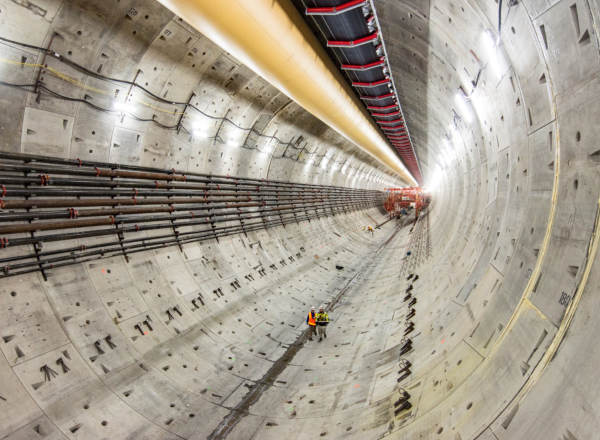
The Manhattan Tunnel award offers a useful sense of the market. In February 2025, Tutor Perini announced an approximately $1.18 billion design-build contract from the Gateway Development Commission for a joint venture with its Frontier-Kemper subsidiary. The scope included twin tunnels roughly 700 feet long and 30 feet in diameter, plus an access shaft intended eventually to become a ventilation facility.
Seven hundred feet sounds almost modest. The surroundings explain the price of complexity. The commission described utilities, sewer lines, historic fill and old foundations along Manhattan’s western shore. Proposed protective shielding would support excavation through that crowded underground environment. A tunnel’s length tells you little about the difficulty of inserting it beneath a functioning city.
This is where Tutor Perini fits: expensive, interdependent work requiring equipment, specialist labor, financial capacity and a credible delivery plan. Alternatives include Kiewit, Skanska USA, FlatironDragados and Walsh. The company reports fewer competitors pursuing large fixed-price civil jobs. That is its assessment of the bidding market, rather than a promise that every new contract will carry an attractive margin.
The useful habit to borrow
The group’s roots stretch to Bonfiglio Perini’s construction business in 1894 and Albert Tutor’s company in 1949. The two lineages merged in 2008. Gary Smalley became CEO in January 2025. The company’s safety approach calls for job-specific plans that evolve with conditions, training and accountability. Those are stated operating practices; they should not be confused with a guarantee of incident-free construction.
The financial recovery became clearer in 2025: revenue reached about $5.5 billion, and net income attributable to the company was $80.4 million. By June 2026, backlog stood at $19.9 billion. Backlog represents work remaining under contracts. It still needs labor, materials, execution and collection before it becomes money available to the business.
The habit worth borrowing is to follow a project through all those stages. Agree how changes will be documented. Choose a delivery method that fits the uncertainty. Track collections alongside construction progress. The approach becomes harder when designs are incomplete, subsurface conditions surprise the team or a fixed price leaves little room for rising costs. Tutor Perini’s story gives the reader a practical question to carry into any ambitious project: who pays when the plan changes?